
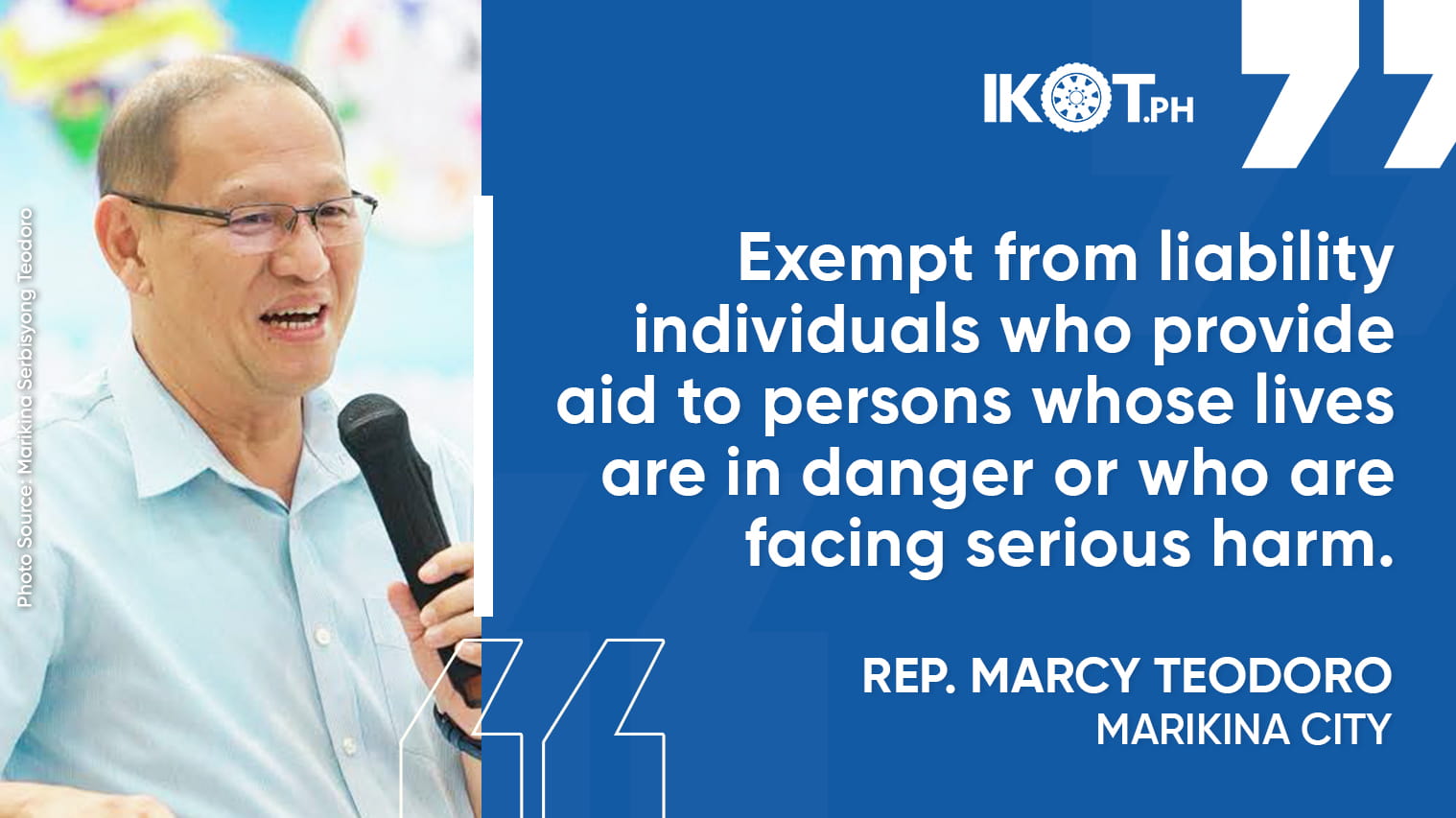
To further encourage volunteerism, the House Committee on People’s Participation, chaired by Marikina City Representative Marcy Teodoro, moved to consolidate six bills seeking to protect “Good Samaritans” — individuals who selflessly render assistance to people in need during emergencies.
Set for consolidation are House Bills (HBs) 828, 4031, 4252, 2932, 4461, and 4709, which share the common objective of exempting from liability individuals who, in good faith and without expectation of compensation, provide aid to persons whose lives are in danger or who are facing serious harm.
“Explore the possibility of allowing local government units (LGUs) to provide insurance coverage for volunteers.”
Beyond legal protection, Teodoro also explored the possibility of allowing local government units (LGUs) to provide insurance coverage for volunteers, in a manner consistent with the regulations of the Commission on Audit (COA).
Philippine National Volunteer Service Coordinating Agency (PNVSCA) Executive Director Donald Gawe informed the committee that provisions on volunteer incentives are already found under Republic Act No. 9418, or the Volunteer Act of 2007, although these are stated in general terms.
The legislator suggested that the PNVSCA and the Department of the Interior and Local Government (DILG) work together to determine how insurance incentives may be implemented, particularly the establishment of a standard insurance coverage scheme that would take into account the financial capacity of LGUs.
“I propose refining the legal protection provisions to make them more inclusive, in order to encourage wider public participation, especially during calamities.”
Zambales 2nd District Representative Doris Maniquiz sought clarification on provisions in some of the proposed measures requiring certain volunteers to be registered or authorized to render assistance during emergencies.
Maniquiz proposed refining the legal protection provisions to make them more inclusive, in order to encourage wider public participation, especially during calamities that may occur at any time.