
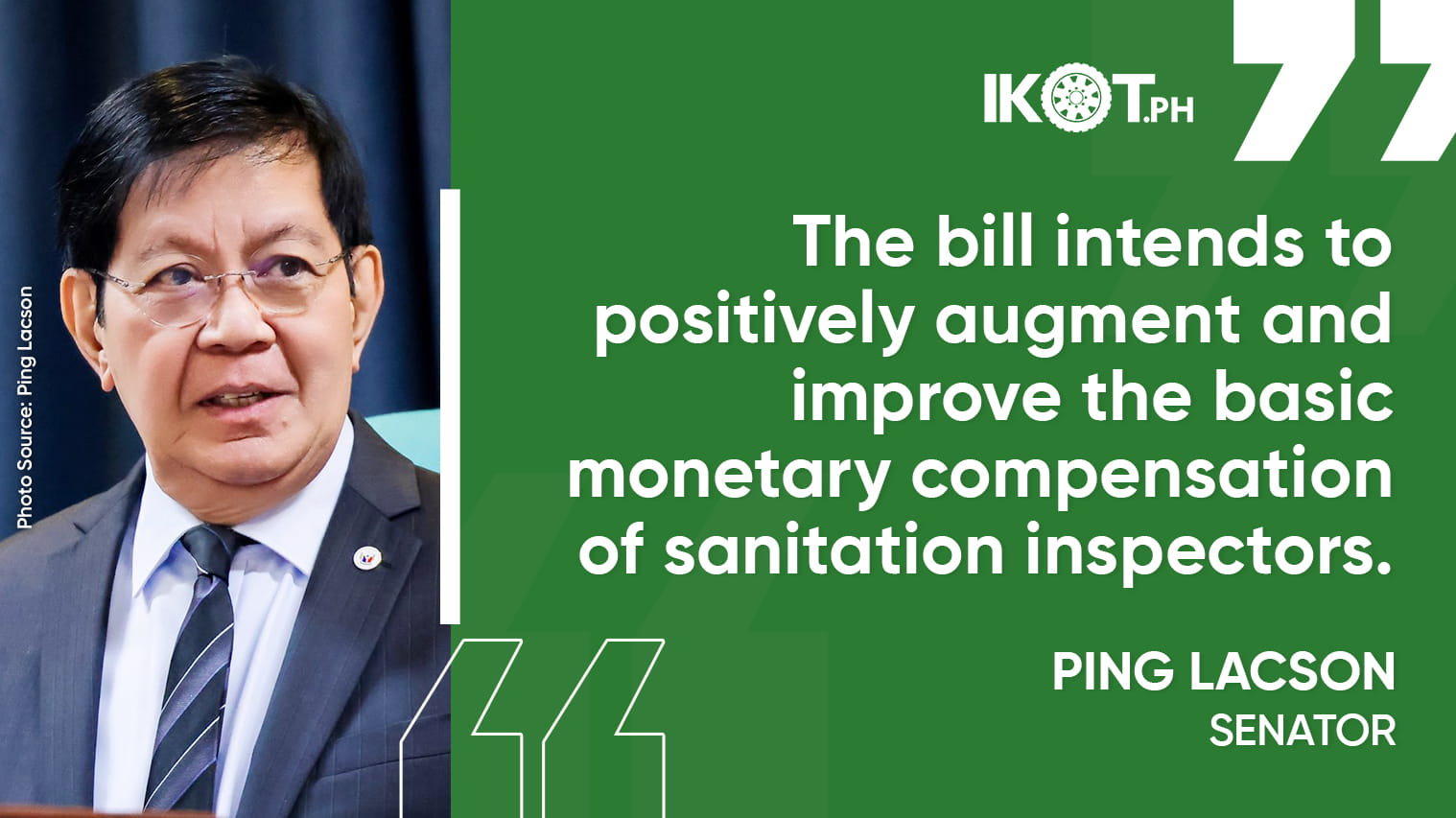
Sanitation inspectors – the unsung “foot soldiers” of the Department of Health who help safeguard public health at the community level – may soon get long-overdue improvements in benefits and working conditions under a bill filed by Senate President Pro Tempore Ping Lacson.
Lacson filed Senate Bill 1725, seeking to positively augment and improve the compensation of sanitation inspectors by modifying their salary grade schedule.
“This bill aims to professionalize the health and sanitary-related services rendered by sanitation inspectors.”
“This bill aims to professionalize the health and sanitary-related services rendered by sanitation inspectors by requiring the registration and accreditation of the sanitation inspectors to ensure the healthcare and welfare of the community,” the veteran legislator said in his bill titled “An Act Modifying the Salary Grade Schedule and Enhancing the Benefits of Sanitation Inspectors, Protecting their General Working Conditions, and Appropriating Funds Therefor”.
The seasoned lawmaker added the bill “further intends to positively augment and improve the basic monetary compensation of sanitation inspectors by modifying the salary grade schedule for all registered sanitation inspectors nationwide and correlating the existing position titles of SIs to the next higher salary grade.”
The senator noted SIs have the duty to enter any premises involved in manufacture, preparation or packing of any food for sale.
Yet, a 2021 joint press statement of the Department of Health, World Health Organization and United Nations Children’s Fund showed the 2,700 sanitation inspectors in the country were unevenly distributed, with 68 percent of cities in the country having fewer SIs than required. The standard ratio is one SI for every 20,000 population, he noted.
“Despite all the health hazards that a sanitary inspector encounters in the fulfillment of his/her duties, a Sanitary Inspector I only receives a monthly salary of P18,255.00.”
“Despite all the health hazards that a sanitary inspector encounters in the fulfillment of his/her duties, a Sanitary Inspector I only receives a monthly salary of P18,255.00,” he lamented.
Under Lacson’s bill, all SIs shall be registered with the local health boards of the provinces, cities or towns where they serve. The SI Registry shall be subject to approval by the city and town health boards. The provincial SI registry shall be publicized in the provincial, city and town bulletin boards, including barangay health centers.
Registered SIs must be duly accredited by the city or town health board. SIs must complete a regular training program on environmental health sanitation within five years from registration.
Accredited and registered SIs are entitled to allowances including:
* Hazard allowance of at least P1,000 a month;
* Subsistence allowance of at least P200 a day;
* Laundry allowance of at least P500 a month if the SIs are required to wear prescribed uniforms legally;
* Transportation allowance of at least P1,000 a month;
* A one-time gratuity cash incentive of at least P10,000 for those who satisfactorily served for at least 10 years;
* Discount privileges including 20% discount on items enumerated under the Expanded Senior Citizens Act of 2010, where the commercial establishment may claim the discount as tax deduction.
The bill also provides education and career enrichment for accredited and registered SIs.
During their incumbency, SIs shall be entitled to health benefits including free medical care including surgery, medicines, x-ray and laboratory fees; compulsory medical examination annually; emergency assistance of up to P10,000 chargeable against the funds of the concerned local government unit (LGU); and mandatory and immediate membership in the Philippine Health Insurance Corp. (PhilHealth).
Other benefits include insurance coverage from the Government Service Insurance System (GSIS) borne by their respective LGUs; sick and maternity leaves; disability benefit; housing; leave benefits; freedom from interference or coercion; a monthly longevity pay of 5% of the basic monthly pay for every five years of service; free legal services; and preferential access to loans.
SIs shall also avail of occupational safety and health (OSH) standards including the rights to job safety orientations, to be informed of possible work hazards and health risks, to trainings, to refuse unsafe work, to be issued with personal protective equipment, and to comply with OSH standards.
Provincial, city and town health offices and local health boards must adopt and implement measures to prevent and/or minimize sanitation-related work hazards and risks.
Also, SIs shall be protected against discrimination and removal without valid cause. Local health boards shall establish grievance mechanisms to process SIs’ complaints against discrimination and unjust removal.
Meanwhile, the bill allows the organizing of accredited and/or registered SIs into groups and associations; as well as representation in local health boards, water councils, social development councils, and disaster risk reduction management councils.
SIs shall be prohibited from engaging in partisan political activity, while the Department of Health through its Center for Health Development shall conduct continuous capacity-building for SIs.
Violations of the provisions of the measure face a penalty ranging from P50,000 to P500,000, or imprisonment of one to five years, or both.
Funds for the implementation of the measure shall be charged to the National Tax Allotment of LGUs, other local funds, the special health fund under the Universal Health Care Act, including the General Appropriations Act of the year following its enactment into law.