
A bill filed by Senate President Pro Tempore Ping Lacson seeks to grant an amnesty on unpaid estate taxes covering the estates of individuals who died on or before Dec. 31, 2025, with outstanding or accrued tax liabilities as of that date.
Senate Bill No. 1889 aims to broaden the tax base and accelerate revenue collection, while minimizing prolonged litigation over tax liabilities. It also seeks to facilitate the reintegration of idle or previously immobilized assets to the formal economy.
“The proposed bill… seeks to enact a broader and more pragmatic Estate Tax Amnesty framework. It authorizes a one-time opportunity for estates of decedents who died on or before a specified date to settle outstanding estate tax liabilities at a uniform rate of six percent, subject to simplified documentary and procedural requirements,” Lacson said in the proposed “Estate Tax Amnesty Act of 2026.”
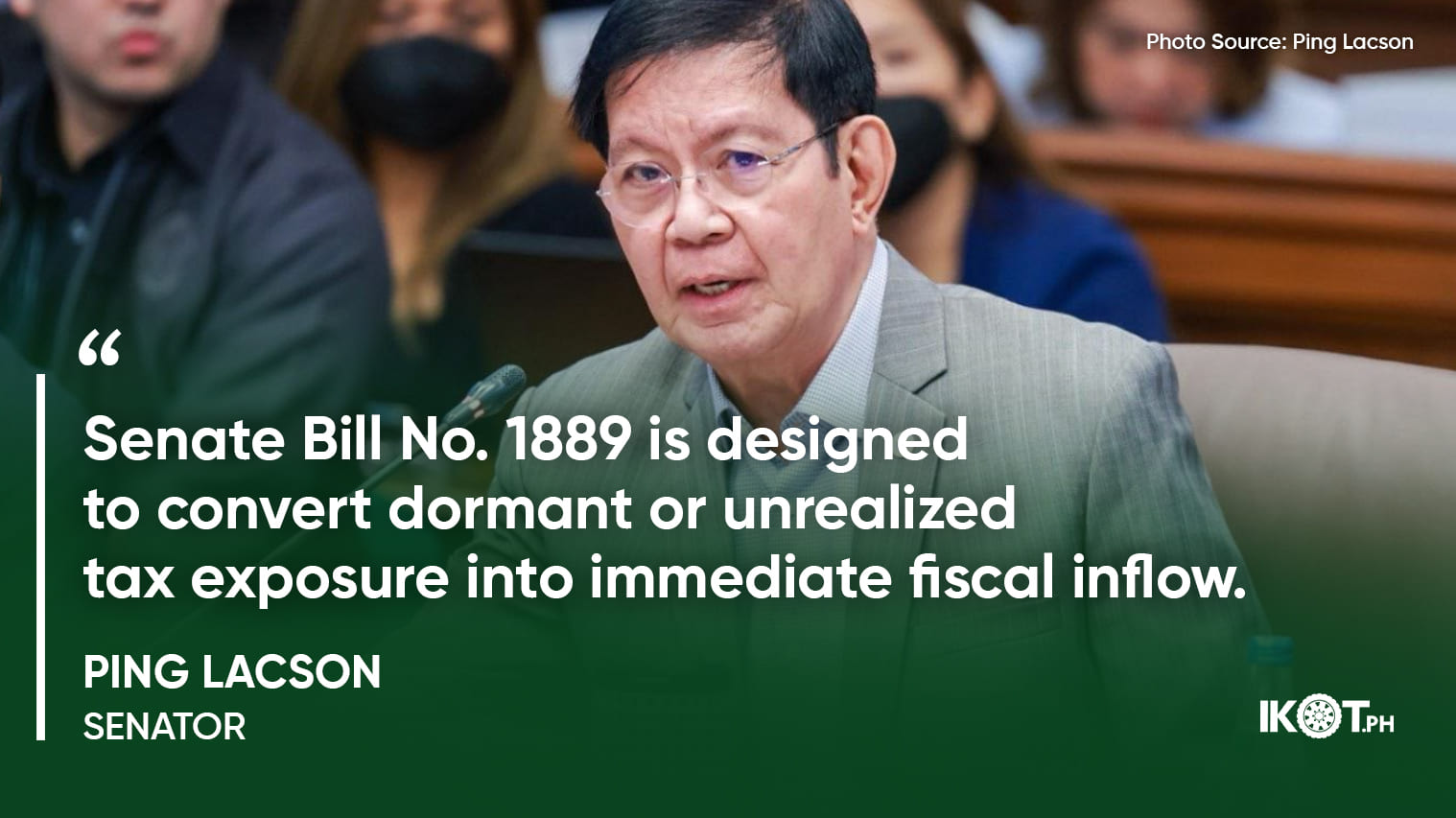
The veteran legislator added the measure “is designed to convert dormant or unrealized tax exposure into immediate fiscal inflow, enhance administrative efficiency, and allow the Bureau of Internal Revenue to redirect enforcement resources toward current compliance efforts.”
“Payment under the amnesty program aims solely to settle tax liability, and does not extinguish liabilities under laws not covered by the amnesty.”
The seasoned lawmaker pointed out that the bill clarifies the limited legal effect of availment, where payment under the amnesty program aims solely to settle tax liability, and does not extinguish liabilities under laws not covered by the amnesty.
“Proper parties and the Government retain full authority to pursue forfeiture, recovery, reversion, or criminal prosecution in accordance with applicable law. In this manner, fiscal settlement is compartmentalized from adjudication of substantive rights,” the senator added.
Also, he said the bill strengthens administrative efficiency by limiting documentary requirements, providing for electronic filing and payment, and separating the process of tax settlement from the subsequent transfer of properties.
“It widens the taxable universe, accelerates revenue collection, reduces prolonged litigation over tax liabilities, and facilitates productive reintegration of idle or immobilized assets into the formal economy.”
“By removing restrictive disqualifications and inserting clear safeguards preserving enforcement authority, the proposed bill presents a balanced and defensible policy approach. It widens the taxable universe, accelerates revenue collection, reduces prolonged litigation over tax liabilities, and facilitates productive reintegration of idle or immobilized assets into the formal economy,” Lacson explained.
Under the bill, an Estate Tax Amnesty shall be granted to the estate of those who died on or before Dec. 31, 2025, with or without assessments issued therefore, whose estate taxes remained unpaid or had accrued as of Dec. 31, 2025.
The amnesty may be availed of notwithstanding any pending assessment, investigation, civil or administrative case, including actions for recovery of property, forfeiture or reversion, involving estate tax liabilities.
An estate may enjoy immunities and privileges of the Estate Tax Amnesty and pay an estate amnesty tax at the rate of 6 percent based on the decedent’s total net estate at the time of death.
If an estate tax return was previously filed with the BIR, the estate tax rate of 6 percent shall be based on net undeclared estate. If the allowable deductions exceed the value of the gross estate, heirs, executors or administrators may avail of estate tax amnesty and pay the minimum estate amnesty tax of P5,000.
Those who wish to avail of this amnesty may file the required forms manually or electronically.
The BIR shall issue a Certificate of Availment of the Estate Tax Amnesty within 15 calendar days from submission to the BIR of the Acceptance Payment Form and Estate Tax Amnesty Return.
Also, the BIR shall coordinate with applicable regulatory agencies to set up a system allowing the transfer of title over properties to heirs and/or beneficiaries and cash withdrawals from bank accounts of the deceased.
However, payment of the estate amnesty tax shall not legitimize any lawful acquisition or void transaction; or bar the government from pursuing lawful claims, forfeiture, reversion or recovery of ill-gotten wealth.
Neither shall it extinguish liabilities arising under laws not covered by the estate tax amnesty.
The bill also said the subsequent adjudication of ownership, forfeiture, reversion or recovery in favor of any party or the government shall not entitle the estate, heirs, transferees or beneficiaries to any refund, credit or reimbursement of the estate amnesty tax paid.
Meanwhile, any information or data in the Estate Tax Amnesty Return and related documents shall be confidential and shall not be used as evidence in any investigation, prosecution or proceeding involving estate tax liabilities covered by the bill.
But the bill does not prohibit or restrict proceedings involving enforcement of lawful claims, forfeiture, reversion or recovery of ill-gotten wealth, or violations of laws not expressly covered by the estate tax amnesty granted under this Act.