
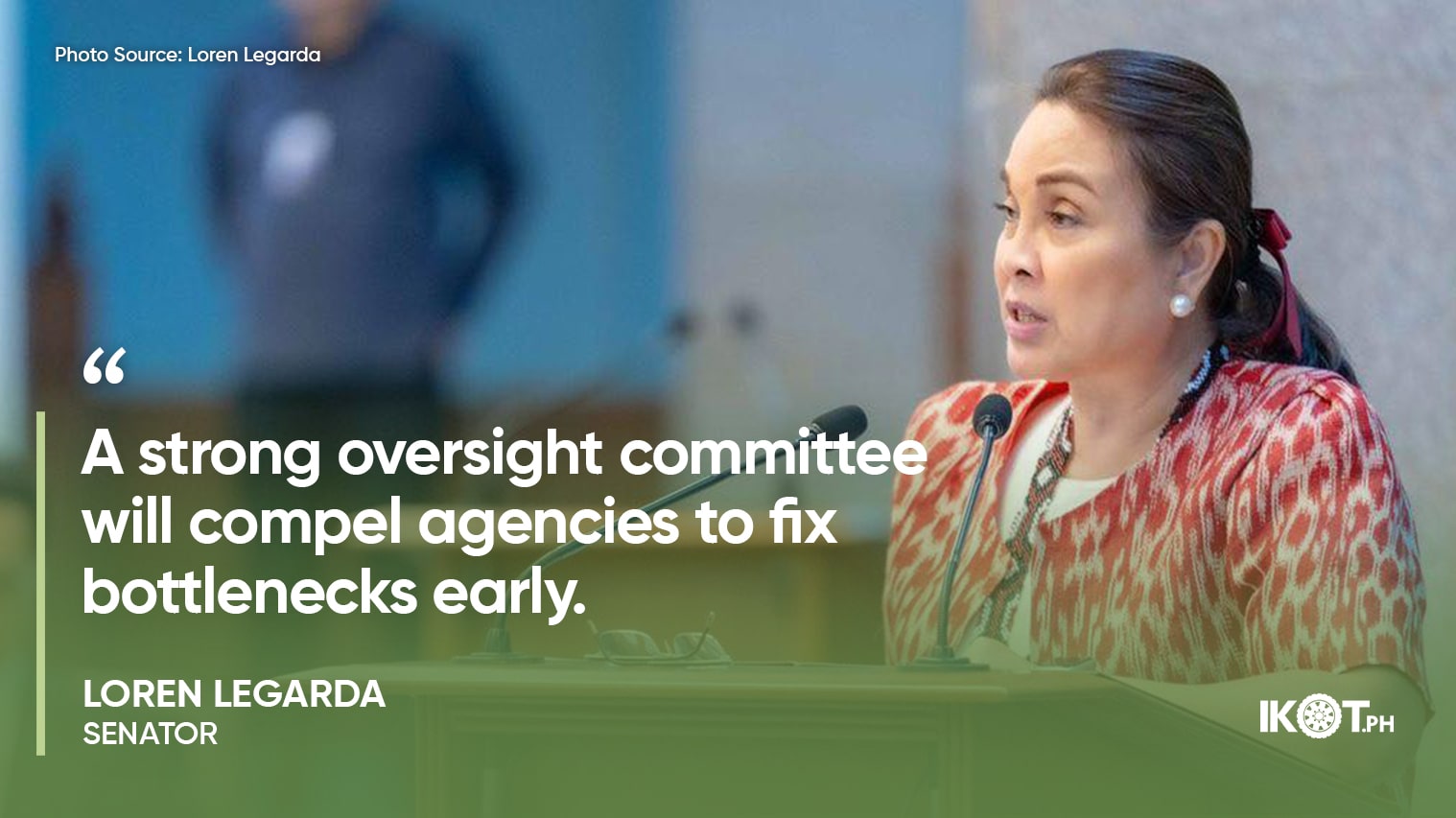
Senator Loren Legarda has expressed her full support for the formation of a Joint Congressional Oversight Committee on Public Expenditures, saying it is a vital reform to ensure that every peso in the national budget is spent with integrity, transparency, and in line with the country’s development priorities.
Legarda said the joint oversight body of the Senate and the House of Representatives, already established under the General Appropriations Act (GAA) 2026 and in previous GAAs, should be formally activated and function on a regular basis to fully carry out its mandate.
“This oversight committee is not about micromanaging agencies. It will be created so that funds meant for hospitals, classrooms, farms, and disaster resilience do not get lost in delays, waste, or misuse,” the veteran legislator stressed.
The seasoned lawmaker warned that chronic underspending, poorly designed projects, and implementation leakages translate directly into unfinished roads, overcrowded hospitals, and vulnerable communities left without protection from disasters.
“Every time an agency sits on its budget or fails to implement it properly, it translates to a family waiting longer for a health center, a student losing a chance at quality education, a farmer still without irrigation,” the lady senator said.
She further underscored that idle appropriations weaken government performance and directly affect citizens waiting for services.
“Funds that remain idle are not savings.”
“Funds that remain idle are not savings. They represent targets not achieved, services delayed, and opportunities lost. Underspending driven by weak expenditure and procurement capacity imposes a real cost on the delivery of public programs,” Legarda explained.
She also cautioned that leaving budgets idle prevents the government from channeling funds to agencies with stronger track records.
“When budgets are unused, resources that could have been realigned to agencies with stronger implementation records and proven sectoral impact remain locked in underperforming programs. This distorts efficient resource allocation and undermines equity in public spending,” Legarda said.
“A strong oversight committee will compel agencies to fix bottlenecks early and prove that they are turning appropriations into tangible results,” she added.
With the recently signed ₱6.793 trillion national budget for 2026, Legarda said continuous year-round monitoring will strengthen the credibility of the spending program and protect key investments in health, education, livelihoods, and climate and disaster resilience.
“Responsible and integrity-driven budgeting does not end when the President signs the GAA.”
“Responsible and integrity-driven budgeting does not end when the President signs the GAA,” she noted. “Congress has a duty to follow the implementation from line item to last mile to ensure that the budget that we debated and defended in the plenary is implemented properly in every barangay.”
Supporting Senator Win Gatchalian’s call to look closely into underspending and critical projects, Legarda said she wants the oversight body to prioritize sectors where delays and inefficiencies are most painful for ordinary citizens.
“We should start where the stakes are highest: hospitals operating beyond capacity, irrigation systems that farmers have waited on for years, classrooms and local infrastructure that remain on paper,” she said.
“When people clearly see how every project is planned, funded, and completed, they gain confidence that public office is a public trust and that their hard‑earned taxes are working for them and the communities, not undermining them,” Legarda concluded.