
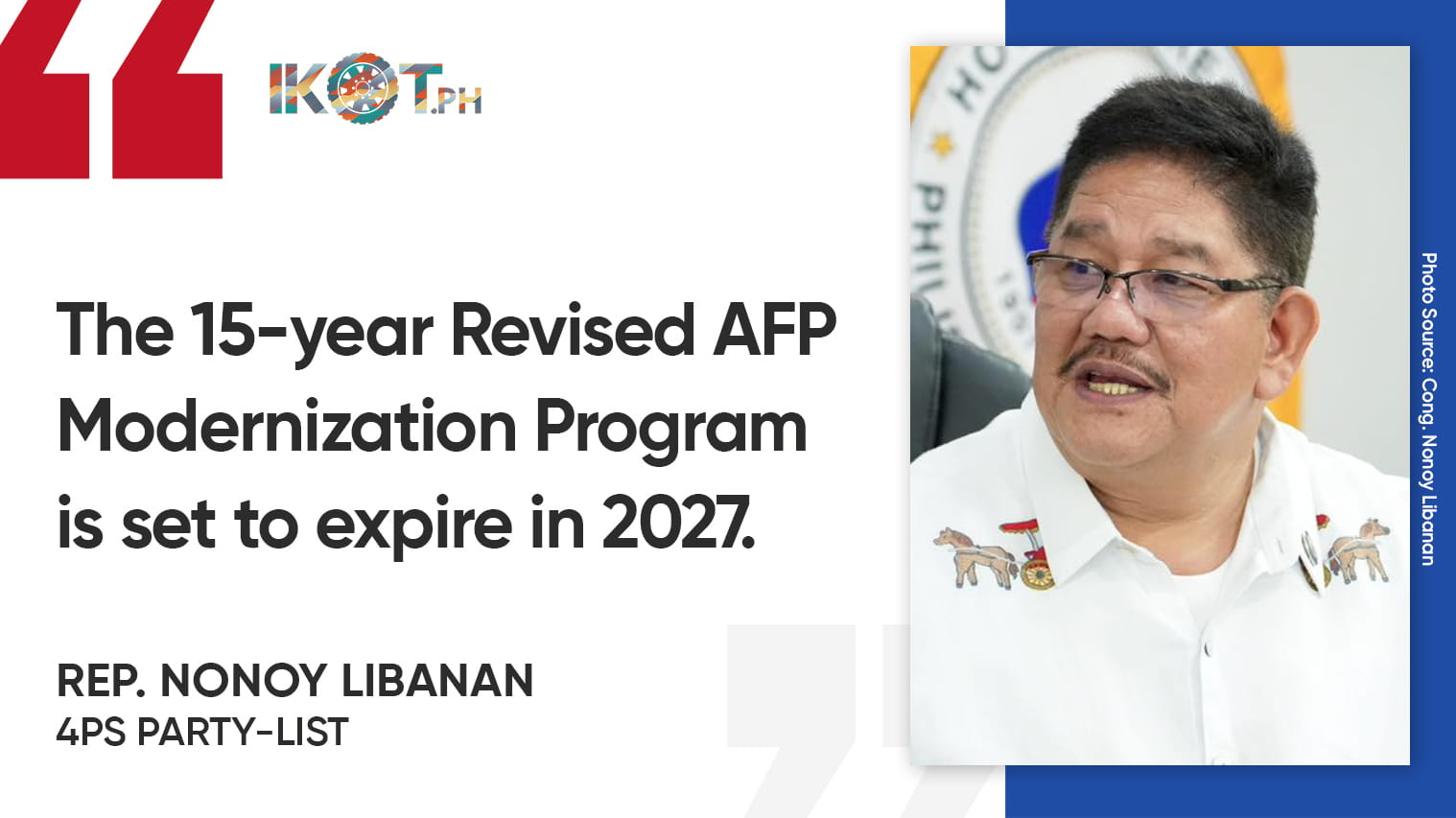
House Minority Leader Nonoy Libanan has called on Congress to prioritize the passage of a successor Armed Forces of the Philippines (AFP) modernization law, stressing the need for continuity and long-term planning as the current program approaches its 2027 conclusion.
“The 15-year Revised AFP Modernization Program, enacted in 2012, is set to expire in 2027, and early legislative action would ensure a smooth transition to the next phase of the military’s modernization,” Libanan said.
“Early legislative action would ensure a smooth transition to the next phase of the military’s modernization.”
The AFP modernization program covers the acquisition of advanced military equipment, weapons systems, and defense-related technologies, including intelligence, surveillance, and other critical operational capabilities.
“Congress should enact a successor modernization framework ahead of the current program’s expiration. By acting early, we can ensure that the AFP remains capable, credible, and responsive while maintaining a stable and coherent modernization strategy,” the veteran legislator added.
“By acting early, we can ensure that the AFP remains capable, credible, and responsive while maintaining a stable and coherent modernization strategy.”
In 2025, the program marked key milestones with the delivery of two newly built 3,200-ton guided-missile frigates—the BRP Miguel Malvar and the BRP Diego Silang.
These warships complement the 2,600-ton guided-missile frigates BRP Jose Rizal and BRP Antonio Luna, which were delivered in 2020 and 2021, respectively.
Additionally, the Department of National Defense received five more multi-role S-70i Black Hawk helicopters in 2025 and finalized a contract for 12 additional FA-50PH supersonic fighter jets.
The 2026 General Appropriations Act allocates ₱40 billion in capital outlays for the military’s modernization projects, up from ₱35 billion in 2025.
Congress first approved a 15-year AFP modernization program in 1995 through Republic Act No. 7898, with initial funding of at least ₱50 billion for the first five years.
The program was revised and extended in 2012 under Republic Act No. 10349, which increased initial funding to ₱75 billion for the first five years.
A review of budget records shows that from 2013 to 2025, Congress allocated a total of ₱313.6 billion in new appropriations to support the AFP modernization program.
An additional ₱134.1 billion in “unprogrammed appropriations” was also authorized to support the AFP’s modernization efforts over the same period.