
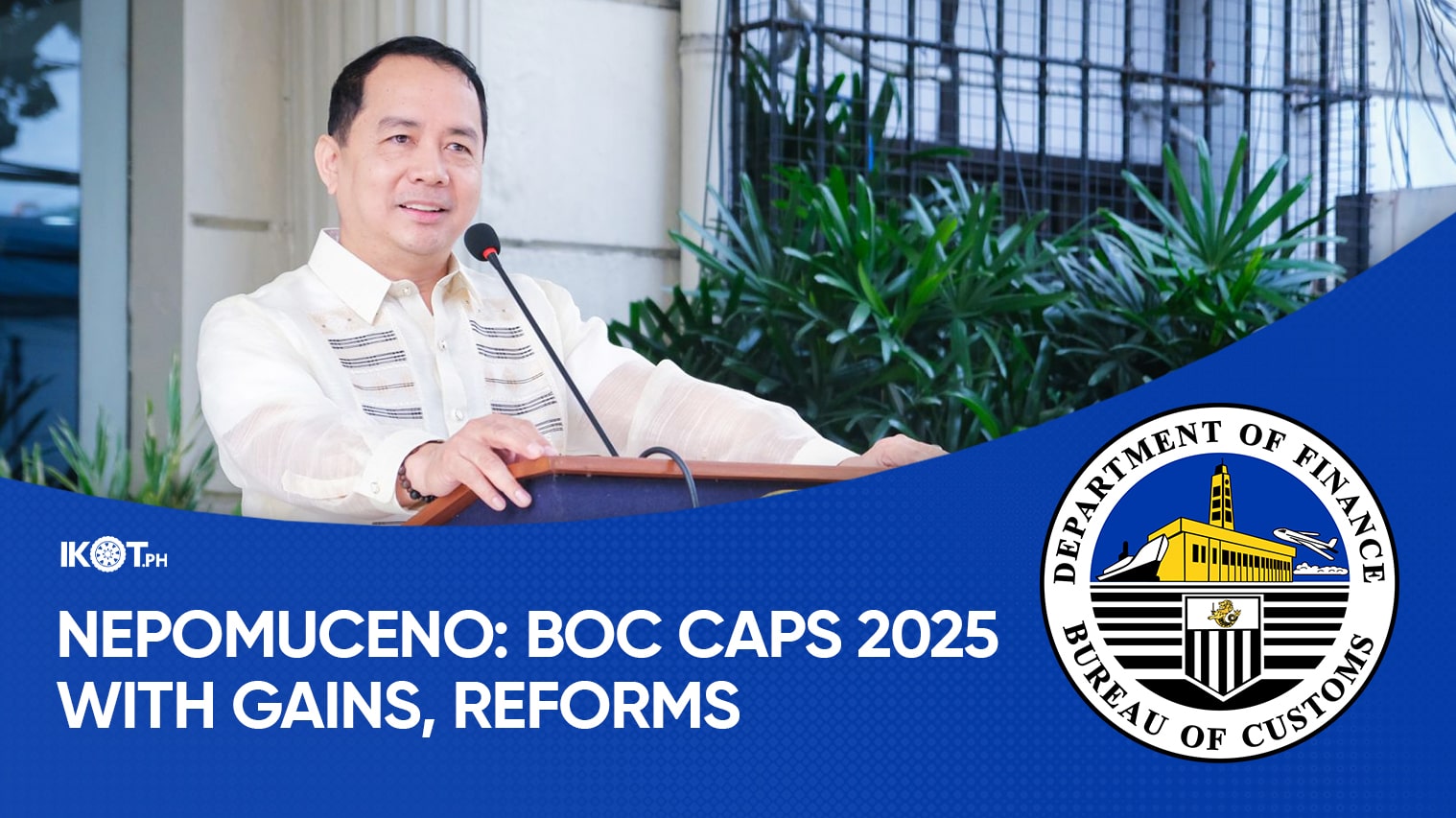
Under the directives of President Ferdinand Marcos Jr. and the leadership of Commissioner Ariel Nepomuceno, the Bureau of Customs (BOC) capped 2025 with strong gains in revenue collection, trade facilitation, border security, and institutional reforms, reinforcing its role in national development and economic stability.
Preliminary figures from January to December 2025 show that the BOC generated approximately ₱934.400 billion in revenues, exceeding the same period’s collection in 2024 by 1.9 percent, or ₱17.726 billion.
This growth was achieved despite the challenges including the lower import volumes, the suspension of rice importation, and global commodity price fluctuations.
The performance highlighted the positive impact of the bureau’s efficiency, strengthened compliance measures, and the expanded use of digital systems in sustaining the revenue collection.
Border protection remained a core priority of the BOC in 2025, as it intensified efforts to prevent the entry of prohibited, misdeclared, and undervalued goods.
Based on preliminary data for the year, the BOC conducted 1,024 enforcement operations that resulted in the seizure of smuggled and prohibited goods valued at approximately ₱61.707 billion.
These outcomes reflected strengthened intelligence coordination, enhanced risk profiling, and closer collaboration with law enforcement and regulatory agencies.
“2025 was more than numbers or milestones—it was a year that showed the Bureau of Customs can transform.”
“2025 was more than numbers or milestones—it was a year that showed the Bureau of Customs can transform, proving that integrity, service, and trust are not just ideals, but values we put into action every single day,” he said.
The Bureau also continued to improve oversight of bonded warehouses and expanded the use of non-intrusive inspection technologies to ensure regulatory compliance while minimizing disruption to legitimate trade.
In line with its commitment to good governance and institutional integrity, the BOC implemented firm reform measures throughout the year. These included the strict enforcement of the “No Take” policy, the issuance of an Anti-Conflict of Interest directive, the launch of the “Isumbong kay Commissioner” online portal, the rollout of the enhanced BOC Tax Estimator, the revision of the BOC Code of Conduct and Citizens’ Charter, and the establishment of the Balikbayan and OFW Action Center. Collectively, these initiatives strengthened internal controls, reinforced accountability, and improved public access to customs services.
“Every reform, every operation, every decision we make is about changing the way the public experiences the BOC.”
“Every reform, every operation, every decision we make is about changing the way the public experiences the BOC. As we step into 2026, our mission is clear: to make the Bureau faster, more transparent, and genuinely reliable, and to build an institution that earns the confidence and respect of every Filipino,” Nepomuceno added.
Through these accomplishments, the BOC gained recognition and support from its stakeholders across the business and trade sectors. The BOC formalized cooperation through signed agreements with the Philippine Chamber of Commerce and Industry and the Federation of Philippine Industries, further strengthening public-private collaboration.
The Bureau also received commendations from organizations such as the Federation of Filipino-Chinese Chambers of Commerce and Industry, Inc., the Federation of Indian Chambers of Commerce (Phil.) Inc., the Philippine Chamber of Customs Brokers, Inc., the Customs and Industry Training Institute (CITI) Philippines Corp., and the Makati Business Club. During the recent general assembly of the Customs Industry Consultative and Advisory Council, stakeholders expressed strong confidence in the BOC’s ongoing reforms and sustained direction under the leadership of Nepomuceno.
Looking ahead, BOC remains committed to sustaining these reforms, deepening partnerships, and harnessing digital innovations to further enhance efficiency and public service.