
The runaway cost of pork has Camarines Sur Reps. Migz Villafuerte and Luigi Villafuerte batting for the speedy and full implementation of a new livestock law, which can, in the long haul—in the words of Agriculture Secretary Francis Tiu Laurel Jr.—“restore sanity” to the market prices of liempo, kasim and other meat products.
With the market cost of pork soaring to as high as P480 a kilo across Metro Manila markets since November, the Department of Agriculture (DA) recently imposed per-kilo maximum suggested retail prices (MSRP) of P370 on liempo, and P330 on pigue (pork ham or leg) and kasim (pork shoulder or Boston butt) to shield meat buyers from even higher prices during Christmas and the New Year.
The MSRPs took effect at the start of December “to restore some sanity in the retail price of pork, a favorite protein source among Filipinos that is in high demand especially during the Christmas season,” said Agriculture Secretary Francisco Tiu Laurel Jr. in a media report.
“Those prices are absurd given how farm gate prices have fallen recently, threatening the viability of small and medium-sized hog raisers,” Tiu Laurel said.
Lately, though, the DA has been issuing Notices to Explain (NTEs) to retailers who have failed to comply with the department’s MSRP for pork, said DA Assistant Secretary Genevieve Guevarra.
During a recent price monitoring visit to Mega Q Mart in Quezon City, Guevarra said some market sellers have been non-compliant with the MSRP, prompting the DA to issue orders to these non-complaint retailers.
“This new law aims to sharpen the competitiveness of our livestock and poultry sectors by creating the Animal Competitiveness Enhancement Fund (AnCEF), which will receive an annual budget of ₱20 billion, sourced from tariff collections from imports of livestock, chicken and dairy products.”
According to the DA price monitoring report, the average price of imported liempo (pork belly) and kasim (pork shoulder) have exceeded the MSRP, averaging P392.92 and P341.12 per kilo, higher than the prescribed P370 and P330.
Previously, the DA had agreed with hog producers to set a minimum farm-gate price of P210 per kilo, to protect the margins of hog raisers after the outbreak of the deadly virus Asian Swine Fever (ASF) decimated local stocks and pushed both backyard and commercial raisers into financial losses.
The DA temporarily banned this December pork imports from Spain and Taiwan following confirmed ASF outbreaks by the Paris-based World Organization for Animal Health (WOAH), respectively, in Barcelona and Taichung City.
According to the DA-attached Bureau of Animal Industry (BAI), as of November 28, 7 provinces in 6 regions have been hit with ASF outbreaks.
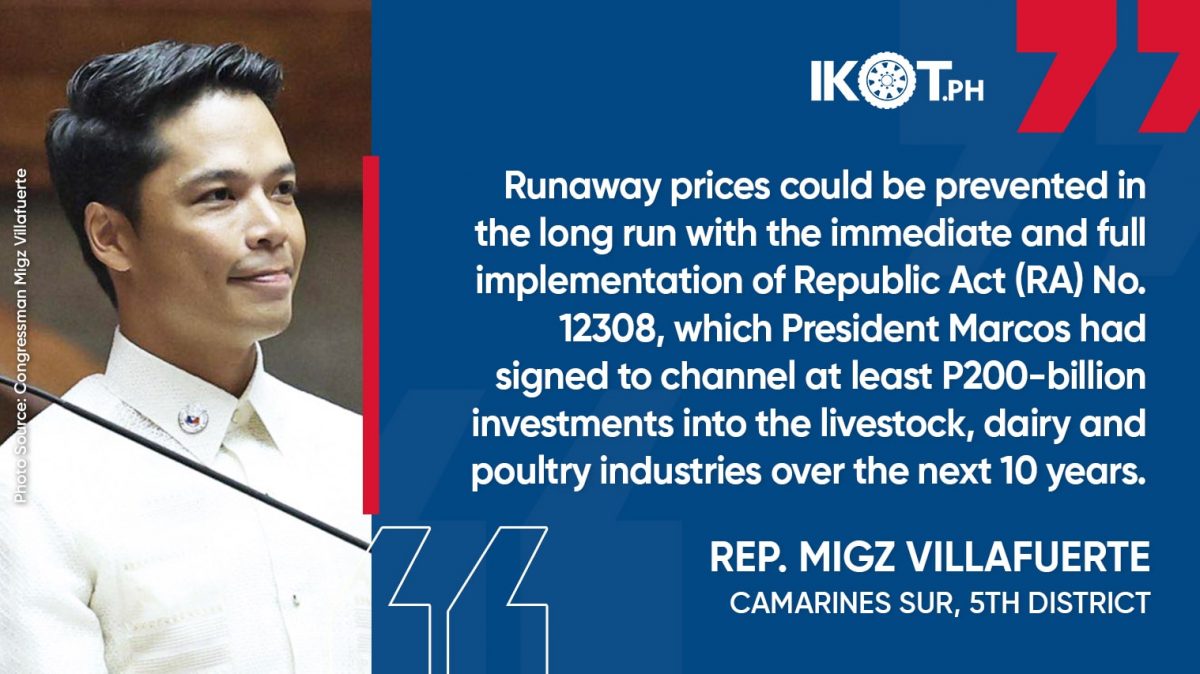
Migz Villafuerte noted that runaway prices could be prevented in the long run with the immediate and full implementation of Republic Act (RA) No. 12308, which President Marcos had signed to channel at least P200-billion investments into the livestock, dairy and poultry industries over the next 10 years.
This will mean, among others, badly-needed intervention and compensation programs for hog growers devastated by the half-decade onslaught of the killer virus ASF and which the government expects to eventually cut back the cost of pork for Filipino consumers, Migz said.
Shrinking domestic production resulting from the local outbreak of ASF since 2019 is one main reason for the surge in pork prices in local markets.
An author of RA 12308, or the ”Animal Industry Development and Competitiveness Act (AIDCA),” Migz said: “This new law aims to sharpen the competitiveness of our livestock and poultry sectors by creating the Animal Competitiveness Enhancement Fund (AnCEF), which will receive an annual budget of ₱20 billion, sourced from tariff collections from imports of livestock, chicken and dairy products.”
The DA has been issuing Notices to Explain (NTEs) to retailers who have failed to comply with the department’s MSRP for pork.
To last for 10 years, the annual P20-billion AnCEF shall fund programs like herd repopulation or buildup, accreditation of breeding centers or stock farms, credit assistance for growers, mechanization and food safety services, animal feed development and compensation of those affected by animal diseases like ASF and avian influenza (AI) or bird flu, Migz said.
“Tariff collections in excess of the P10 billion earmarked yearly for the AnCEF under RA 12308 shall be used to finance such programs as the recovery and recompensation of animal growers reeling from the outbreaks of animal diseases,” Migz added.
He said that, “In setting aside P200 billion or more over the next decade to help bring our distressed animal growers back on their feet and re-sharpen their competitiveness, RA 12308 will not only boost our country’s food security; it will also shore up the incomes of these industry players; draw new investments towards the livestock, poultry and dairy industries; and create more jobs for Filipinos.”
The House version of the ratified congressional bill that became RA 12308 had consolidated various measures, including HB 423 that Migz Villafuerte authored in the 19th Congress with then-Rep and now Camarines Sur Gov. LRay Villafuerte, Rep. Tsuyoshi Anthony Horibata and the Bicol Saro partylist.
Villafuerte said that animal growers who have been hurt by the impact of ASF and Avian Influenza (AI) or bird flu since these deadly viruses resurfaced in the past decade, have long sought the establishment of the AnCEF, which was patterned after the annual P10-billion Rice Competitiveness Enhancement Fund (RCEF) that was established under RA 11203 or the Rice Tariffication Law (RTL).
Later on, RA 12078, or the “Agricultural Tariffication Act,” amended the RTL by raising the RCEF amount to P30 billion and extending this Fund’s life for 10 more years till 2031.
LRay Villafuerte had co-authored RA 11203.
Migz and LRay Villafuerte had co-authored RA 12078.
Migz Villafuerte said that under RA 12308, 26% of the Fund shall be used for BAI’s repopulation and herd build-up, and improvement and accreditation of established breeding centers/stock farms nationwide; 7% for the herd buildup of the Philippine Carabao Center (PCC) and the National Dairy Authority (NDA); and 6% for animal health and welfare, native animal development programs, disease control, prevention and response, and pest and disease emergency response.
Also, 9% of the Fund shall be used for the Capacity Recovery Fund (CRF) of the BAI for its Animal Emergency Response Task Force (AERTF); 14% to the Philippine Center for Postharvest Development and Mechanization (PHilMech) for building or improving shared service facilities like slaughterhouses and poultry dressing plants; and 14% for developing and augmenting food safety, animal extension support, and training services.
Moreover, 5% shall go to the BAI, NDA and PCC for the development and propagation of animal and poultry feeds; 15% to the BAI for credit to the animal industry sector, including zero-interest loans in calamity cases; 1% to the DA-Agribusiness and Marketing Assistance Service (DA-AMAS) for marketing and trade promotion activities; 2% to the BAI and PCC for farm school-based and/or industry-driven research and development (R&D) programs; and 1% to the DA for the accreditation of small-hold livestock raisers into formal groups such as cooperatives or organizations.
Migz said that AnCEF’s beneficiaries shall be small livestock raisers, livestock cooperatives, associations, or organizations accredited by the DA, with preferential attention accorded to livestock raisers who are members of cooperatives, associations or organizations.