
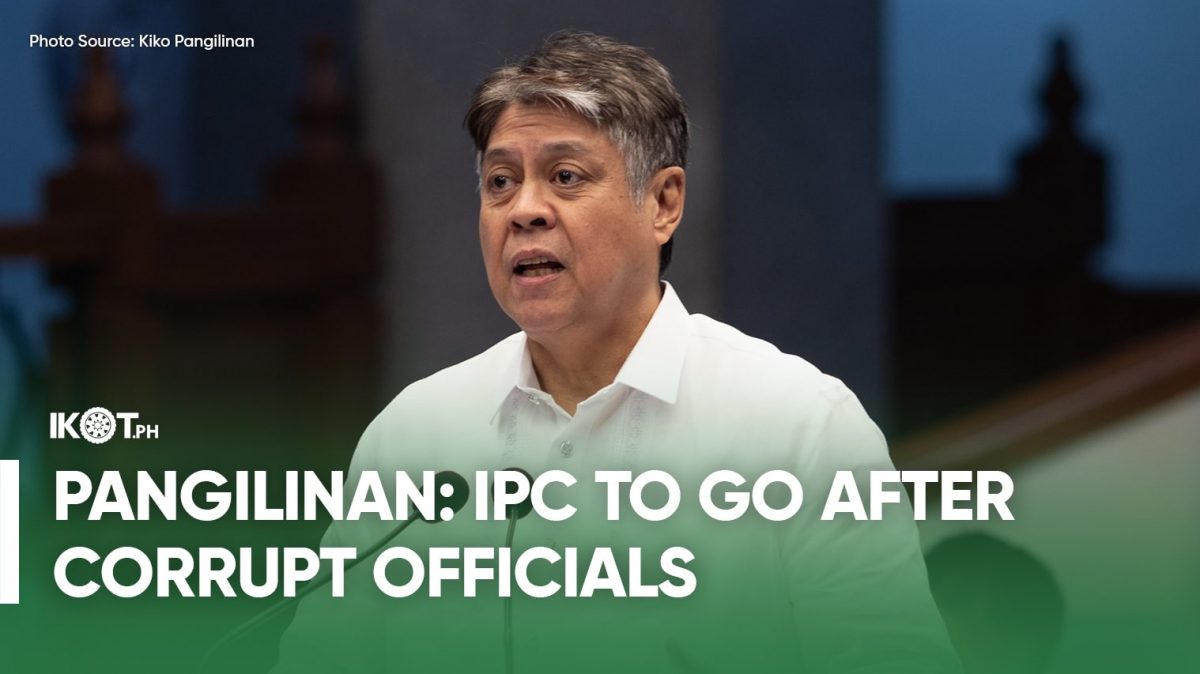
The Independent People’s Commission (IPC) will work “immediately” and “thoroughly” to hold officials behind the massive infrastructure corruption involving the government’s flood control programs accountable, Senator Kiko Pangilinan said as he sponsored and defended Senate Bill No. 1512 during the Senate’s Plenary Session.
This comes after President Ferdinand Marcos Jr. included the IPC measure under the priority agenda of his administration.
During his sponsorship of the IPC Act, Pangilinan—chair of the Senate Committee on Justice and Human Rights—explained the commission’s composition and sunset provision, as well as its prosecutorial powers along with the Office of the Ombudsman and the Department of Justice.
“May taning ang buhay nila, at dapat kumilos nang mabilis. We do not have the luxury of time.”
“We would like to impress upon the members of the commission that they’re not there forever, that they have to act quickly and immediately, and that may taning ang buhay nila, at dapat kumilos nang mabilis. We do not have the luxury of time,” the veteran legislator responded to the question raised by Senate President Vicente Sotto III, the bill’s principal author, about the IPC’s sunset provision.
Under the measure, the commission shall remain enforced only until June 30, 2028, or the end of the Marcos administration, “unless otherwise extended by law.”
“Ang taong bayan ay talagang atat na atat na mayroong managot dito sa naging pinakamalaking eskandalo ng corruption sa kasaysayan ng ating Republika.”
“Ang taong bayan ay talagang atat na atat na mayroong managot dito sa naging pinakamalaking eskandalo ng corruption sa kasaysayan ng ating Republika,” the seasoned lawmaker said.
“Kaya, we want them to act immediately, to investigate thoroughly, and file these cases as soon as they can. And therefore, we have given them a limited period within which to undertake this task,” the senator added.
He also stressed that the IPC could not be weaponized for political agenda nor its powers be abused since it provides for citizens’ participation and social accountability by working with civil society organizations, Church-based groups, people’s organizations, and academic institutions.
“Mr. President, this provision may seem innocuous, but indeed, when people are, the citizens themselves are engaged directly with the process of searching for the truth, we believe that transparency is encouraged and promoted, and therefore accountability will follow,” Pangilinan assured.
He likewise explained that the composition of the IPC will not allow for corruption and abuse within its ranks because two of the members of the commission will come from the private sector, while the other three will come from “distinguished sectors of society” such as retired Supreme Court justices, Certified Public Accountants with expertise in auditing and forensic accounting, and engineers or architects.
“So the composition of the commission, Mr. President, will ensure that this will not be weaponized and that it will be impartial and science-based,” Pangilinan stressed.
He also allayed concerns that the IPC’s powers and authority would duplicate those of the Office of the Ombudsman, the Department of Justice (DOJ), and other investigative and prosecutorial agencies.
Pangilinan explained that the law will create two special prosecutorial teams under the Office of the Ombudsman and the DOJ, who will assist the IPC “in every step of the fact-finding” process.
This will eliminate fears that the investigation will drag on because the Ombudsman and DOJ would have to undertake a second fact-finding after the IPC makes its recommendations.
Under SB 1512, the IPC will have the power to issue subpoenas, the power to suspend and freeze assets and follow the money trail, the power to cite individuals and entities in contempt, the power to cancel licenses of the Professional Regulation Commission (PRC), the power to grant witness immunity and protection, and the power to issue look out orders and recommend hold departure orders to proper authorities.
The proposed measure will also give the IPC the power to suspend and blacklist contractors and remove them from the Philippine Government Electronic Procurement System, the power to recommend to the President policy measures, the power to temporarily issue closure orders, the power to sequester assets temporarily, the power to deputize the National Bureau of Investigation, the Philippine National Police, the Criminal Investigation and Detection Group, and other law enforcement agencies in the conduct of its investigation.
The proposed measure was filed amid the massive multi-billion-peso flood control scam that has gripped the nation since congressional hearings began in August.
The investigation has uncovered a deep-seated web of corruption that includes high-ranking officials of the government.