Senator Kiko Pangilinan called for the immediate use of existing appropriations and other available resources for agriculture and food security programs, while also urging stronger collaboration with the private sector to bolster the country’s local food systems amid escalating tensions in the Middle East.
The chairperson of the Senate Committee on Agriculture, Food, and Agrarian Reform made these remarks during the committee hearing on the impact of rising oil prices on food production recently.
Pangilinan emphasized that the ongoing conflict in the Middle East poses significant risks to global supply chains, further disrupting the country’s food systems due to its impact on food prices and the availability of fuel, fertilizer, and other imports.
The veteran legislator inquired with the Department of Agriculture (DA), the Department of Finance (DOF), and the Department of Social Welfare and Development (DSWD) on the possibility of already tapping into existing appropriations under the 2026 General Appropriations Act (GAA) to immediately address the rising costs of fuel and fertilizer in the agriculture and fisheries sectors.
With the declaration of an energy emergency, the national government can access national disaster or calamity funds, which could serve as one possible funding source.
“Timely utilization of funds could accelerate support for farmers and fisherfolk, including access to inputs, post-harvest support, cold storage, and logistics infrastructure.”
The seasoned lawmaker stressed that timely utilization of funds could accelerate support for farmers and fisherfolk, including access to inputs, post-harvest support, cold storage, and logistics infrastructure.
The senator also highlighted the need not only for cash assistance, or ayuda, but also for fuel and fertilizer subsidies for farmers and fisherfolk.
According to the DA, the agency is exploring several potential funding sources to support cash assistance and subsidies. These include ₱8 billion in unobligated continuing appropriations from its 2025 budget; ₱10 billion in unreleased farm-to-market roads funds under the 2025 budget of the Department of Public Works and Highways.
The DA is also considering other possible sources of funding under its 2026 budget for alternative interventions. These include the ₱16-billion fertilizer allocation currently intended for inorganic fertilizers, ₱1 billion in savings from energy conservation measures, and ₱2 billion under the basic research program. It is likewise studying the possible realignment of up to 20 percent, or about ₱33 billion, from the ₱165-billion 2026 budget of the Office of the Secretary. All these shall be undertaken in accordance with applicable laws, rules, and regulations.
Earlier reports indicate that cash assistance will also be sourced from the ₱10-billion Presidential Assistance to Farmers and Fisherfolk under the FY 2026 GAA, while fuel assistance is expected from the ₱150-million Fuel Subsidy Program under the FY 2025 GAA continuing appropriations of the DA.
“Public-private partnerships can help scale solutions in market access, food distribution, and farmers’ and fisherfolk’s income generation.”
Pangilinan also underscored the role of the private sector in bolstering the food value chain, noting that public-private partnerships can help scale solutions in market access, food distribution, and farmers’ and fisherfolk’s income generation.
“We are taking a holistic approach to addressing a possible food shock—bringing together manufacturers, food producers, and all those involved in agriculture, industry, and fisheries production, because all are part of the value chain,” he said.
Pangilinan shared that during the COVID-19 pandemic, he pooled resources to buy produce directly from farmers, which he then donated to community pantries that already had networks and mechanisms in place to distribute food items to beneficiaries. He suggested the idea of implementing a similar setup to help the agriculture and fisheries sectors in the current crisis.
“I did this in my private capacity, not as a senator—purchasing directly from farmers and delivering the goods through existing networks; a similar setup could be adopted moving forward,” Pangilinan recalled.
He also continues to push for the full implementation of the 2019 Sagip Saka Act, which he authored and sponsored, allowing national government agencies and local government units to purchase directly from farmers and fisherfolk.
The DSWD, Pangilinan pointed out, could source its food needs for its hot meals and feeding programs directly from farmers and fisherfolk. Other government agencies should also utilize the Sagip Saka Act, he added.
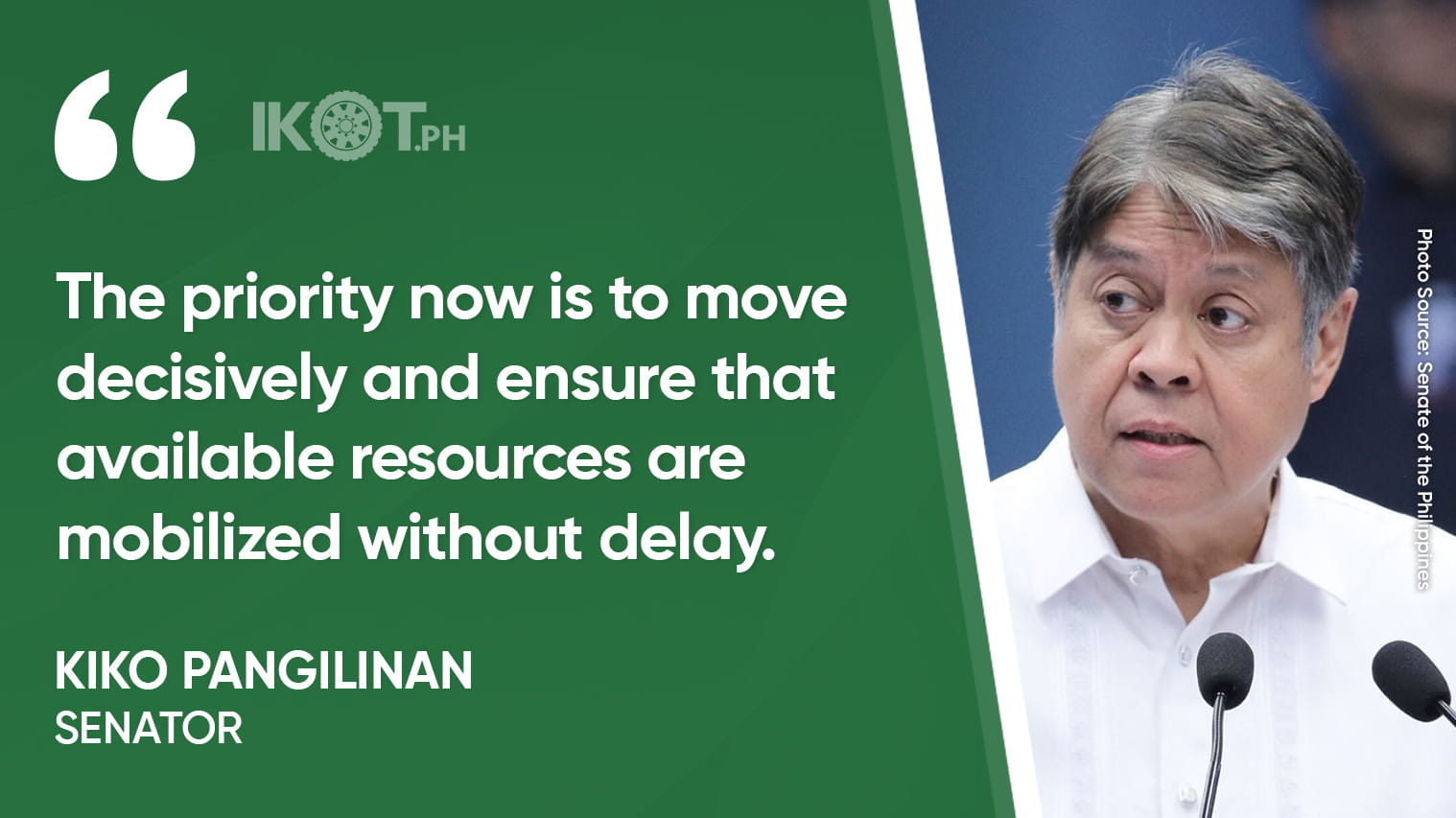
Pangilinan emphasized that the priority now is to move decisively and ensure that available resources are mobilized without delay to reach farmers and fisherfolk on the ground.