
There’s a quiet kind of grief that doesn’t come with condolences.
It slips into ordinary moments—while folding laundry, scrolling past someone else’s milestone, hearing a song you haven’t heard in years. It’s the sudden awareness that somewhere along the way, life veered. Not dramatically. Not tragically. Just… differently. And now you’re here, living a version of life that works, but isn’t the one you once imagined.
You don’t always know what to call that feeling. It isn’t regret, exactly. You made the best choices you could with what you knew then. It isn’t envy either, though it sometimes disguises itself that way. It’s more like a soft ache for a timeline that quietly closed—the job you almost took, the city you almost moved to, the person you almost loved, the version of you that almost became.
People rarely talk about this kind of yearning because nothing obviously went wrong. There was no singular loss to point to. You studied, worked, showed up, endured. Life moved forward the way life does—one practical decision at a time. And practicality, over years, has a way of reshaping dreams into something more manageable. Something explainable. Something safe.
You told yourself: later.
Later, when money is steadier.
Later, when family needs less.
Later, when you’re braver.
Later, when you’re not so tired.
Later became another year, then several. And eventually the dream didn’t disappear—it just moved out of the center of your life and into a quieter room you don’t visit as often.
The Self That Still Waits
But sometimes you do visit. Usually at night. Or during long commutes. Or when someone asks, casually, “If you could do anything, what would you choose?”
And you feel it—that flicker of recognition. Of a self that still exists somewhere beneath the routines and responsibilities. The self that wanted differently. Bigger, maybe. Or simply other.
Many people are carrying this right now without naming it. They’re living competent lives. Functional lives. Lives that look fine from the outside. Bills paid. Roles fulfilled. Expectations met. And yet there’s a low, persistent question beneath everything:
Is this it?
Not in a dramatic, life-is-over way. Just in a quiet recalibration of possibility. The realization that certain paths narrow as years pass. That some doors don’t stay open forever. That you can love parts of your life and still mourn parts that never arrived.
The Lives We Imagine We Lost
There’s also the tender truth that some of what you yearn for never actually existed—not in reality. It lived in imagination, in youth, in hope untested by circumstance. The relationship that might have failed. The career that might have disappointed. The freedom that might have felt lonelier than you expected. We don’t just grieve what was lost; we grieve what was never tried.
And yet the feeling remains real. The longing is real. Because at its core, it isn’t about a job or a place or a person. It’s about identity. About who you thought you might become, and who you are now.
There’s a particular moment many people recognize: when you encounter someone living close to the life you once pictured for yourself. Maybe they moved abroad. Maybe they pursued the art you set aside. Maybe they chose differently in love. You’re happy for them, sincerely. But somewhere inside, a sentence forms before you can stop it:
That could have been me.
The mind is gentle with others and ruthless with itself. It edits history, rewrites courage, magnifies roads not taken. It forgets context—the fears you had, the limits you faced, the responsibilities you carried. It compares your lived reality with someone else’s curated outcome.
And so yearning can feel like failure, even when it isn’t.
But here’s the part we rarely say out loud: a life can be both meaningful and misaligned at the same time. You can be grateful and restless. Committed and curious. Content in many ways and still quietly wondering about others. These states aren’t contradictions; they’re the normal complexity of being human.
The lost life—the could-have-been—doesn’t always disappear. It lingers like an echo. Sometimes painful, sometimes motivating, sometimes simply there. And over time, people learn different ways to live beside it.
Some revisit old desires in smaller forms: a class taken late, a hobby revived, a place finally visited. Not to reclaim the past, but to acknowledge it. To say: this mattered to me once, and maybe it still does in some way.
Others come to see that the imagined life wasn’t necessarily better—just different. And different always carries its own unseen costs. Every chosen path closes others. Every identity formed leaves others unformed. No one lives all their possible lives.
And some, eventually, recognize something gentler: that the yearning itself is evidence of aliveness. Of capacity. Of a self that once reached outward. The fact that you can feel the absence of another path means you once envisioned it. Desired it. Believed in it.
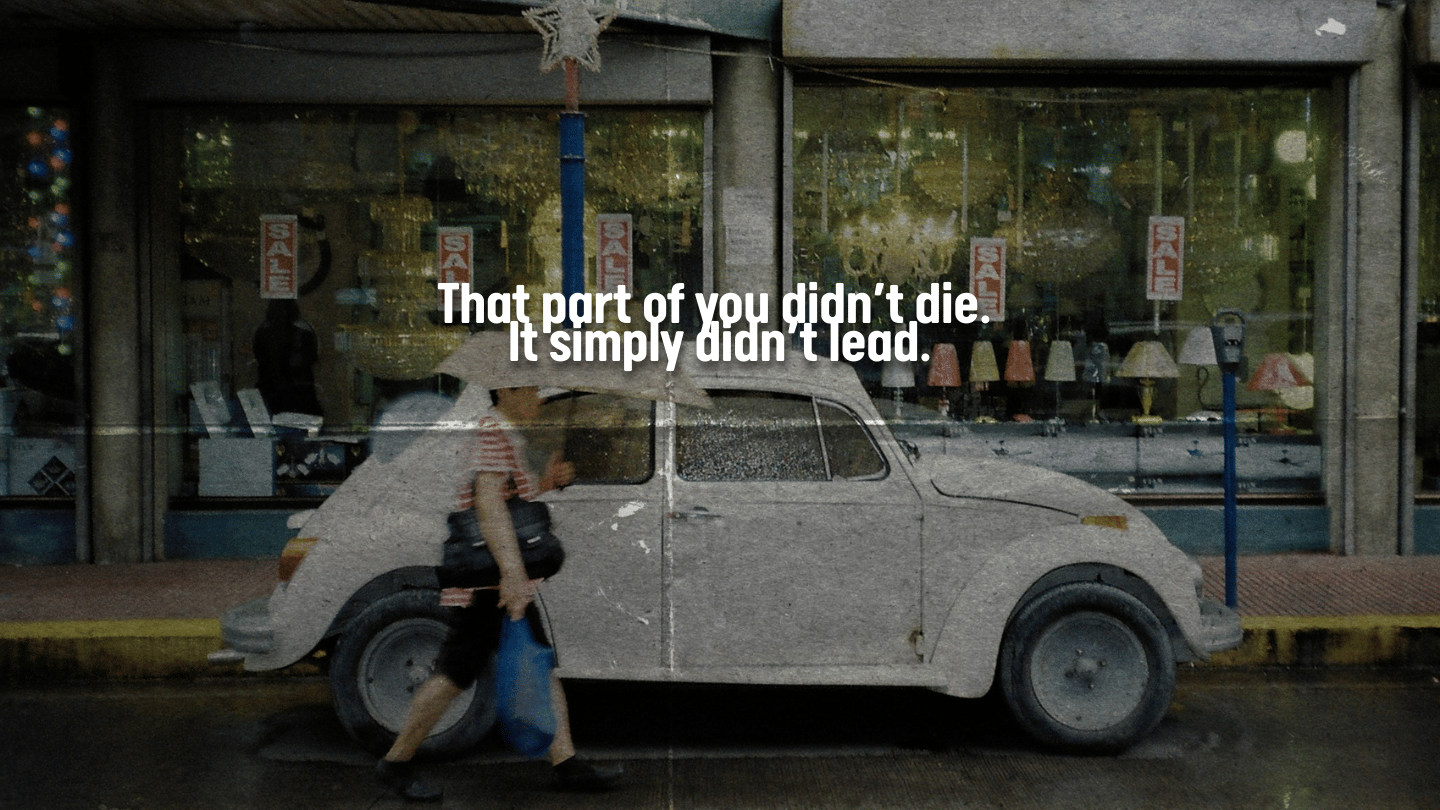
That part of you didn’t die. It simply didn’t lead.
Most days, the feeling fades into the background. You answer emails. Pay bills. Make dinner. Care for people. Life continues in its steady, practical rhythm. But every so often, the quiet grief returns—not to accuse you, but to remind you of breadth. Of the many selves you carry within the single life you live.
And maybe the goal isn’t to erase that ache. Maybe it’s to hold it without shame. To let it exist alongside the life you have built—not as proof you chose wrong, but as evidence that you once imagined widely.
There are lives we live. There are lives we almost lived. And there is the space between them, where memory and possibility meet.
Most of us spend our days there at least once. Not lost. Not failed. Just human.