
Camarines Sur representatives Luigi Villafuerte and Migz Villafuerte want the Senate to join the House of Representatives in standing up for line workers in the electric power and telecommunications (telecom) industries by passing a House-approved measure providing mandatory insurance plus other benefits to these indispensable crews with high-risk jobs.
The rest of the windfall that await line workers in a bill cleared just recently by the bigger chamber include accident, disability, medical and retirement benefits, to underscore the Congress’ appreciation of the dangers faced daily by these power and telecom industry crews in delivering their respective companies’ vital services to the public, the Villafuertes said.
In a recent plenary session, the House passed by a 197-0 vote the substitute House Bill (HB) No. 7239, in place of several similar measures, including HB 2399, which Luigi and Migz Villafuerte had authored with fellow CamSur Rep. Tsuyoshi Anthony Horibata and Bicol Saro Rep. Terry Ridon.
“During extreme weather conditions, electric power and telecom lines often absorb severe damage, leading to interruptions in electricity, communications, health service delivery and disaster response efforts of government agencies, NGOs (non-government organizations) and other stakeholders in areas affected by typhoons, floods, tidal waves or surges or other natural disasters,” Luigi, a House deputy majority leader, said.
Under such conditions, said Luigi, “Line workers perform an essential and often dangerous role in restoring power and communications, even in the height of erratic weather. They risk their safety and even their lives to repair distribution systems and re-establish electricity and communications following calamities.”
Migz said, meanwhile, that “beyond disaster response, line workers regularly conduct pole repairs, maintenance and electrification or telecom projects in underserved and remote areas, supporting rural development goals.”
Also known as the “Line Workers Insurance and Benefits Act,” HB 7239 recognizes the contributions of line workers and the risks they encounter in ensuring the continuous and reliable supply of electricity and telecommunications, not only in residential dwellings, but most importantly, in commercial and industrial establishments, specifically in the countryside and rural areas.
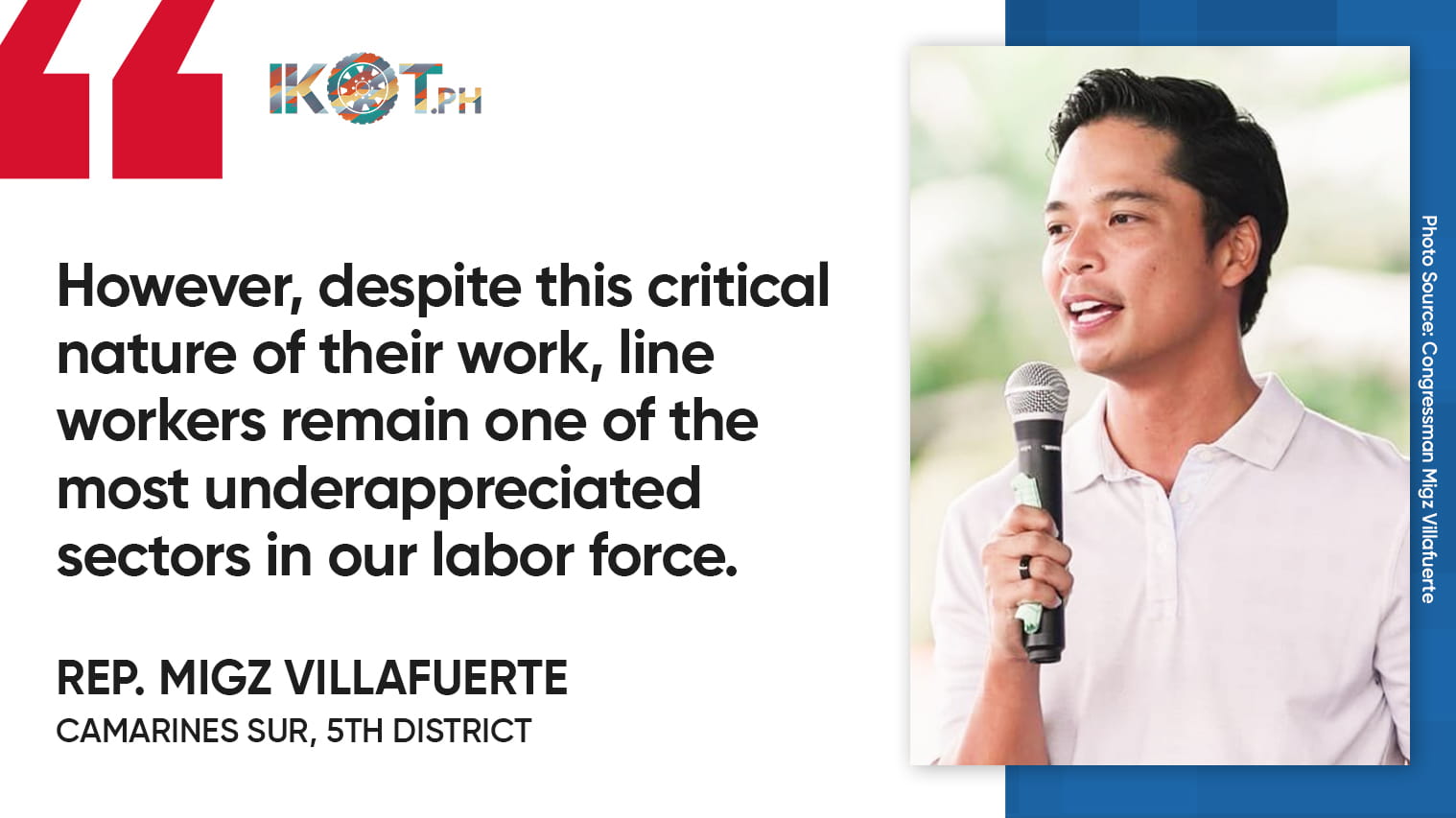
“However, despite this critical nature of their work, line workers remain one of the most underappreciated sectors in our labor force,” added Migz, who chairs the House committee on information and communications technology (ICT).
To formally acknowledge their invaluable contributions to society in their high-risk delivery of power and telecom services, the Villafuertes expressed the hope that our senators would similarly pass their version of the House-approved HB 7239.
This bill entitles all line workers to life, accident or disability insurance benefits, with a minimum required coverage of P200,000 for small distribution utilities (DUs); up to P1 million for mega large DUs, and P2 million for transmission or grid operators.
“In addition, line workers shall be granted under the House-passed bill other types of windfall like retirement benefits, mortuary assistance, disability benefits and reimbursement of their medical expenses incurred in the line of duty,” Luigi and Migz said.
They noted that a similar bill was approved by House members and subsequently transmitted to senators in the 19th Congress, but this pro-line men measure did not clear the Senate.
Among the other authors of HB 7239 are Majority Floor Leader Sandro Marcos III, Deputy Speaker Kristine Singson-Meehan, APEC Rep. Sergio Dagooc and Palawan Rep. Jose Alvarez, who chairs the House committee on energy that had endorsed the plenary approval of this bill.
In a separate report, Marcos said that line workers serve as a vital link to the efficient flow of electricity and telecom services and are exposed to significant occupational risks, warranting commensurate benefits, including mandatory insurance coverage.
“They are among our workers who keep the economy going,” Marcos said.
Also known as the “Line Workers Insurance and Benefits Act,” HB 7239 recognizes the contributions of line workers and the risks they encounter in ensuring the continuous and reliable supply of electricity and telecommunications, not only in residential dwellings, but most importantly, in commercial and industrial establishments, specifically in the countryside and rural areas.
As such the bill requires the employers of these line workers to provide them insurance coverage and other benefits in addition to what regular employees receive under existing labor laws.
This Act shall cover all line workers in telecom companies, telecom line contractors, powerline contractors, private DUs, electric cooperatives (ECs) and transmission or grid operators.
These line workers shall be entitled to life and accident or disability insurance benefits, and their coverage shall be effective upon the start of their employment until their separation from their companies, either by resignation, termination or retirement.
Under the bill, employers shall cover 100% the insurance premium payments of their respective line workers.
“Line workers perform an essential and often dangerous role in restoring power and communications, even in the height of erratic weather.”
Employers who are already providing insurance coverage to their line workers equal to or more than the minimum requirement as prescribed in HB 7239 are no longer required to make adjustments to their insurance coverage.
Otherwise, employers shall augment the amount of coverage to comply with this Act, provided that in no way shall this bill be construed to diminish or reduce any insurance coverage that the line workers are already receiving or any entitlement under existing laws, company policy, or employment contracts or collective bargaining agreements (CBAs) between employers and their employes.
Within 90 days upon approval of this Act, the National Electrification Administration (NEA) shall, together with the Department of Labor and Employment (DOLE) and Energy Regulatory Commission (ERC), and in consultation with the DUs, ECs and telecom sector, promulgate and issue the IRR to effectively implement the provisions of this Act.
The Villafuertes have also introduced separate measures advancing the welfare of other sectors, including HB 2048 providing for universal social pension (socpen) for the elderly that will mean a monthly allowance of at least P500 for all senior citizens, including those who are not considered indigent or without incomes.
They likewise filed HB 1985,which accords media people the rights now enjoyed by their fellow workers in the government and private sector, such as security of tenure, hazard and overtime pay, mandatory additional insurance coverage and other job-related benefits.
HB 1985, otherwise known as the “Media Workers’ Welfare Act,” seeks to guarantee the rights of media workers to self-organization and additional economic benefits enjoyed by other workers; and to establish a safe, protected atmosphere conducive to their productive, free and fruitful work.