
Speaker Faustino “Bojie” Dy III said the government is “all hands on deck” as the House of Representatives moves swiftly to pass a measure allowing the suspension of the mandatory biofuel blending requirement under the Biofuels Act of 2006 after President Ferdinand Marcos Jr. certified the bill as urgent.
House Bill (HB) No. 8469, or the proposed Oil Price Stabilization Act, would allow the President to temporarily suspend mandatory biofuel blending if blended fuel prices are at least five percent higher than pure fuel, thus easing pump prices.
Dy said the President’s certification underscores the urgency of protecting Filipino consumers and businesses from rising fuel prices amid the escalating crisis in the Middle East.
“The President’s certification makes clear that this is an urgent matter affecting every Filipino household and the entire economy. The House stands ready to act swiftly on this measure so we can give government the flexibility to stabilize fuel prices,” the Speaker from Isabela said.
“Our priority is to protect consumers, keep transport and production costs manageable, and ensure that energy supply remains stable.”
“Our priority is to protect consumers, keep transport and production costs manageable, and ensure that energy supply remains stable,” the veteran legislator said.
HB 8469 seeks to amend Section 5 of Republic Act No. 9367, or the Biofuels Act of 2006, to allow the President to suspend the mandatory use of locally sourced biofuels for up to one year upon the recommendation of the National Biofuels Board and the Department of Energy.

The measure is now up for second reading in the House plenary after the Committee on Energy, chaired by Palawan Representative Jose Alvarez, approved it recently.
Under Article VI, Section 26(2) of the 1987 Constitution, the President’s certification of a bill as urgent allows Congress to dispense with the usual requirement that a measure be approved on separate days for second and third readings, enabling lawmakers to pass the bill more quickly in response to a public need or emergency.
“The proposed amendment provides the government with flexibility to respond to abnormal price movements in the global oil market.”
The seasoned lawmaker said the proposed amendment provides the government with flexibility to respond to abnormal price movements in the global oil market.
Under the current law, gasoline and diesel sold in the country must contain biofuel components such as bioethanol and biodiesel.
While the policy supports renewable energy and local biofuel industries, the blending requirement can sometimes raise pump prices when biofuel components become more expensive or supply becomes tight.
He said allowing the temporary suspension of the blending requirement during such periods would help ease cost pressures and prevent unnecessary increases in pump prices.
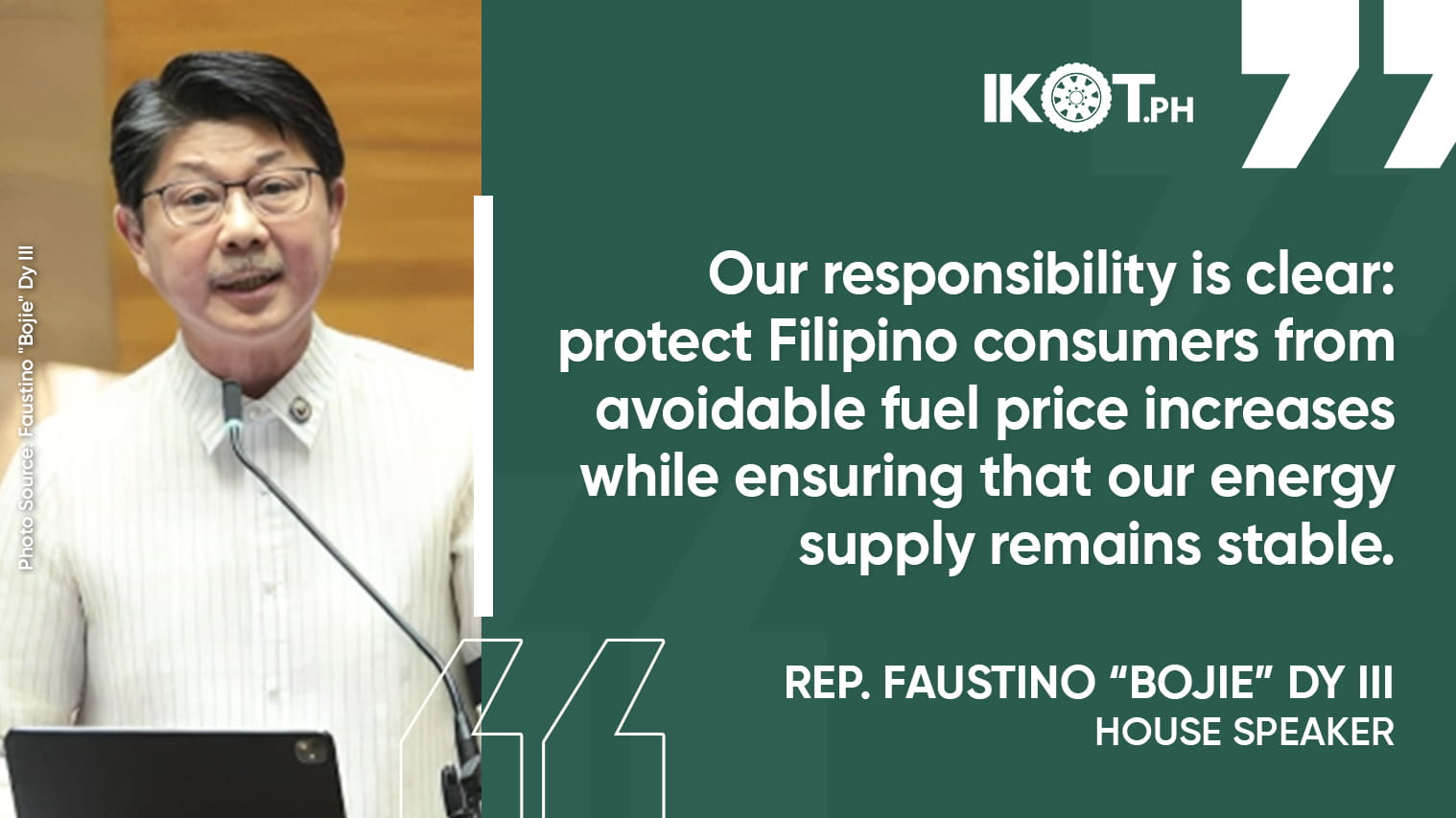
“At the end of the day, our responsibility is clear: protect Filipino consumers from avoidable fuel price increases while ensuring that our energy supply remains stable and responsive to global developments,” Dy concluded.