

Why stability often looks less exciting than we expect.
Most people expect financial progress to be obvious.
A higher salary.
A new car.
A bigger home.
Something visible enough for others to notice.
Something that signals, “Okay na. Umangat na.”
But for many Filipinos, real financial progress doesn’t look like that.
It arrives quietly.
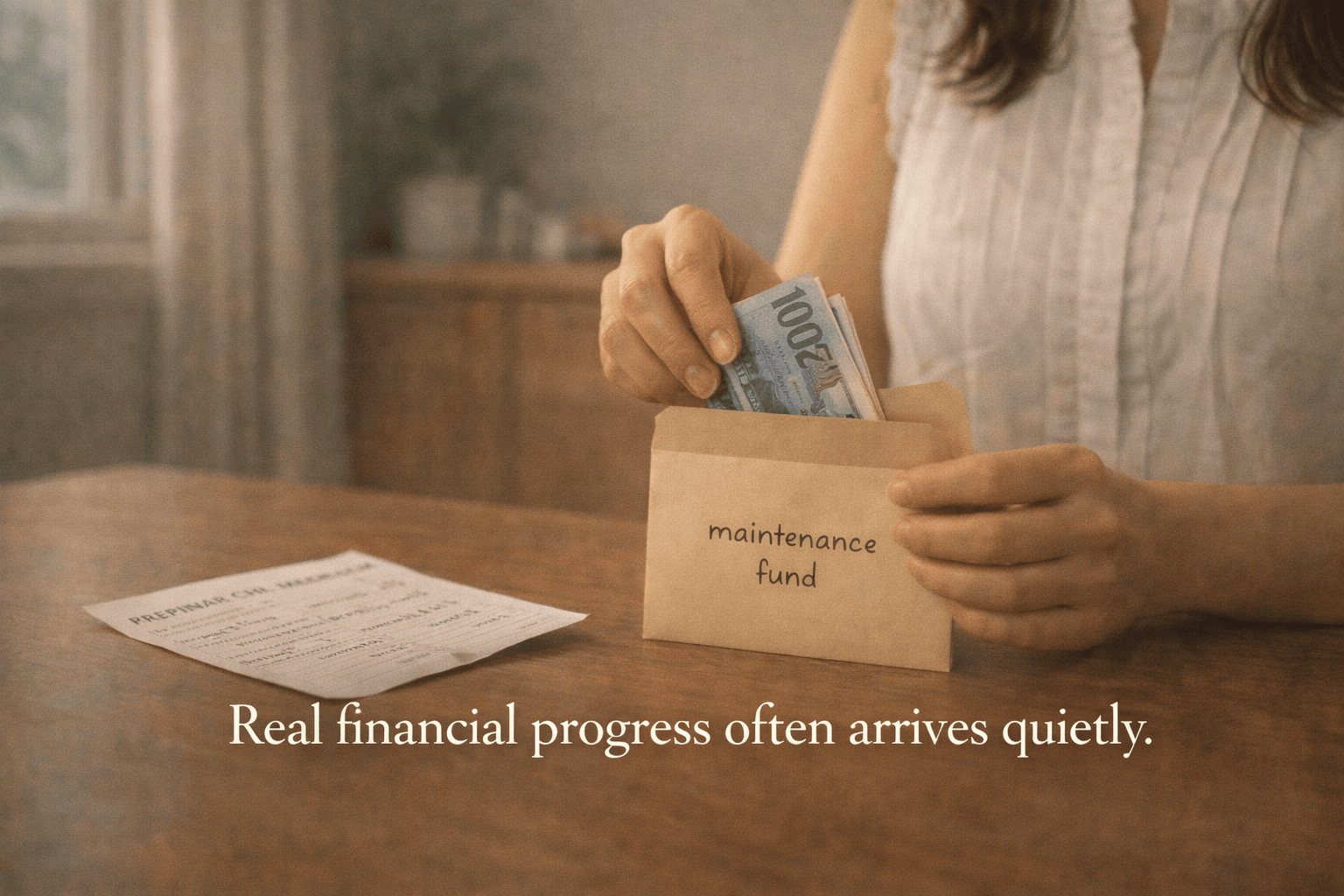
It shows up in ways that rarely get posted online or talked about at family gatherings.
Sometimes, progress simply looks like fewer emergencies.
Not none—just fewer.
The washing machine breaks, but this time you don’t panic.
The electricity bill spikes, but it doesn’t derail the whole month.
A child’s school payment comes due, and you already expected it.
Small moments like these rarely feel dramatic. But they matter more than they appear.
Because what’s improving isn’t only your balance.
It’s the friction in your financial life.
For a long time, money may have required constant mental effort.
Checking your balance before buying groceries.
Recomputing expenses while standing in line at the pharmacy.
Replaying the same numbers late at night just to make sure nothing was missed.
Every decision carried weight.
But when progress begins, that weight slowly eases.
Not overnight.
Not perfectly.
Just enough to notice.
You refill groceries without calculating every item in your head.
You open your banking app without bracing yourself first.
You send money to family without worrying that the rest of the week will collapse.
Money stops dominating every thought.

And when that happens, something subtle but important shifts.
Your mind gets quieter.
This kind of progress rarely gets applause.

No one congratulates you for sleeping better because bills no longer keep you awake.
No one celebrates the moment you realize you didn’t check your bank balance ten times that day.
No one posts about the relief of finally knowing that next month’s rent is already covered.
But these changes matter.
Because real financial progress is not only about accumulation.
It is also about reduced urgency.
It’s about fewer moments of dread.
Fewer decisions made in panic.
Fewer nights spent replaying worst-case scenarios.
For people who spent years reacting—covering gaps, solving crises, stretching every peso—the absence of chaos can feel unfamiliar.
Sometimes even suspicious.
You might catch yourself wondering:
Ano’ng nangyayari, meron pa ba?.
Baka bumabagal lang ako.
Am I missing something?
But calm is not the absence of progress.
Often, it is the result of it.

When financial pressure begins to loosen, life becomes less about constant adjustment and more about steady movement.
You recover from setbacks faster.
You make decisions with less second-guessing.
You have enough breathing room to pause before saying yes or no.
And that breathing room is not small.
It is structural.
Because when money stops demanding constant attention, energy returns to other parts of life—your work, your family, your health, your plans for the future.
That kind of progress is quiet.
But it is powerful.
In fact, one of the clearest signs of financial growth is this:
Money begins to occupy less space in your mind.
Not because it doesn’t matter anymore.
But because it no longer controls every decision.
This is the kind of progress many people miss because they are still waiting for applause.
But the most meaningful improvements rarely announce themselves.
They simply show up as a life that feels a little lighter than it used to.
A little calmer.
A little easier to carry.
And in the long run, that quiet stability often matters far more than the loud milestones everyone else notices.
Not all financial progress makes noise—but the kind that gives your life more room to breathe is often the kind that lasts.
Catch Thanjo’s personal finance column every Tuesday at 7 p.m. on IKOT.PH and across Facebook, X (Twitter), and Instagram.
DISCLAIMER:
The views and opinions of our partners and contributors expressed in this article are exclusively their own and are made in their personal capacities. They do not reflect the views, policies, or official stance of IKOT.PH, its editors, officers, or affiliates. As such, nothing contained herein shall be construed as professional advice or as an official declaration, endorsement, or position of IKOT.PH