
Senator Raffy Tulfo coordinated with officials of the Department of Transportation (DOTr), Department of Energy (DOE), Bureau of Fisheries and Aquatic Resources (BFAR), and the Department of Agriculture (DA), via Zoom recently, in his capacity as Chairman of the Senate Committee on Public Services, to closely monitor and oversee programs addressing the impact of rising petroleum prices on the agricultural and transport sectors amid the ongoing conflict in the Middle East.
According to Tulfo, this is a crucial time to lay down systematic plans to implement smoother systems in distributing fuel subsidies directly to farmers, fisherfolks and public utility drivers/riders at the time when they need it the most.
The legislator emphasized that it is important to ensure such measures in order to anticipate the effects and to minimize impacts on their sectors to fully support the livelihoods of said workers especially that there’s no assurance yet of any immediate resolution to the tensions in the Middle East.
“Dahil sa kaguluhan sa Middle East, siguradong may impact ito sa presyo ng langis.”
“Dahil sa kaguluhan sa Middle East, siguradong may impact ito sa presyo ng langis. Marami nang gasolinahan ang pinayagang magtaas ng presyo,” the lawmaker said.
“Ang concern ko, lubhang maaapektuhan din ang mga PUV drivers, farmers, fisherfolks. Anong programa mayroon ang gobyerno para maaddress ang isyung ito para makatulong sa kanila?” the senator from Isabela and Davao explained.
In fact, last March 3 oil price hikes were already rolled out by various oil companies at ₱1.90/L on gasoline, ₱1.20/L on diesel and ₱1.50/L on kerosene.
In the said online meeting, DOE Undersecretary Sandy Sales told Tulfo that the said hike was not yet related to the breakout of conflict in the Middle East and this is only from the normal average weekly adjustment on prices.
Sales added that the senator was correct in pointing out that prices of petroleum products in the world market will steadily increase in the coming days especially that they also received reports that the Strait of Hormuz which is identified as one of the main trade routes of the global oil supply passes through is shut down by Iranian forces.
On the other hand, DOTr Assistant Secretary for Road Transport and Non-Infrastructure Assistant Secretary Jojo Reyes said that they currently have ₱2.5 billion funds ready to be allocated as fuel subsidies from the 2025 General Appropriation Act which will be distributed in DILG which will get 33.9% or ₱832 million for tricycle operators and drivers associations (TODAs), 11.01% or ₱270 million to DICT for delivery riders and 55% or ₱1.3 billion to LTFRB for public utility vehicle (PUV) drivers.
From these, tricycle drivers are expected to receive ₱1,150 per unit, ₱1,800 per delivery rider, ₱10,500 per modernized jeepney unit and and estimate of ₱4,500 – ₱5,000 for traditional jeepneys and others according to Reyes.
“Farmers registered in the Registry System for Basic Sectors in Agriculture (RSBSA) may get an estimate of ₱3,500 – ₱4,500 fuel subsidy.”
Meanwhile, DA Undersecretary Roger Navarro said they still have remaining ₱100 million from the Bayanihan Law passed during the pandemic that can be allocated for farmers, a matter which Tulfo strongly rejected obviously because of the very small amount to which he further obliged Navarro to explore ways in securing more funds. In addition, Navarro stated farmers registered in the Registry System for Basic Sectors in Agriculture (RSBSA) may get an estimate of ₱3,500 – ₱4,500 fuel subsidy.
For the part of the fisherfolks, Tulfo also engaged with BFAR National Director Elizer Salilig where he reported that they currently have a ₱50 million fund deposited at the Development Bank of the Philippines (DBP) which can be allocated for fuel subsidy to fisherfolks but the bureau is restraint to utilize until a supplemental agreement can be secured from DBP which they are still waiting to be released for sometime now.
In a message, the DBP confirmed to Tulfo’s Senate office that they have yet to release said agreement pending their recommendation of a provision to release the subsidy in the mode of cash in line with his long time proposal due to the beneficiaries’ distant locations which may not be accessible by the banks.
Tulfo also highlighted the need for the said agencies to study creating new policies to implement and distribute fuel subsidies that doesn’t necessitate to comply to the technicality threshold of awaiting Dubai Crude Oil to reach $80 per barrel before triggering to release such assistance.
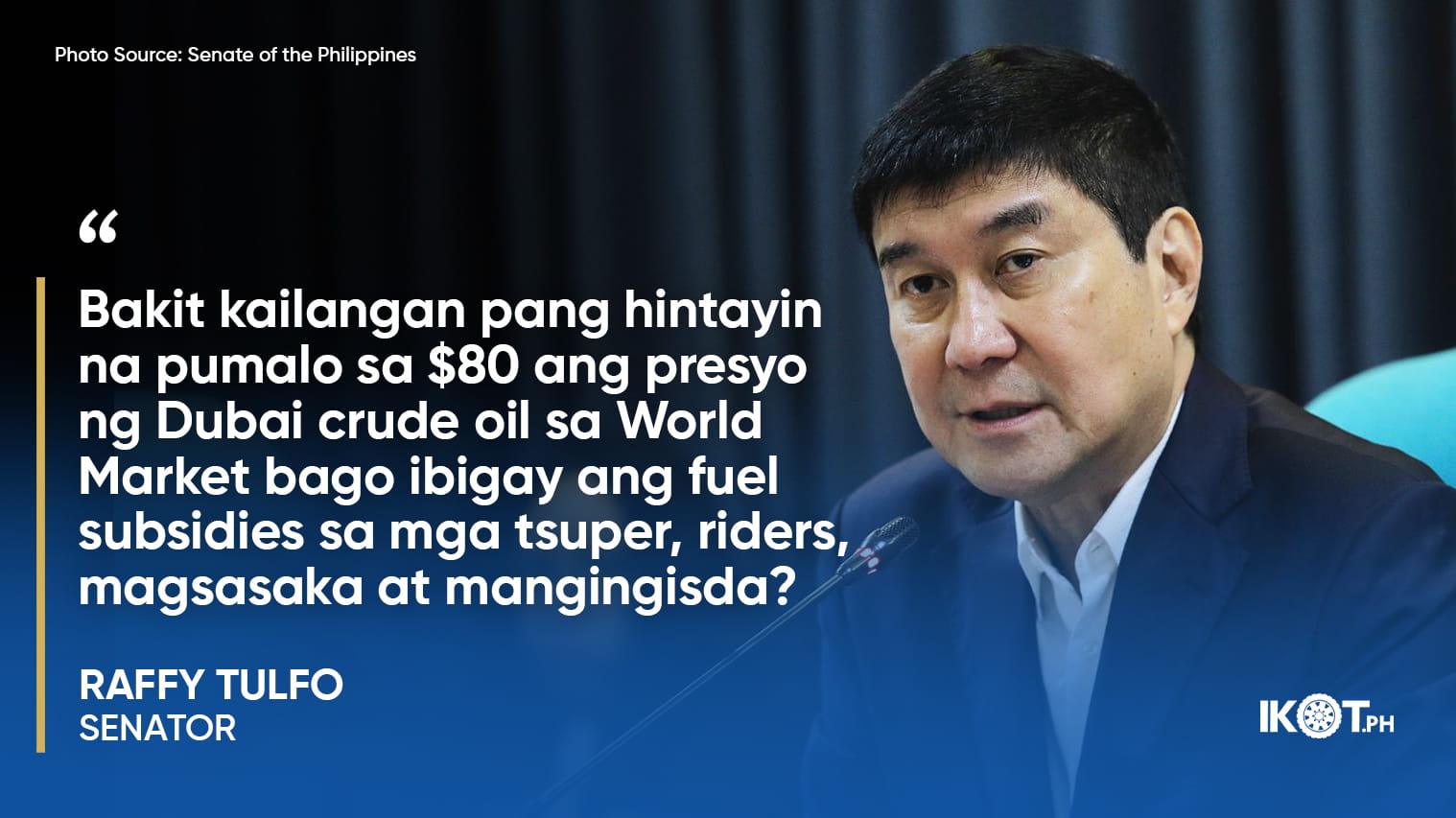
“Matagal ko nang sinasabi ito, bakit kailangan pang hintayin na pumalo sa $80 ang presyo ng Dubai crude oil sa World Market bago ibigay ang fuel subsidies sa mga tsuper, riders, magsasaka at mangingisda samantalang bago pa man tumaas ito ay pinapayagan na nating tuloy-tuloy na magtaas ng presyo ang mga kompanya ng langis,” Tulfo stressed.