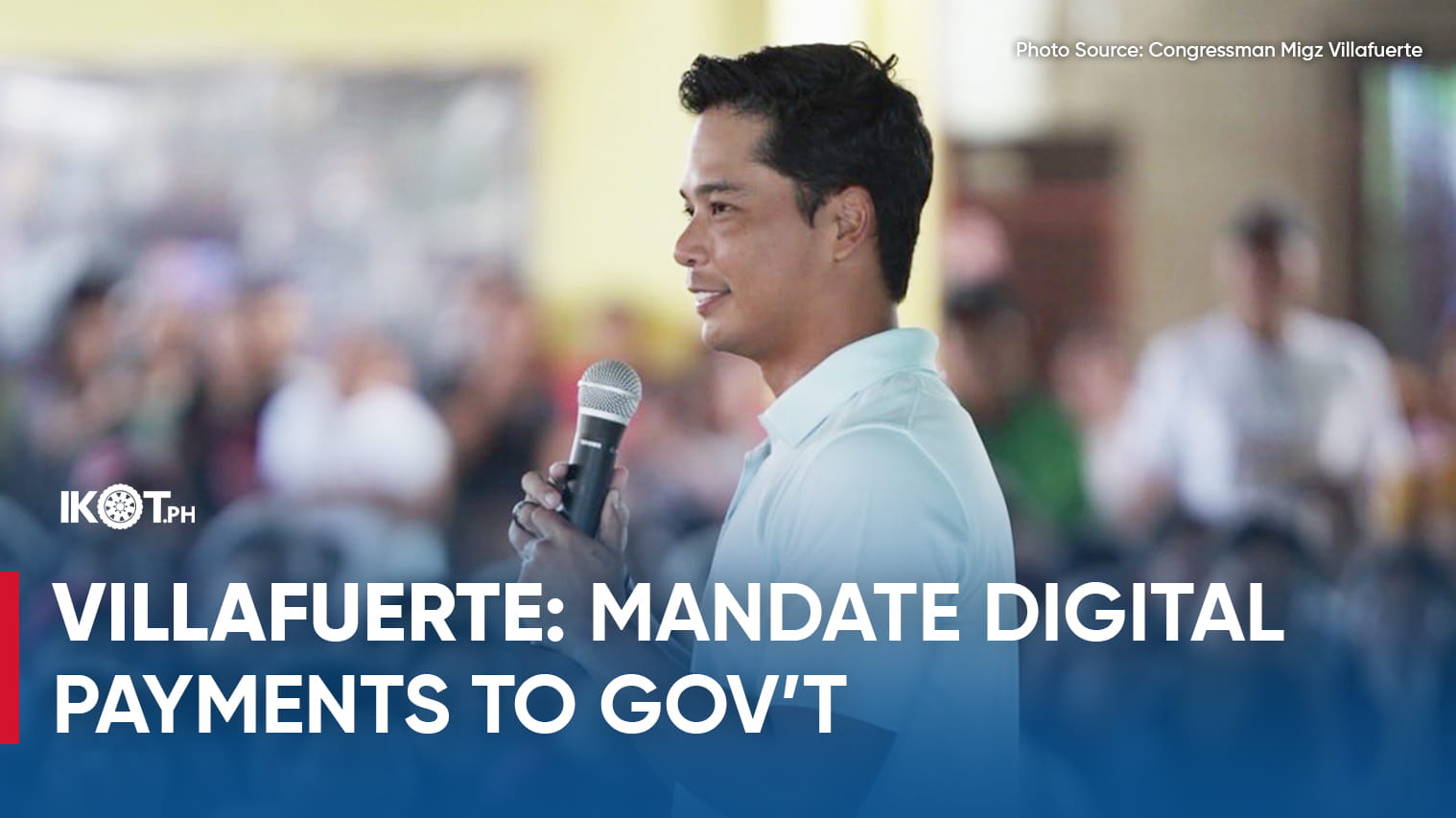
With the three-fold jump in the volume of electronic fund transfers (EFTs) to 4.065 billion transactions worth over P22 trillion, Camarines Sur Rep. Migz Villafuerte wants Congress to further boost the growth momentum of Philippine e-commerce by writing a law mandating the use of online payments in most official dealings.
“The sustained dramatic growth in both volume and value of EFTs cleared through Instapay and PESONet underline the deepening public trust and confidence in digital platforms,” said Villafuerte, “and the government can persuade more Filipinos to embrace fintech (financial technology) via the mandatory payment online of most official transactions such as the collection of taxes, payment of fees and disbursements of public funds.”
Villafuerte noted that as early as 2023, Google projected in its e-Conomy Southeast Asia Report that the country’s e-commerce could reach $35 billion by 2025 and a higher $60 billion by 2030; and its digital payments growing to $126 billion in 2025 and to $220 billion in 2030.
The former governor of Camarines Sur also said that accelerating the momentum of the government’s digital transformation will help the Bangko Sentral ng Pilipinas (BSP) hit its target of making online transactions account for 60% to 70% of all retail payments by 2028.
He said BSP along with national government agencies (NGAs) and local government units (LGUs) should make a concerted effort to further accelerate the use of safe and interoperable online cash transactions in Government, as a way to outweigh assorted challenges that stand in the way of the Marcos administration’s digital transformation agenda.
Villafuerte said that the country’s largest organization of business organizations—the Philippine Chamber of Commerce and Industry (PCCI)—has pointed out that digitalization will sharpen the country’s competitiveness as an investment hub and at the same time help deter corruption.
“Such challenges to a speedy switch to online payments at this point include the inadequate access to reliable digital infrastructure, slow internet connectivity especially in remote areas, costly digital payment fees and limited acceptance of digital payments,” said Villafuerte.
Villafuerte said that the country’s largest organization of business organizations—the Philippine Chamber of Commerce and Industry (PCCI)—has pointed out that digitalization will sharpen the country’s competitiveness as an investment hub and at the same time help deter corruption.
At the recent 51st Philippine Business Conference and Expo, PCCI president Enunina Mangio said that, “We stand at an inflection point where digital transformation is no longer optional—it is imperative for national competitiveness and prosperity.
In its most recent report on EFTs, the Bangko Sentral ng Pilipinas (BSP) revealed that the combined value of InstaPay and PESONet transactions soared by 41.15% to P22.054 trillion as of November 2025, from P15.64 trillion a year ago.
The volume of total transactions of both clearing houses went up more than three times year-on-year (YOY) to 4.065 billion over the January-November 2025 period, from 1.339 billion over the same 11 months in 2024.
The value of InstaPay transactions rose 56.18% to P10.209 trillion in the same 11-month period, from P6.537 trillion the previous year.
According to the BSP, the volume of transactions coursed through this payment gateway totaled 3.958 billion at end-November, from 1.247 billion a year earlier.
Meanwhile, the value of PESONet transactions climbed 30.35% to P11.845 trillion in the same 11-month period, from P9.087 trillion in the previous year.
Volume-wise, transfers made via PESONet went by 16.19% YOY to 106.626 million from 91.772 million.
InstaPay and PESONet are automated clearing houses under the BSP’s National Retail Payment System (NRPS), which enables people and businesses to transfer Philippine pesos between participating banks and non-bank financial institutions in the country.
Villafuerte, who chairs the House committee on information and communications technology (ICT), explained that InstaPay is an EFT facility for low-value transactions up to a maximum of P50,000 each and used mainly for e-commerce and remittances, while PESONet covers high-value transactions and serves as an online alternative to paper-based checks.
A former governor, Villafuerte said that HB 3646 seeks to help the government and BSP overcome challenges to an even speedier digital transformation, such as the inadequate access to reliable digital infrastructure, slow internet connectivity especially in remote areas, costly digital payment fees and limited acceptance of digital payments.”
Villafuerte said that to accelerate the adoption of digital payments, HB 3646 requires LGUs to “issue their respective ordinances requiring merchants within their localities to establish or outsource arrangements or mechanisms that would enable them to receive payments from clients and make payments to creditors and suppliers in digital form as a prerequisite for the approval or renewal of their business permits.”
“No new or renewal of business permit shall be approved unless the merchant concerned shows to the satisfaction of the LGU that a functional digital payment system accessible by mobile phone or other access devices is installed or provided by a duly registered PSP in the merchant partner’s place of business,” the bill states.
It directs LGUs to “ensure that merchants in their jurisdictions have access to appropriate digital payment solutions and have the capacity to effectively use the same, with due consideration to small and micro-merchants, including market vendors, tricycle operators and food stalls.”
The LGU shall, under the bill, extend assistance to small and micro-merchants to facilitate their adoption of digital transaction capability; while the BSP and Departments of Trade and Industry (DTI), of the Interior and Local Government (DILG) and of Information and Communications Technology (DICT) shall similarly facilitate measures to provide capacity building for the NGAs, LGUs and Government-owned or controlled corporations (GOCCs).
Also, LGUs may impose reduced fees or grant other incentives for merchants providing efficient digital payment systems.
Also known as the “Promotion of Digital Payments Act,” HB 3646 aims for the:
· Mandatory use of digital payment platforms for collecting taxes, fees, tolls, imposts, other revenues, purchases, and public disbursements, as well as account-based disbursements that credit government payments directly to recipients’ accounts;
· Mandatory adoption by the BSP of the national quick response (QR) code standard to enable interoperable QR-based payments and remove the need for multiple merchant and client accounts;
· Mandatory issuance by LGUs ordinances requiring merchants to install a functional digital payment systems at their place of business and to extend assistance to small and micro-merchants to facilitate their adoption of digital transaction capability;
· Mandatory establishment by government entities implementing digital payments of technical support units to coordinate with payment service providers, adopt and implement a comprehensive incentive framework for financial transactions, and allocate funds to cover compliance costs;
· Mandatory implementation by the BSP along with the DTI, DILG and DICT of capacity-building initiatives; and
· Mandatory improvement by the Department of Science and Technology (DOST) and DICT of access to and affordability of digital infrastructure, which are both crucial for the long-term sustainability of a fully digitized financial ecosystem.
Under HB 3646, Villafuerte said that NGAs, LGUs and GOCCs may create their respective digital payment technical support and maintenance service units, which shall be responsible for troubleshooting and maintaining coordination with the partner-Payment Service Providers (PSPs) for technical and other concerns within the respective agencies.