
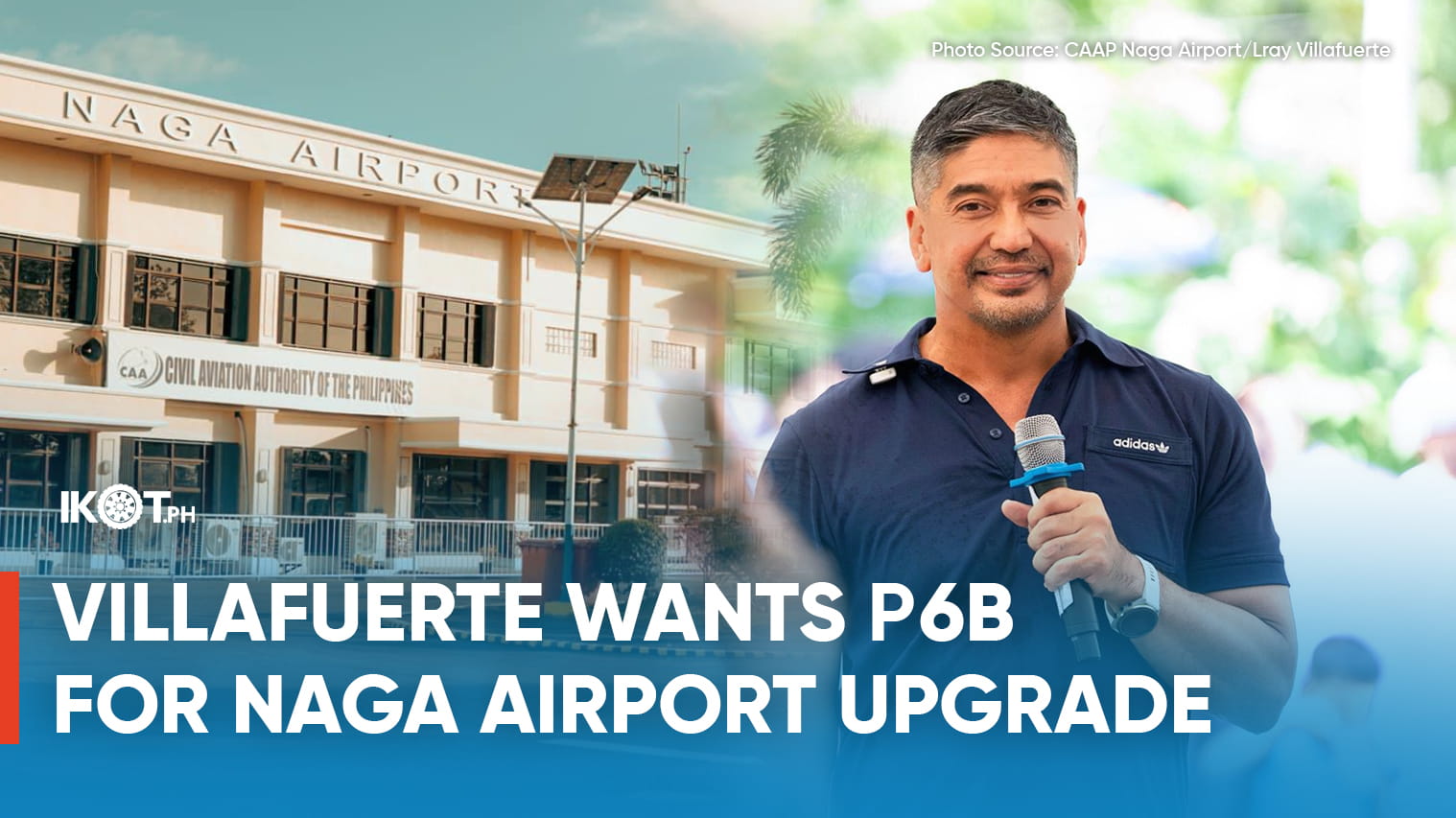
Camarines Sur (CamSur) Governor and National Unity Party (NUP) president LRay Villafuerte is calling for a three-year P6 billion plan to accelerate the long-overdue modernization of the Naga Airport to sustain—and even boost—the momentum of CamSur as one of the country’s economic, investment and tourism frontrunners.
Backdropped by the latest Department of Tourism (DOT) data proclaiming CamSur as the No. 1 tourist destination in Bicol, Villafuerte said: “Our province could cement its status as one of the country’s must-see places if the long-planned upgrade or expansion of the Naga Airport were to proceed at full speed in order to dramatically boost passenger capacity and tourist arrivals in, say, three years’ time.”
“For this to happen,” said Villafuerte, “the government needs to considerably augment the 2026 budget for airport improvements for the Naga airstrip to raise it about five times to P2 billion, and then set aside in the next NEPs (National Expenditure Programs or national budget plans) another P2 billion in 2027 and P2 billion more in 2028—or a total of P6 billion in three years to double the length of the runway to two (2) kilometers so it could start taking in the bigger passenger jets.”
“Unless the Naga Airport becomes modern and large enough to fly in and fly out passenger jets with 300or more seats per plane and that are used for international flights, there is simply no way for our province to charm and accommodate a far, far bigger number of both foreign and domestic tourists to go to our must-see places like the CWC (CamSur Watersports Complex) and Caramoan Islands,” Villafuerte, who is the League of Provinces of the Philippines (LPP) senior vice chairman for South Luzon, said.
In the meantime, Villafuerte appealed to the Department of Transportation and Communications (DOTr) and low-cost airline Cebu Pacific Air (Cebgo) to put off anew the plan to stop all the remaining turboprop flights at the Ninoy Aquino International Airport (NAIA) and transfer them to the Clark International Airport in Pampanga beginning March 29.
Villafuerte has been lobbying for the long-delayed modernization of the Naga Airport even when he was still a
This March 29 deadline, which will be the last leg of the two-year phaseout of turboprop operations to decongest NAIA, will mean that all turboprop flights of Cebgo in Coron (Palawan) and in Naga City and those of Cebgo-subsidiary Airswift in El Nido (Palawan) will, starting the day after, be taking off from or landing at the Clark airport.
With the current runway only 1.2 km long, Cebgo only uses in its Manila-Naga-Manila flights the turboprop Bombardier Q400 planes that each seat 50 to 90 passengers.
In contrast, jets like the wide body Airbus 300 planes, which are used in international flights and need longer runways to land or take off, can each accommodate 180 to 360 passengers per flight.
“CamSur might no longer be on the radar for many foreign or domestic tourists once the turboprop phaseout happens in end-March because the options—both exhausting—that will be left for visitors after March 29 are: [1] a two-hour land trip from Metro Manila to Clark in Pampanga and then a flight from Clark to Legazpi City in Albay and then a two-hour land trip from Albay to Naga City, or [2] a 10-hour land trip from Metro Manila to Naga City,” he said.
So, even if the government were to clear the accelerated expansion plan of P6 billion over three years, Villafuerte appealed to the DOTr and Cebgo to put the March 29 deadline on hold and let Naga Airport-NAIA turboflights continue after that—at least even if until the end of summer only.
Villafuerte said that prospective investors might even decide to reconsider plans to invest in CamSur once they can no longer fly directly from Metro Manila to Naga City because of the turboprop phaseout.
“This will just be too bad, considering that CamSur has emerged as one of the country’s formidable investment hubs,” Villafuerte said, “partly on the strength of its marvelous growth narrative as a province that has pole-vaulted from being among the country’s poorest over two decades ago to the current third richest and No. 2 revenue earner among all LGUs (local government units).”
He said that one of CamSur’s attractions as an investment hub, especially for global green or clean energy enterprises, is its status as the country’s emerging capital for renewables, especially in wind power.
At least 16 renewable energy (RE) projects are in the pipeline, according to a Department of Energy (DOE) report, with a combined generation capacity of over 7,668 megawatts (MW) of electricity.
Topping these RE projects is the offshore wind (OSW) farm that the Danish investor Copenhagen Infrastructure Partners (CIP) is putting up on San Miguel Bay for $3 billion and that is expected to create 2,500 jobs.
Now on its pre-development stage and set to start construction work soon, this CIP-funded windfarm will become the country’s biggest OSW project by the time it starts operation, hopefully by 2028.
The DOT reported this January that CamSur is the No. 1 tourist destination in Bicol
Villafuerte said that more investors are likely to set up shop in CamSur once the provincial government gets the go-ahead from the Philippine Economic Zone Authority (PEZA) for its special economic zone (SEZ) at the CamSur Uptown.
The 2026 national budget has a P7.8-billion outlay for the upgrade of 19 airports, of which P444.6 million is allotted for the Naga Airport.
The DOT reported 5.87 million inbound tourists in 2025, or 1.34% less than the 5.95 million arrivals in 2024, and just two-thirds of the record 8.3 million visitors recorded in 2019, prior to the pandemic.
Experts believe that the adoption of tourism-friendly policies like the refund of Value-Added Tax (VAT) payments of tourist-shoppers when they leave the Philippines, and an expansion of airport capacity will enable the Philippines to increase the number of inbound tourists.
The DOT reported this January that CamSur is the No. 1 tourist destination in Bicol.
On Villafuerte’s watch as three-term governor, CamSur became the top tourist destination in the Philippines in 2010 and 2012, according to a National Statistical Coordination Board (NSCB) report that used data from Department of Tourism (DOT) regional offices.
CamSur’s rise as a top must-see place in the 2010s happened on the strength of Villafuerte’s aggressive marketing push as governor for his province as an: (1) extreme sports capital with the establishment of the CWC—considered as the world’s best wakeboard park and the site of world-renowned sports events notably the Ironman Triathlon, which was held there for three consecutive years—and (2) ecotourism haven with Caramoan Islands and its famous white and pink sand beaches.
Caramoan has been the location of five international editions of the global reality TV show “Survivor” for 15 years running, boosting the local economy and providing jobs to thousands of CamSur folk.
In Resolution No. 3-61 s. 2025 issued last year, the Regional Development Council (RDC) for Region V, “urgently and strongly requested” the Department of Budget and Management (DBM) to restore the P1.2 billion proposed allocation for the Naga Airport Development Project (NADP) in the 2026 NEP.
Comprising the top LGU officials, regional directors of Departments and representatives of non-governmental organizations (NGOs) in Bicol, RDC V fretted in the resolution that the then-DOTr proposed NEP outlay of only P444 million for the NADP—from the original approved allocation of P1.6 billion “will further extend the project timeline to almost 20 years.”
“A national priority project for the Bicol region with the strong support of the Bicol RDC,” this lower DOTr allocation is, said the RDC-V resolution, “not aligned with the Presidential declaration of the NADP as a priority national project.”
Villafuerte, who had been lobbying for the long-delayed modernization of the Naga Airport even when he was still a congressman representing CamSur’s second legislative district, recalled that back in 2015, the Investment Coordination Committee (ICC) of the then-National Economic and Development Authority (NEDA) Board chaired by then-President Aquino already approved a budget of P1.636 billion for the modernization or expansion of the runway of the Naga Airport.
Resolution No. 2024-02 on the phased relocation of NAIA turboprop operations was issued in December 2024 by the DOTr-led Manila Slot Coordination Committee (MSCC), as a way to decongest NAIA, accommodate more passengers and maximize the use of secondary airports like the Clark airport.