
In support of the growing public clamor for greater transparency in the government procurement system, Deputy Minority Leader Luigi Villafuerte and Migz Villafuerte are seeking swift congressional approval of a measure prohibiting close relatives of public officials from acquiring government contracts.
With the people’s best interest and the protection of the general welfare in mind, Luigi and Migz are proposing an amendatory law to Republic Act (RA) No. 12009, or the “New Government Procurement Act, to strengthen mechanisms for state procurement, particularly in the areas of transparency, competitiveness, efficiency, proportionality, accountability, public monitoring, professionalization, sustainability, and value for money.
To reinforce existing policies and safeguard measures in government procurement, House Bill (HB) No. 5981 seeks to prohibit all relatives of public officials within the fourth civil degree of consanguinity or affinity from entering into any government contract.
Fourth degree of consanguinity or affinity covers spouses, children, parents, cousins, nephews, nieces, uncles, aunts, great aunts, great uncles, grand nephews, grand nieces, great-grandparents, great-great grandparents, great grandchildren and great-great grandchildren by virtue of blood relations or marriage.
Luigi said that under HB 5981, “The necessary IRR (implementing rules and regulations) of this Act shall be jointly promulgated by the GPPB (Government Procurement Policy Board), DILG (Department of the Interior and Local Government), PPP (Public Private Partnership) Center and GCGG (Governance Commission for Government-Owned or -Controlled Corporations or GOCCs), in consultation with the concerned government agencies.”
HB 5981 was written by the Villafuertes along with fellow Camarines Sur Rep. Tsuyoshi Anthony Horibata and Bicol Saro Rep. Terry Ridon.
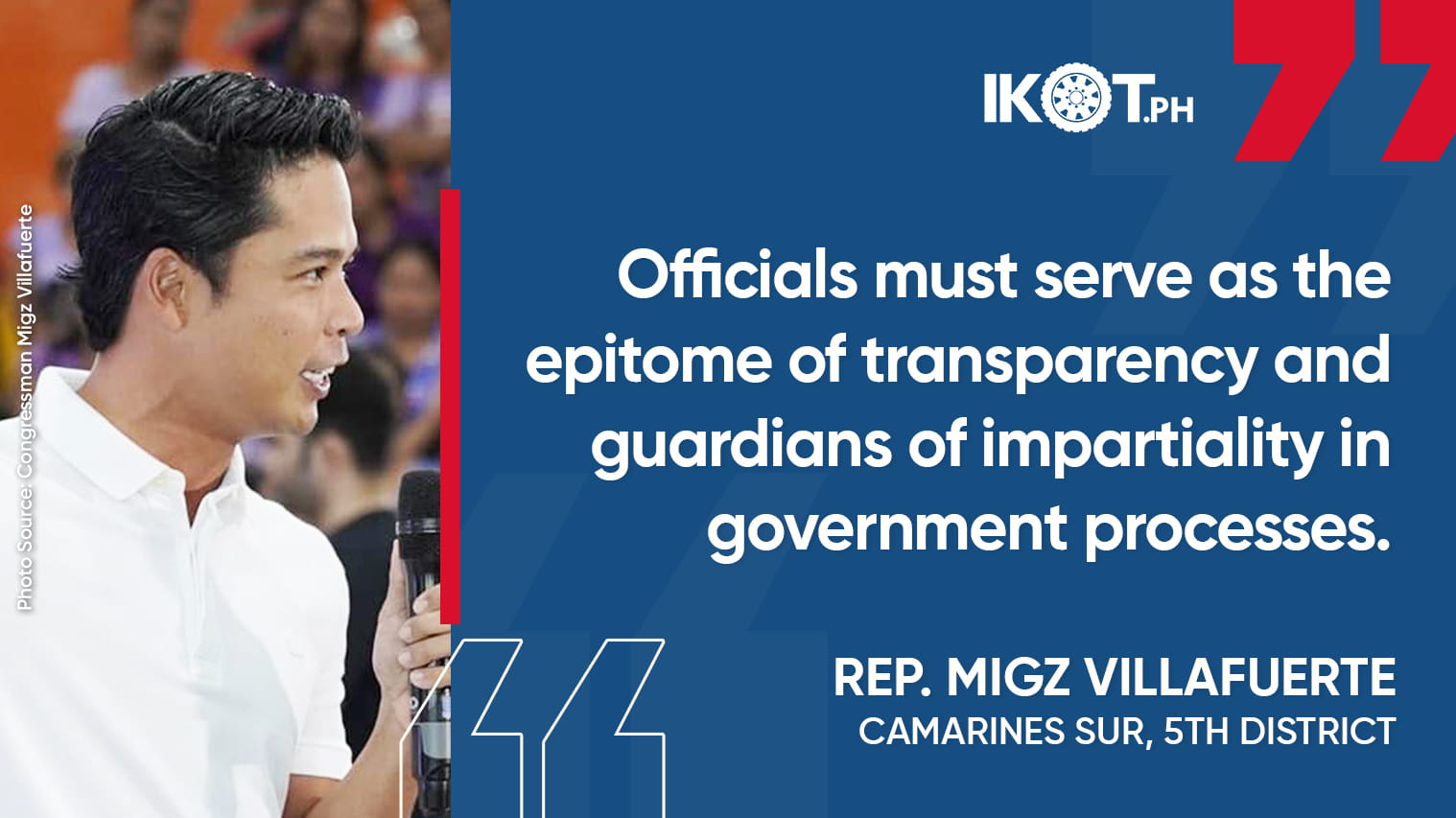
Migz, who chairs the House committee on information and communications technology (ICT), noted that, “Officials must serve as the epitome of transparency and guardians of impartiality in government processes, as Section 1, Article XI of the 1987 Constitution states that: ‘Public officers and employees must at all times be accountable to the people, serve them with utmost responsibility, integrity, loyalty, and efficiency, act with patriotism and justice, and lead modest lives.’”
The Villafuertes wrote HB 5981 with fellow CamSur Rep. Tsuyoshi Anthony Horibata and Bicol Saro Rep. Terry Ridon.
Section 1 of the bill on “Disqualification on the Basis of Relationship” states that, “Notwithstanding any provision of law to the contrary, all relatives of public officials within the fourth civil degree of consanguinity or affinity shall be barred from entering into any government contract.”
The bill defines “public official” as the heads of agencies, heads of procuring entities, members of governing boards, or public officers or employees exercising policy-determining, supervisory, or managerial functions, whether in the career or non-career service, including military and uniformed personnel, whether or not they receive compensation, regardless of amount.
The term “government contract” is defined, meanwhile, in the bill as “any contract between a private entity and any government agency or instrumentality, including GOCCs and local government units (LGUs), that pertains to: (a) supplies, materials, machinery, equipment, and services; (b) infrastructure projects; (c) joint ventures; and (d) PPP projects.”
Contracts also cover “(e) other similar or analogous agreements or undertakings to which the latter is the procuring party, partner, shareholder, implementing agency, end user, or a party contributing public funds or property: Provided, That, this shall exclude contracts that are highly technical, proprietary, or confidential in nature.”
The bill provides that within 60 days from the effectivity of this Act, the GPPB, DILG, PPP Center and GCG, in consultation with government agencies concerned, shall jointly promulgate the IRR necessary to effectively implement its provisions.