
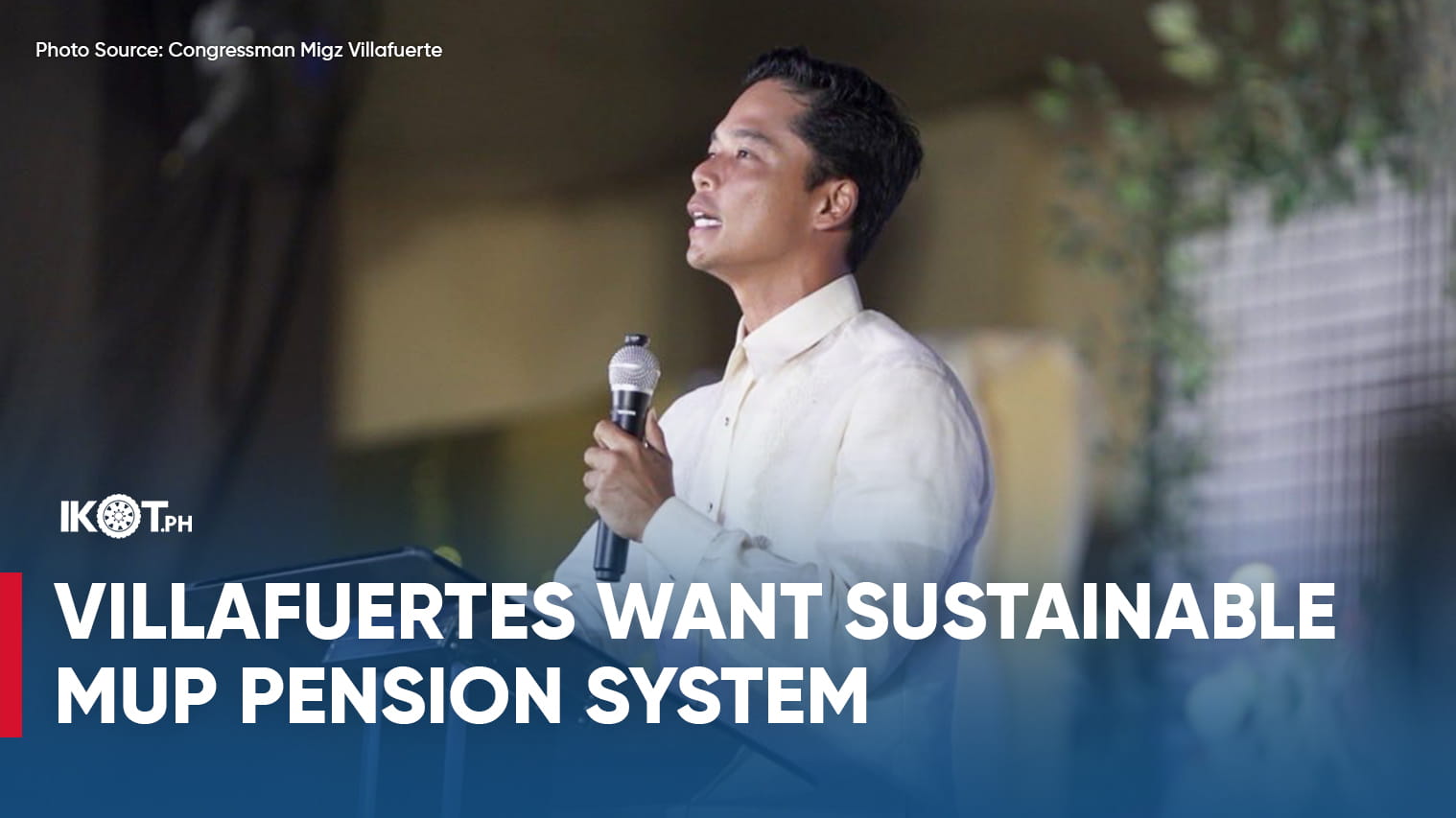
As Malacañan currently reviews the pension system of military and uniformed personnel (MUP), Camarines Sur representatives led by Migz Villafuerte and Luigi Villafuerte are proposing new legislation to establish a “sustainable, equitable and financially sound” annuity plan in place of the current one whose long-term sustainability is being doubted by no less than our country’s economic managers themselves.
Migz Villafuerte, who chairs the House committee on information and communications technology (ICT), and Luigi Villafuerte, a deputy majority leader, said the ongoing Palace review of the non-contributory pension system for MUP should set the stage for an overhaul of the current one that would decisively address concerns over its long-term sustainability in the face of the government’s fiscal constraints.
“There is an urgency for the current Congress to write new legislation on a sustainable, equitable and financially sound annuity system for our MUP pensioners in recognition of their invaluable contribution as our frontliners in national defense, peace and order, public safety and disaster response,” Migz said.
Luigi said, meanwhile, that, “The congressional approval of such a pension bill would be a most fitting contribution of the 20th Congress to the Marcos administration’s fresh effort to bump up the living standards of our MUP, given the President’s issuance last year of Executive Order (EO) No. 107 that upgraded the base pay schedule and subsistence allowance of our military and uniformed personnel.”
In EO 107 that was signed by Mr. Marcos last December, the updated MUP base pay schedule will be carried out in three tranches—with the first one started last Jan. 1; the second on Jan. 1, 2027; and the third and last one on Jan.1 2028.
The proposed MUP pension plan is part of the priority legislative agenda that President Marcos drew up last September with the Legislative-Executive Development Advisory Council (LEDAC).
EO 107 also raised the subsistence allowance of MUPs to P350, from P150.
Acting Secretary Rolando Toledo of the Department of Budget and Management (DBM) said recently that the President’s economic team is currently studying MUP pension reforms in compliance with EO 107, which provided for a 15%-hike base pay of MUP, for implementation in three tranches in 2026, 2027 and 2028.
This EO 107-ordered increase in the base pay of MUP will consequently raise the pension received by about 200,000 pensioners, given that this monthly annuity is, under the law, indexed automatically to the salaries of active personnel.
As a result, said Toledo, the inter-agency technical working group (IATWG) created under EO 107 is now doing a comprehensive review of the current MUP pension system, in a bid to come up with a “sustainable and equitable pension system.”
The IATWG, which is composed of representatives from the DBM, Department of Finance (DOF), Bureau of Treasury (BOT) and Government Service Insurance System (GSIS), is also tasked to draw up a draft bill based on the outcome of its ongoing review, and which shall be submitted to the Office of the President (OP) before the 20th Congress reopens in July for its second regular session.
Under the 2026 General Appropriations Act (GAA), the Marcos administration has allotted over P145 billion for the pension payments of MUP and veterans.
Under the current MUP annuity system, our soldiers and other uniformed personnel do not contribute to their pension plan, and their benefits are sourced from the GAA.
When Monetary Board (MB) member Benjamin Diokno was still DOF secretary, he had proposed reforms to the MUP pension system, believing that the current one was not fiscally tenable and could lead to a potential fiscal crisis.
As the Villafuertes supported the pay hike of MUP as ordered by the President in EO 107, they said that the 20th Congress can enlarge the current efforts to bump up the living standards of our frontliners in defense and public safety by way of new legislation to establish a “sustainable, equitable and financially sound” annuity plan for them.
Although the House of Representatives had previously passed an MUP pension bill in the 19th Congress, Migz and Luigi said that it stalled following the Senate’s failure to pass a counterpart measure.
MUP are the members of the Armed Forces of the Philippines (AFP); Philippine National Police (PNP); Philippine Coast Guard (PCG); Bureaus of Fire Protection (BFP), of Jail Management and Penology (BJMP), and of Corrections (BuCor); and the commissioned officers of the Hydrography Branch of the National Mapping and Resource Information Authority (NAMRIA).
This proposed MUP pension plan is part of the priority legislative agenda that President Marcos drew up last September with the Legislative-Executive Development Advisory Council (LEDAC).
The House of Representatives had already approved 12 of the 48 priority bills drawn up last year by the President with LEDAC.
Migz and Luigi Villafuerte had co-authored 24 of these 48 House-approved LEDAC priority bills.
The Villafuertes said that they had introduced HB 1550, which is otherwise known as the “Military and Uniformed Personnel Pension System Act,” with fellow Camarines Sur Rep. Tsuyoshi Anthony Horibata and Bicol Saro Rep. Terry Ridon.
For those who entered the active service prior to the effectivity of this Act, the bill provides that the monthly retirement pay shall be 50% of the base pay and longevity pay of the grade next higher than the permanent grade last held by the personnel in case of 20 years in active service, increasing by 2.5% for every year of active service rendered beyond 20 years to a maximum of 90% for 36 years of active service and over.
For new entrants to the MUP service, the monthly retirement pay shall be 50% of the base pay and longevity pay of the permanent grade last held by the personnel in case of 20 years in active service, increasing by 2.5% for every year of active service rendered beyond 20 years to a maximum of 90% for 36 years of active service and over.
Upon retirement, an MUP shall choose between the following modes of payment of retirement benefits:
· Lump Sum – Received in advance and in one lump sum, retirement benefits equivalent to 36 months; and 3 years thereafter, received monthly retirement benefits as they accrue; or
· Direct Pension – Received monthly retirement benefits as they accrue.
The retirement pay of an MUP who is killed-in-action or wounded-in-action resulting in total permanent disability, as duly certified by the appropriate medical certification process of the respective services, is computed at the rate of 90% of the monthly base and longevity pay of the retirement grade of the personnel regardless of years in active service.
For new entrants, the monthly retirement pay shall be 50% of the base pay and longevity pay of the permanent grade last held by the personnel in case of 20 years in active service, increasing by 2.5% for every year of active service rendered beyond 20 years to a maximum of 90% for 36 years of active service and over.
An MUP who separates or resigns from the service without reaching 20 years of satisfactory active service shall receive a separation pay equivalent to one month’s base pay plus longevity pay of the permanent grade that the MUP holds at the time of separation for every year of active service.
Before reaching retirement age, MUP members may, under HB 1550, voluntarily retire upon accumulation of at least 20 years of satisfactory active service, subject to the approval of the appropriate authority.
The President of the Philippines is authorized under the bill to, upon the recommendation of the MUP Trust Fund Committee, and subject to consultation with the Senate President and Speaker, to adjust the pension and survivorship pension at a rate lower than the adjustment prescribed herein owing to adverse fiscal or economic conditions, as certified by the Development Budget Coordination Committee (DBCC).
To establish a sustainable and financially sound MUP pension system, HB 1550 seeks to:
· Guarantee a three percent (3%) annual salary increase in the base pay of active MUP for the first 10 years;
· Amend the compulsory retirement age from 56 to 57 years old.
· Create two trust funds for AFP and MUP members, which will serve as budgetary support for separation and retirement benefits, including the payment of retirement pay, separation pay, and assistance to indigent pensioners;
· Establish the funding sources of these two trust funds;
· Specify the computation for mandatory contributions and retirement benefits.:
· Exempt both trust funds from the payment of taxes and lay down processes of its asset and revenue management and disposition;
· Establish the MUP Trust Fund Committee, which shall be responsible in ensuring the fiscal sustainability of the trust funds;
· Designate the Government Service Insurance System (GSIS) as the fund manager and benefits administrator; and
· Allocate P50 million pesos as funding for the operations of the MUP Trust Fund Secretariat.
In effect, HB 1550 seeks to amend certain provisions of Republic Act (RA) No. 11709, specifically the provisions related to compulsory and optional retirement age.
RA 11939 was enacted in 2023 to further strengthen professionalism and promote the continuity policies and modernization initiative in the AFP.
Before reaching retirement age, MUP members may, under HB 1550, voluntarily retire upon accumulation of at least 20 years of satisfactory active service, subject to the approval of the appropriate authority.
The bill provides for the compulsory retirement of MUP with total permanent disability as a result of injuries suffered or sickness contracted in the performance of duty—as duly certified by the appropriate medical certification process of the respective services, that the extent of the disability or sickness renders them unfit or unable to further perform the duties of their positions.
To ensure that fiscal risks related to the MUP pension system are managed and addressed, the bill creates an MUP Trust Fund Committee, to formulate policies, consistent with law, to ensure the fiscal sustainability of the pension and propose appropriate policy interventions.
The two trust funds to be set up by HB 1550 are the: (1) AFP Trust Fund for the budgetary support of separation and retirement benefits of the AFP, and (2) Uniformed Personnel Services Trust Fund for the budgetary support of separation and retirement benefits of the uniformed personnel.
These trust funds shall be funded through the following:
· Capitalization – Such sums as may be necessary to capitalize and sustain the fund as determined by the Committee shall be appropriated and released to the Funds;
· Mandatory Contributions. – New entrants shall contribute 9% of their monthly compensation as personal share, and the National Government shall provide 12% as its share; and
· Additional Sources of Funding – The trust funds may be augmented from the unprogrammed appropriations and proceeds derived from the lease, joint development, auction of development rights, or disposition of government properties identified for the purpose, investment income from the MUP trust funds identified and administered by the fund manager subject to actuarial validation, and savings of the National Government, provided that the proceeds from the disposition of assets of the MUP service shall inure exclusively to its personnel.
For the AFP Trust Fund, additional funds may be sourced from the proceeds of the following: (1) Residual assets and funds of the AFP retirement separation benefits system; (2) Sale of military reservations, as may be authorized by the Congress, pursuant to the provisions of existing laws and regulations governing sales of government properties; and (3) Lease or joint development of military reservations, as may be authorized by the President.
Additional funds may be sourced, too, from: (4) Income derived from public-private partnerships (PPPs) entered into by the Department of National Defense (DND) or the AFP, as may be authorized by the President, pursuant to the provisions of existing laws and regulations; and (5) Non-strategic real estate assets of the DND or the AFP as determined by the DND Secretary.