
Amid the series of double-digit fuel price hikes, Parañaque 2nd District Representative Brian Raymund Yamsuan has proposed the establishment of a regular, continuing government program that would provide targeted financial aid to qualified beneficiaries in the farm and fisheries, and transport sectors.
Yamsuan filed House Bill (HB) 8340 which aims to set up a comprehensive fuel subsidy program for public transport workers, municipal fisherfolk, small farmers and agricultural producers, and other low-income sectors whose means of livelihood are threatened by increases in the prices of petroleum products.
Solidifying his support for the grant of special powers to the President to enable the government to cushion the impact of the oil price shock on consumers, Yamsuan also filed HB 8339 which aims to clothe the Chief Executive with the authority to reduce or suspend the excise tax on petroleum products during national or global economic emergencies. Under the bill, this power can only be exercised upon the recommendation of the Secretaries of Finance, and of Energy.
Yamsuan has proposed under the bill that recipients of the fuel subsidy program be registered to existing government registries to ensure that the aid reaches the target beneficiaries.
Yamsuan said these measures, along with his recommendation to allow the temporary shift to work-from home setups and online classes, comprise his proposed three-pronged approach to soften the impact on the economy and the public of the global oil price disruption triggered by the Middle East conflict.
The Parañaque lawmaker said his proposal to institutionalize a fuel subsidy program for sectors vulnerable to oil price increases would ensure that the government has a stable mechanism to support them rather than responding to every crisis “on an ad hoc basis.”
Under the proposed fuel subsidy program, cash aid of not less than P7,000 per month would be given to each qualified beneficiary. The funds for the program shall be included in the annual General Appropriations Act under the respective budgets of the Department of Energy (DOE), Department of Transportation (DOTr), Department of Agriculture (DA) and the Department of Social Welfare and Development (DSWD).
“Several measures have been filed in Congress seeking to provide fuel subsidies to specific sectors, such as fisherfolk and farmers, and separate proposals focused solely on public transport drivers. This bill builds upon these efforts by integrating them into a single, comprehensive program that covers all sectors whose livelihoods are directly dependent on fuel,” Yamsuan said.
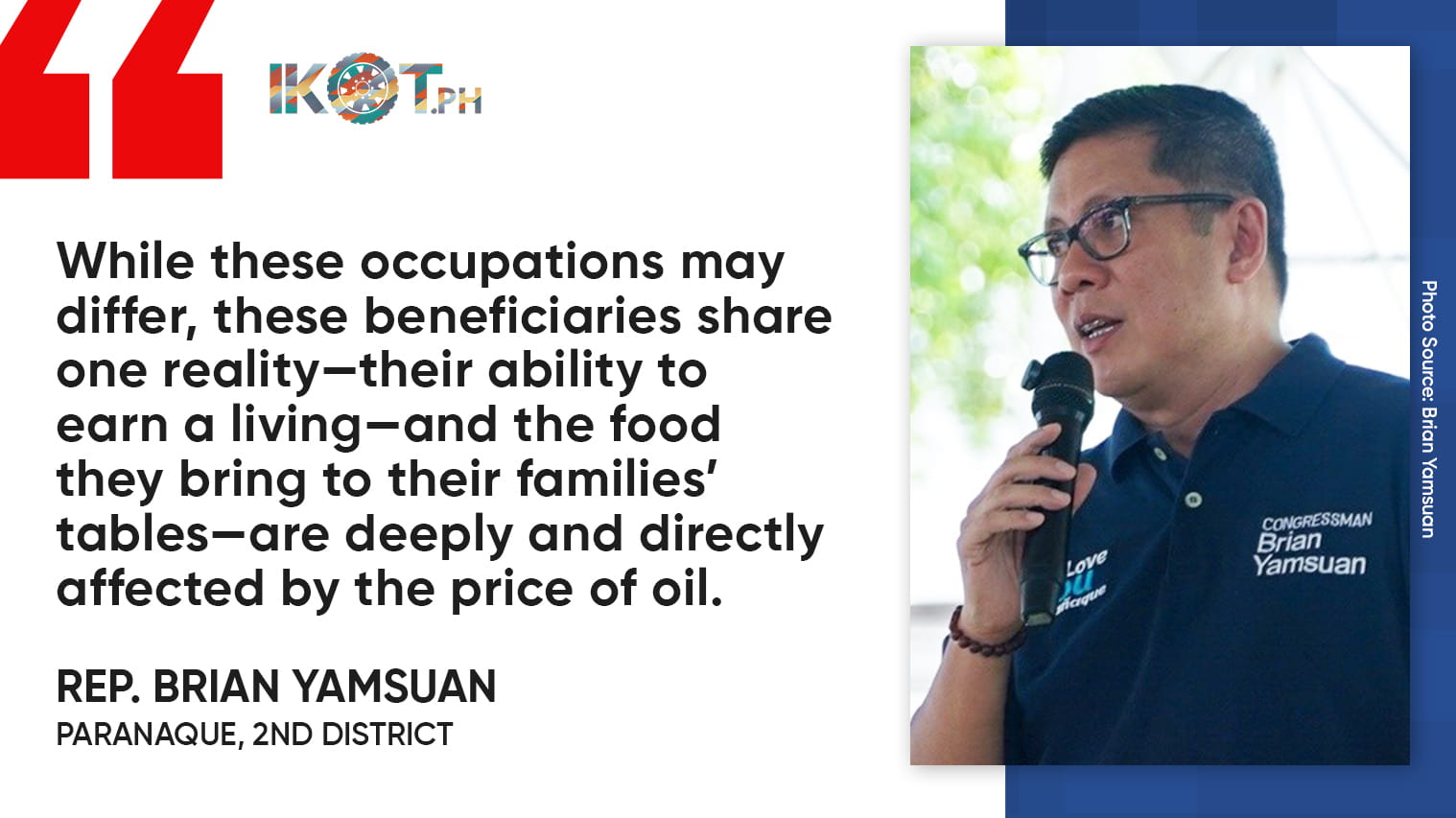
“While these occupations may differ, these beneficiaries share one reality—their ability to earn a living—and the food they bring to their families’ tables—are deeply and directly affected by the price of oil,” added Yamsuan, who is a vice chairperson of the House Committee on Transportation and former chairperson of the House Committee on Aquaculture and Fisheries Resources.
Yamsuan has proposed under the bill that recipients of the fuel subsidy program be registered to existing government registries to ensure that the aid reaches the target beneficiaries.
These include the database of the Land Transportation Franchising and Regulatory Board (LTFRB), the Municipal Fisherfolk Registration System, the boat registry of the Bureau of Fisheries and Aquatic Resources ((BFAR) and the Registry System for Basic Sectors in Agriculture (RSBSA).
“In this way, we would also be able to streamline the distribution of the aid, strengthen our sectoral databases, and encourage others who should benefit from the subsidy but have not yet been captured by the system to register,” Yamsuan said.
Yamsuan pointed out that these subsidies are not mere ‘ayuda’ or doleouts but are necessary to help tame inflation resulting from sudden spikes in fuel prices.
“Studies done in the agriculture and fisheries sector show that subsidies, which reduce the cost of production inputs, enable small producers to sustain operations during price shocks, and maintain supply levels that help stabilize the prices of food and other basic commodities,” Yamsuan said.
“In our country, sustaining the operations of farmers, fisherfolk and drivers grappling with skyrocketing fuel prices will ensure that essential activities–from food distribution to daily commuting—are not disrupted,” Yamsuan said.
The bill provides for the creation of an Advisory Council chaired by the Secretary of Transportation to review and adjust the amount of the cash subsidies whenever necessary.