
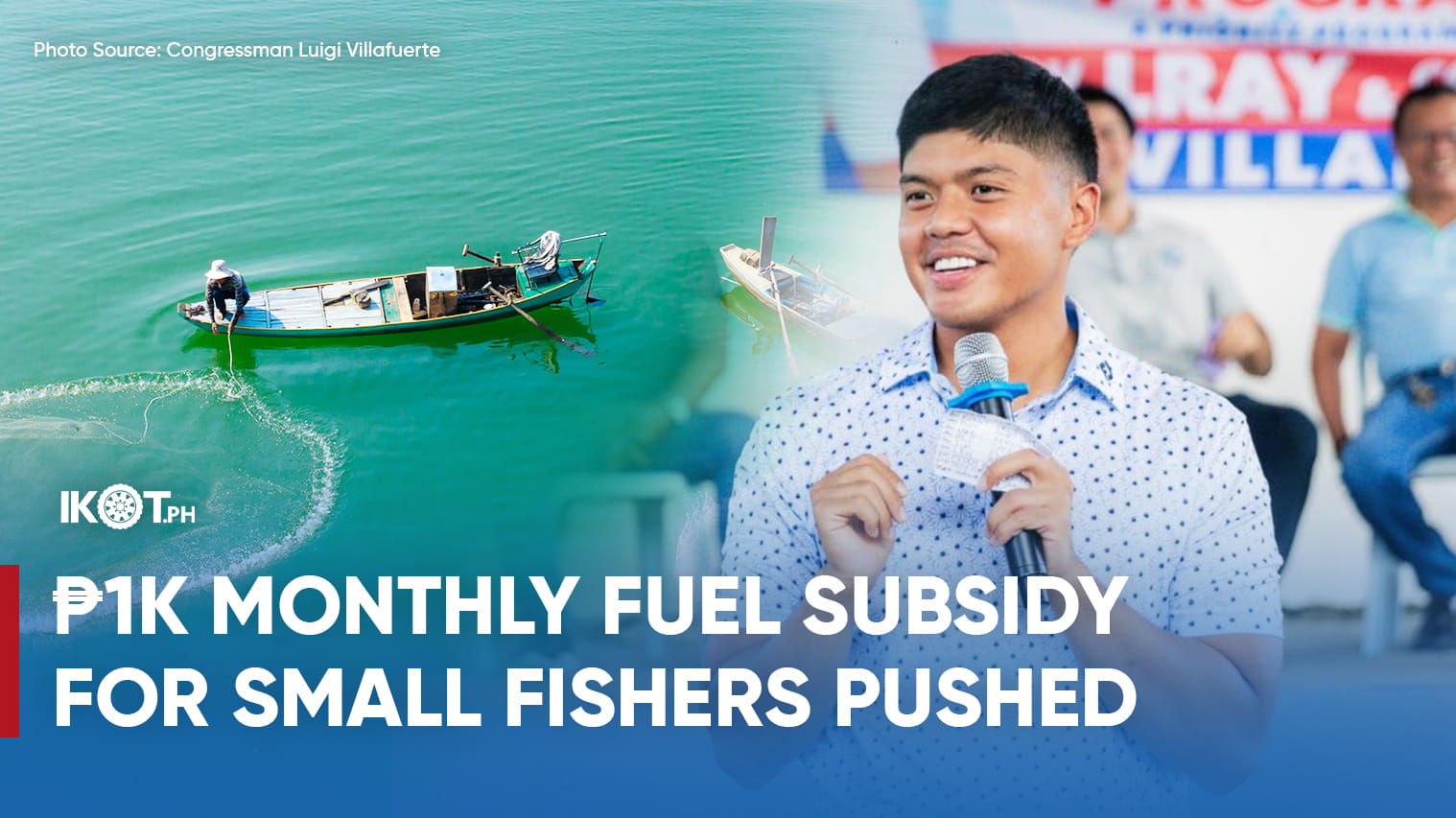
With small fishers weighed down by fast shrinking incomes amid incessantly rising fuel costs and declining fish catch, Camarines Sur Reps. Luigi Villafuerte and Migz Villafuerte see a compelling reason for the Congress to legislate a program providing a monthly fuel subsidy of ₱1,000 to municipal fisherfolk plus their automatic enrollment in the National Health Insurance Program (NHIP).
Although belonging to a sector that is a major contributor to the domestic economy, our fisherfolk are, paradoxically, among the poorest Filipinos as they earn as low as ₱90 to ₱130 each at the end of a day’s fishing, according to the Villafuertes who are pushing the congressional approval of their bill on a proposed subsidy program dubbed “Pantawid Pambangka Program.”
“This proposed Pantawid Pambangka Program is intended to help defray these fisherfolk’s fuel expenses, which eat up as much as 60% to 80% of the daily income they earn from their fish catch,” Luigi, a deputy majority floor leader, said.
Alongside monthly fuel subsidies, Luigi said the proposed subsidy program, as contained in House Bill (HB) No. 3388, also seeks to automatically enroll fisher-beneficiaries in the NHIP of the Philippine Health Insurance Corp. (PhilHealth) to help defray their medical expenses in the face of their meager earnings from fishing.
Rep. Migz Villafuerte said that under the bill, the monthly subsidy of ₱1,000 shall be administered by the Department of Agriculture (DA), and that this amount shall be revised every year to account for inflation.
Migz, who chairs the House committee on information and communications technology (ICT), said that HB 3388 also requires the Social Security System (SSS) to provide micro-insurance mechanisms to fisherfolk who are beneficiaries of this subsidy program.
The Villafuertes said this proposal is in sync with the advocacy of Speaker Faustino Dy III for a wide range of financial assistance and other immediate support systems for Filipino farmers and fisherfolk to ensure long-term stability in the agricultural and fisheries sector.
These CamSur solons pointed out that in a joint hearing in 2025 of the House committees on agriculture and food and on ways and means, Dy had called for “faster, simpler, and more inclusive financial support systems” for Filipino rural folk to ensure long-term stability in this sector.
HB 3388 was likewise authored by fellow CamSur Rep. Tsuyoshi Anthony Horibata and Bicol Saro Rep. Terry Ridon.
The Villafuertes pointed out that with the constant rise in diesel prices, the fuel expenses of small Filipino fishers now account for as high as 80% of their total fishing expenses, forcing them to cut back on the time and days they spend at sea to save on their production costs, which, in turn, lead to their lower earnings.
Since January to mid-February alone, the pump prices of diesel have gone up for eight successive weeks for a total increase of over ₱7 per liter, as geopolitical tensions, notably the conflict between the United States and the European Union (EU) over American President Trump’s interest in Greenland, the US-Iran conflict and supply disruptions in the Strait of Hormuz, have resulted to upward price movements in petroleum products.
With the high cost of fuel, small-scale fishers reportedly spend P800 to P1,000 on diesel per fishing trip, forcing them to earn as low as P300 to P500 when their fish catch is low.
To save on fuel costs, small fisherfolk either cut their fishing trips from 6-8 hours down to 4-5 hours, limit their trips from 5-6 days per week to only 3-4 days, or look for alternative livelihoods.
Luigi and Migz Villafuerte explained that HB 3388 aims “to provide our municipal fisherfolk a fuel subsidy in the form of a voucher in the amount of P1,000 per month for each eligible beneficiary to not only empower our fisherfolk sector with their livelihood, but to likewise aid them, given the vulnerability of their sector.”
This proposal is in sync with the advocacy of Speaker Faustino Dy III for a wide range of financial assistance and other immediate support systems for Filipino farmers and fisherfolk.
“Our fishing sector is considered as having among the poorest Filipinos—despite this sector being one of the major contributors to our economy, contributing 1.3% to 1.5% to the country’s GDP (Gross Domestic Product) and food security—due to low income,” they said.
Citing Bureau of Fisheries and Aquatic Resources (BFAR) data, they said there were 2,302,648 registered fisherfolk in the Philippines as of 2022, and whose daily income per fishing boat was around P272, which is even divided among the two or three persons who man each boat.
Luigi said that, “With the increasing rate of fuel, our fisherfolk are considerably affected because they rely heavily on fuel to ensure they are able to fish even in faraway fishing grounds because of the depletion of nearby fishing grounds.”
“About 80% of their income goes to their fuel expenses, leaving them with a minimal take home pay,” Luigi said, “hence the importance of introducing regular fuel subsidies for them.”
Migz said that under the bill, the monthly subsidy of ₱1,000 shall be administered by the Department of Agriculture (DA), and that this amount shall be revised every year to account for inflation.
The program beneficiaries shall be municipal fisherfolk who fish within municipal waters, whether coastal or inland, and who use motorized fishing vessels of three (3) gross tons or less.
For municipal fisherfolk to become program beneficiaries, they must first register under the National Program for Municipal Fisherfolk Registration of the DA-attached Bureau of Fisheries and Aquatic Resources (BFAR).
To fund the subsidies, the bill provides that the equivalent of 10% of any increase in the government’s collections of fuel excise taxes shall be earmarked for the implementation of this program.