The Bureau of Internal Revenue (BIR), together with the Korea International Cooperation Agency (KOICA), marked the completion of the Electronic Invoicing and Sales Reporting System (EIS) Post Management Support Project and the formal turnover of the enhanced EIS during a Recognition and Transition Ceremony held at the BIR National Office, Quezon City.
The ceremony was led by BIR Commissioner Charlito Martin Mendoza together with Ambassador of the Republic of Korea to the Philippines Lee Sang-hwa, Department of Finance (DOF) Undersecretary Rolando Ligon, Jr., and KOICA Philippines Country Director Jung Youngsun.
The event recognized the successful completion of the 14-month technical assistance project implemented by KOICA through JNH Consulting Co., Ltd., which focused on upgrading system functionalities, addressing critical operational gaps in the system, and strengthening the technical capability of BIR personnel.
In a recorded video message, Finance Secretary Frederick Go underscored the significance of the project in advancing the government’s digital transformation agenda.
“By contributing to the development of our tax systems, doing business in the Philippines is becoming easier, more cost-efficient, and more predictable for all.”
“The EIS Post Management Support Project is proof of our steadfast commitment to modernizing our tax administration. By contributing to the development of our tax systems, doing business in the Philippines is becoming easier, more cost-efficient, and more predictable for all,” Go said.
The finance chief also expressed the government’s gratitude to the Republic of Korea and its implementing partners for helping strengthen the country’s tax systems and build the institutional capability needed to sustain them, emphasizing the enduring value of international cooperation in delivering better public service.
The finance head also expressed the government’s gratitude to the Republic of Korea and its implementing partners for helping strengthen the country’s tax systems and build the institutional capability needed to sustain them, emphasizing the enduring value of international cooperation in delivering better public service.
Mendoza said the project’s greatest accomplishment is not only the enhancements made to the EIS, but the capability it developed within the Bureau to independently sustain, operate, and further improve the system.
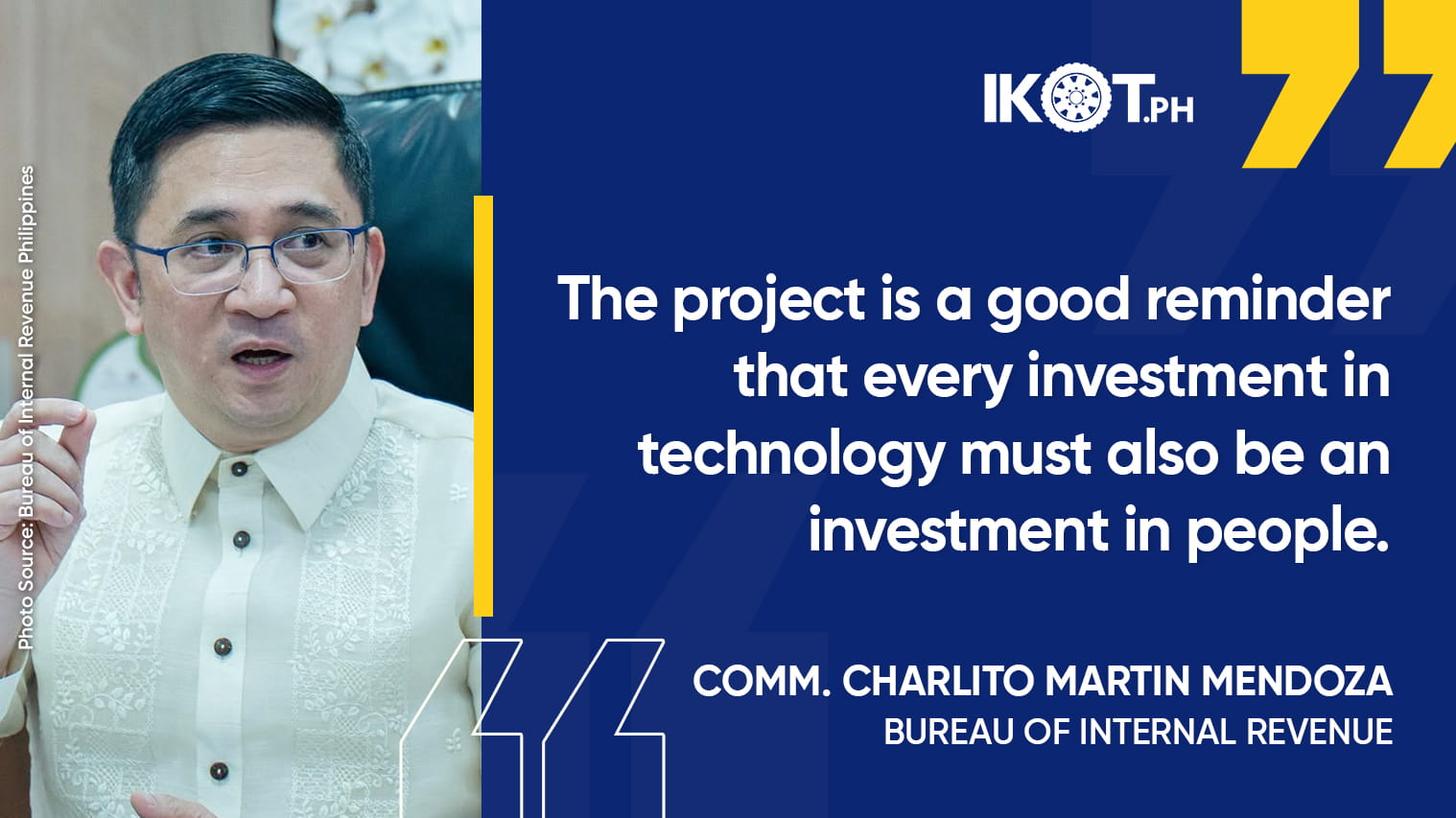
“Under our BIR DARES reform agenda, Digital and Data Transformation has always meant strengthening both our systems and our people. This project is a good reminder that every investment in technology must also be an investment in people,” he said.
In his keynote, Ligon said that while the core EIS was successfully implemented and turned over to the BIR in 2022, the July 7 ceremony marked the completion of the Post Management Support Project that began in May 2025.
“Our teams are now fully equipped to sustain and maximize this system independently. As this project is formally turned over to the Bureau, we do so with complete confidence that the BIR will build on these operational gains to advance its long-term digital transformation,” he said.
KOICA Philippines Country Director Jung Youngsun highlighted the project’s tangible improvements to tax administration, particularly through automatic invoice matching and validation, which significantly enhance the VAT refund investigation process.
Youngsun added that the enhanced EIS also strengthens statistical reporting and complements the Internal Revenue Integrated System (IRIS), enabling faster, more accurate, and more efficient tax administration.
“As we conclude this project, our focus now turns to maximizing the value and sustainability of the EIS. With our Philippine partners’ strong leadership and improved technical capacity, we are confident that the EIS will continue to evolve and deliver even greater value in the years ahead,” he added.
Ambassador Lee Sang-hwa said the EIS reflects the deepening partnership between the Republic of Korea and the Philippines to advance innovation, strengthen governance, and promote inclusive economic growth.
The Ambassador noted that it also serves as a concrete follow-through to the Republic of Korea–Philippines Bilateral Summit held in March 2026 and supports continuing efforts to address the investment-related concerns of Korean companies operating in the country.
“By contributing to the development of our tax systems, doing business in the Philippines is becoming easier, more cost-efficient, and more predictable for all.”
“As the BIR continues to be an essential partner of Korean companies operating in the Philippines, as well as the Korean community at large, I commend Commissioner Mendoza’s able leadership for paying close attention to their concerns, helping address practical difficulties, and successfully balancing effective revenue collection with a fair, transparent, and taxpayer-focused tax administration system,” Lee said.
Also present during the ceremony were Deputy Commissioners Ma. Rosario Charo Enriquez-Curiba, Vener Baquiran, Larry Barcelo, Marissa Cabreros, and Teresita Angeles, together with officials and representatives of the BIR, DOF, the Embassy of the Republic of Korea, KOICA, and JNH Consulting Co., Ltd.