
With the fast-track modernization of the Armed Forces of the Philippines (AFP) and Philippine Coast Guard (PCG) gaining traction among Filipinos, Deputy Majority Leader Luigi Villafuerte is hoping that the 20th Congress would take action in its Second Regular Session on twin proposals to beef up our military’s defense capabilities in the face of increasing national security threats, including the nonstop Chinese incursions in the West Philippine Sea (WPS).
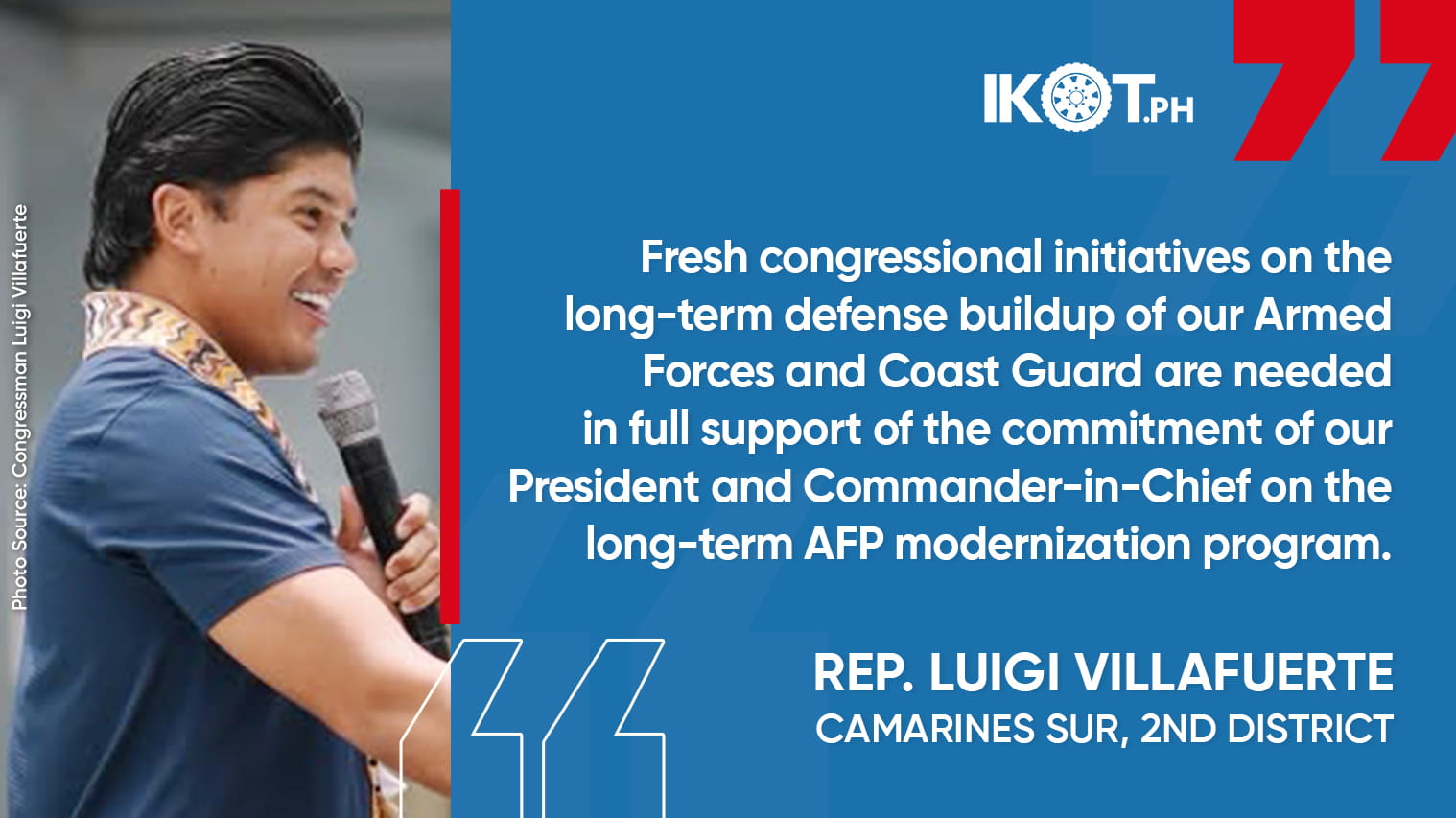
Villafuerte said that, “Fresh congressional initiatives on the long-term defense buildup of our Armed Forces and Coast Guard are needed in full support of the commitment of our President and Commander-in-Chief on the long-term AFP modernization program, more so in light of increasing national security threats, including the incessant tensions in the WPS.”
These twin proposals comprise the allocation of a combined P15 billion for the: (1) rehabilitation of our old yet still operational aircraft, and (2) acquisition plus subsequent manufacture of UAS (unmanned aerial systems) or drones, he said.
Villafuerte said that a survey by the Social Weather Stations (SWS) showed that 45% of Filipinos support the modernization of the AFP and PCG as a priority task to protect our country’s maritime borders.
Conducted over the June 20-29 period among 1,200 respondents, this SWS survey showed that the government’s modernization efforts has the backing of 47% of respondents in Luzon, 46% in Metro Manila, 44% in the Visayas, and 39% in Mindanao.
Also, 64% of respondents of a Pulse Asia poll also support the modernization of the military to protect Philippine territory.
Villafuerte said that a survey by the Social Weather Stations (SWS) showed that 45% of Filipinos support the modernization of the AFP and PCG as a priority task to protect our country’s maritime borders
“It is our hope that our Commander-in-Chief would also consider supporting these two pending bills on recommissioning old yet operational helicopters plus other aircraft, and acquiring, and later on building our own, drones for surveillance, reconnaissance, combat and disaster-response, among others,” Villafuerte said.
He said these are the complementary House Bill (HB) No. 1362 and HB 1363, which, he hoped, would be given priority action by the 20th Congress in its Second Regular Session.
The Congress adjourned sine die last June 3 and reopened last July 27 following the fifth State of the Nation Address (SONA) of the President.
HB 1362 proposes the establishment of the Philippine Unmanned Aerial System Program (PUASP) and Strategic Defense Technology Transfer Program (SDTTP) for “the acquisition of surveillance, reconnaissance, combat, disaster-response and medical evacuation (medevac) drones, and the establishment of an R&D (research and development) program to enable the Philippines to build its own UAS ecosystem in the long run.”
Villafuerte said that HB 1362 sets aside an initial P10 billion for acquiring and, later on, building our own drones not only for fighting terrorism, insurgency and other crimes, but also for disaster response, environmental protection, and border patrol and search-and-rescue missions.
HB 1363 proposes, meanwhile, the creation by the Department of National Defense (DND) of a Military Air Asset Rehabilitation Program (MAARP) to conduct technical inspection and feasibility analysis of old helicopters and other available military aircraft for possible recommissioning.
The DND is tasked under this bill to conduct, with the AFP, a full inventory of all decommissioned aircraft in military storage nationwide, he said.
Also, HB 1363 allocates an initial amount of P5 billion for this recommissioning program, to be sourced from the unprogrammed funds of the national budget or other available funding sources.
Otherwise known as the “National Defense Drone Act,” HB 1362 seeks the establishment of the PUASP to oversee the acquisition of drones, deployment of such unmanned vehicles, inter-agency usage protocols, data security compliance and training of drone operators and technicians.
By way of the PUASP, Villafuerte likewise wants the military to pursue R&D activities with local universities and colleges as well as tech start-ups to spur the local manufacture and maintenance of drones.
These twin proposals comprise the allocation of a combined P15 billion for the: (1) rehabilitation of old yet still operational aircraft, and (2) acquisition plus subsequent
Also, HB 1362 proposes the establishment of the SDTTP, as a complement to the PUASP, to provide tax incentives to the private sector to engage in drone development, as a way to encourage local innovation and reduce long-term costs for this drone acquisition program.
Drones are unmanned aircraft that are operated remotely by pilots from a well calculated distance to oversee a wide range of landscape, seascape, riverscape and cityscape, amongst others, for purposes of aerial photography and aerial videography, surveillance and security, search and rescue, delivery of goods and services, monitoring of climate change and other environmental changes, and military operations.
The HB 1362-proposed P10-billion initial outlay shall be allocated for both PUASP and SDTTP, and to be sourced from the national budget and/or AFP modernization fund, and subsequently, with additional funding through the annual General Appropriations Act (GAA) written yearly by the Congress.
As for HB 1363, or the “Military Air Asset Rehabilitation and Modernization Act,” he said this bill tasks the DND to initiate a Military Air Asset Rehabilitation Program (MAARP) to conduct technical inspection and feasibility analysis of available aircraft for possible recommissioning, and conduct, with the AFP, a full inventory of all decommissioned aircraft in military storage nationwide, within 90 days from the effectivity of this Act.
HB 1363 allocates an initial amount of P5 billion for this recommissioning program, to be sourced from the unprogrammed funds of the national budget or other available funding sources, while subsequent funding shall be included in the annual GAA.
According to the European Union Aviation Safety Agency (EASA), the average lifespan of an aircraft is around 25 to 40 years, depending on the kind of aircraft, Villafuerte said.
“Aircraft are eventually considered to be decommissioned for safety reasons and also for economic reasons, because, just like every vehicle, aircraft depreciate and lead to an increase in maintenance costs,” he said. “Moreover, newer and more efficient models become available to the military.”
As the State’s cost-effective strategy, Villafuerte said, “HB 1363 aims to recommission old yet operational aircrafts to meet the military’s operational demands without compromising our major capital outlay.”
“Considering the current issue on the West Philippine Sea, recommissioning decommissioned aircrafts will help increase our military and territorial presence in the contested Philippine waters and better prepare our AFP for future and possible military operations,” he said.