
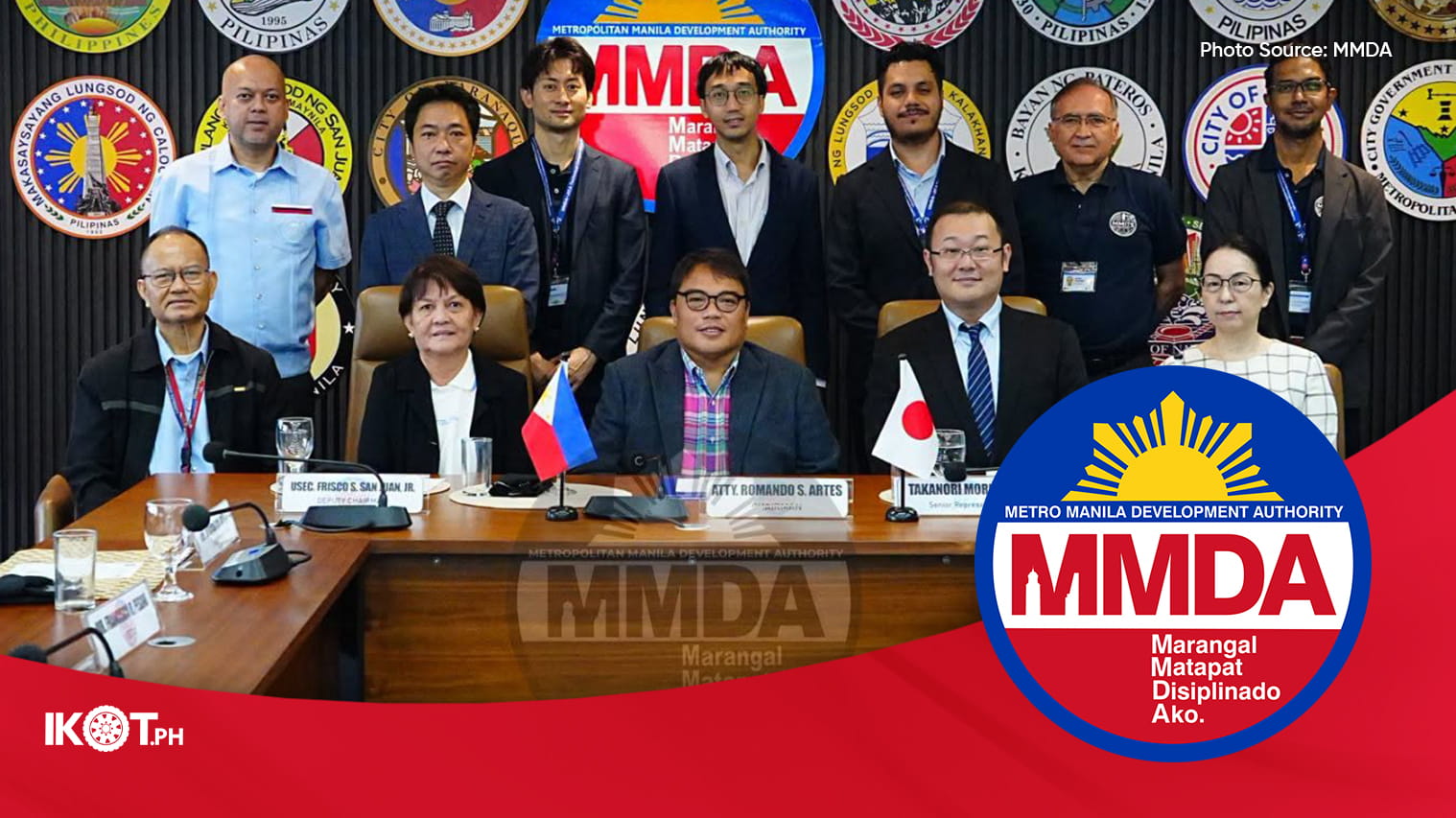
The Metropolitan Manila Development Authority (MMDA), led by Chairman Atty. Don Artes, convened the third Joint Coordination Committee (JCC) meeting for the Capacity Enhancement on Traffic Management with Improvement of Intelligent Transportation Systems for Metropolitan Manila (MMITS) project, bringing together representatives from the 17 local government units (LGUs) of Metro Manila, national government agencies, and members of the academe.
The meeting focused on the project’s progress, key accomplishments, and succeeding activities aimed at strengthening intelligent transportation systems (ITS) planning, traffic data management, and technology-driven traffic management across Metro Manila.
In his welcome remarks, Artes underscored the importance of developing the MMDA’s capacity in ITS planning and implementation, as well as in managing and utilizing transport data.
“These capabilities will be critical in helping us respond to the evolving traffic challenges of the metropolis and in building a more integrated and data-driven traffic management system.”
“The MMITS Project seeks to strengthen our capacity in ITS planning and implementation, as well as in the management and utilization of transport data. These capabilities will be critical in helping us respond to the evolving traffic challenges of the metropolis and in building a more integrated and data-driven traffic management system,” he said.
Japan International Cooperation Agency (JICA) Senior Representative Takanori Morishima noted the progress made by the MMITS Project since the previous JCC meeting, citing the accomplishments achieved through the continued collaboration among JICA, MMDA, NGAs, LGUs, and other partner agencies.
“All these accomplishments so far were made possible through the sincere efforts of MMDA, partner agencies, LGUs and JICA. We look forward to a sustained and even strengthened cooperation among us all,” Morishima said.
He noted that promoting sustainable economic growth is among JICA’s priorities in the Philippines, adding that this requires extensive connectivity between and within urban and rural areas.
“Panahon na para sa ‘bagong gawi’.”
“Panahon na para sa ‘bagong gawi.’ Panahon na para mapabilis at mapaginhawa ang paglalakbay nating mga Pilipino!” Morishima added, citing the words of the MMITS App challenge.
Under Output 1, the committee discussed the finalization of the project’s short-term action plan, with continuous coordination among project delegates to further refine the plan. The task forces relevant to the actual needs and priorities of the MMDA were also identified.
Meanwhile, Output 2 focused on two pilot projects designed to strengthen the use of technology and innovation in traffic management.
One of these is the Smart Pole Implementation Plan, which will involve the installation of multiple types of sensors on existing MMDA poles at one to two selected intersections by the agency. An implementation test will be conducted to collect and analyze traffic and environmental data and evaluate the sensors’ accuracy, and capability.
The 2nd pilot project involves the development of a mobile application resulting from the recently concluded “Bagong Gawi, Bagong Galaw” Mobile Application Challenge, which invited innovators to develop smartphone-based applications that can contribute to traffic management.
Discussions are now underway on the development of the winning application, “Lakbay Points,” developed by a team from Cagayan State University and its potential integration with existing systems of LGUs and NGAs.
For Output 3, it discussed the continuing enhancement of the Waze dashboards and the redevelopment of the traffic data platform to integrate various traffic data sources.
Among the ongoing activities under this output are the Traffic Signal Control Improvement Task Force and the development of the Road DX System, an integrated platform for data, visualization, and decision support.
For the next six months, the project will focus on the further development of the ITS Development Plan, the physical implementation of the first pilot project, and continued coordination with the winning team of the mobile application challenge to further develop an application that can help operationalize and promote Travel Demand Management (TDM) and traffic management.
An open forum was also held which allowed participating LGUs, NGAs, and other stakeholders to raise questions and concerns regarding the development and implementation of the project’s systems and platforms.
In his closing remarks, MMDA Deputy Chairman Frisco San Juan, Jr. emphasized the need to translate the discussions into concrete actions and ensure that the project’s outputs can be integrated into the agency’s regular traffic management operations.
“The discussions today have also given us a clearer direction for the succeeding activities of the project. We need to finalize and validate the ITS Development Plan with our stakeholders, endorse the priority projects for implementation, and ensure that our pilot projects can eventually be scaled up and integrated into our regular traffic management operations,” San Juan said.
The MMITS technical cooperation project between the MMDA and the JICA forms part of the broader reform agenda under the Five-Year Action Plan for Traffic Management 2023–2027, which originated from the JICA Technical Cooperation Project on the Comprehensive Traffic Management Plan implemented from 2019 to 2022.