
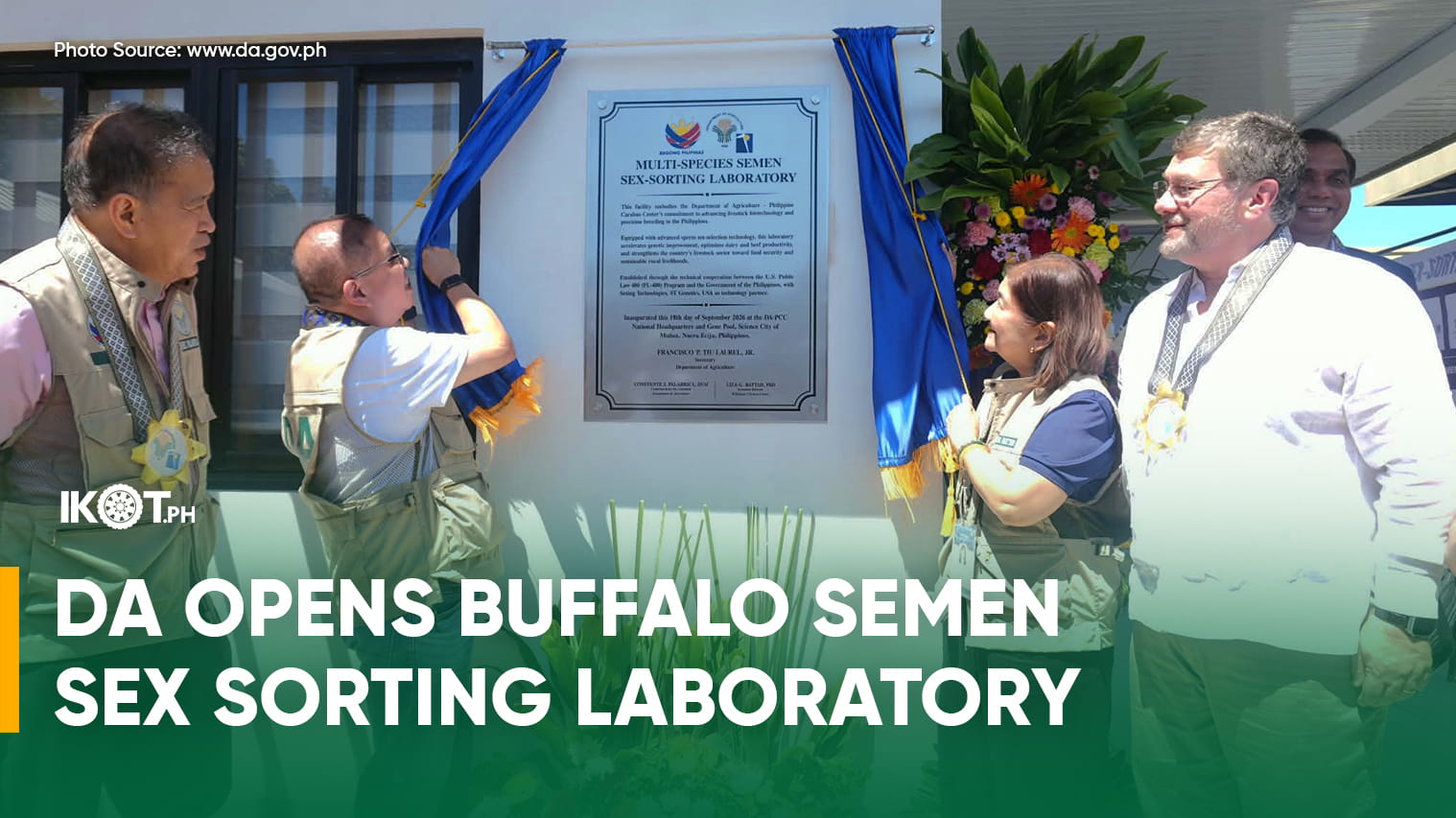
The Department of Agriculture (DA) and the Philippine Carabao Center (PCC) inaugurated the world’s first laboratory dedicated exclusively to sex-sorting buffalo semen—a major milestone aimed at boosting domestic dairy production and reducing reliance on imports.
Located in the Science City of Muñoz in Nueva Ecija, the ₱237.9-million facility uses flow cytometry to separate sperm cells carrying X (female) and Y (male) chromosomes with approximately 90% accuracy.
The technology allows breeders to reliably select female calves for dairy production or male calves for meat and draught work. After sorting, the semen is cryogenically preserved for artificial insemination programs nationwide.
“This facility will give farmers the choice of whether they want a female calf that will eventually produce milk, or bulls for meat and farm work,” Agriculture Secretary Francisco Tiu Laurel Jr. said.
“Producing breeding materials locally saves foreign exchange, creates additional income opportunities for farmers, and strengthens food security.”
“Producing breeding materials locally saves foreign exchange, creates additional income opportunities for farmers, and strengthens food security,” Tiu Laurel added.
The PCC aims to produce around 170,000 sex-sorted semen straws per year, primarily targeting female offspring to expand the country’s dairy herd.
Currently, local milk production meets less than 5% of national demand, leaving the Philippines heavily dependent on imported dairy products and breeding stock.
“By producing sex-sorted semen locally, we expect to lower procurement costs, reduce the risk of foreign livestock disease transmission, and ensure breeding stock is better adapted to tropical conditions.”
By producing sex-sorted semen locally, the DA expects to lower procurement costs, reduce the risk of foreign livestock disease transmission, and ensure breeding stock is better adapted to tropical conditions.
While the laboratory will initially focus on elite water buffalo bulls, the technology can also be applied to ruminant animals.
Funded under US Public Law 480 (Agricultural Trade Development and Assistance Act of 1954), the laboratory was completed in three months under the Intensified Community-based Enterprise Development program.
Distribution for field artificial insemination will begin in the fourth quarter of 2026, with the first batch of genetically targeted calves expected by late 2027.