
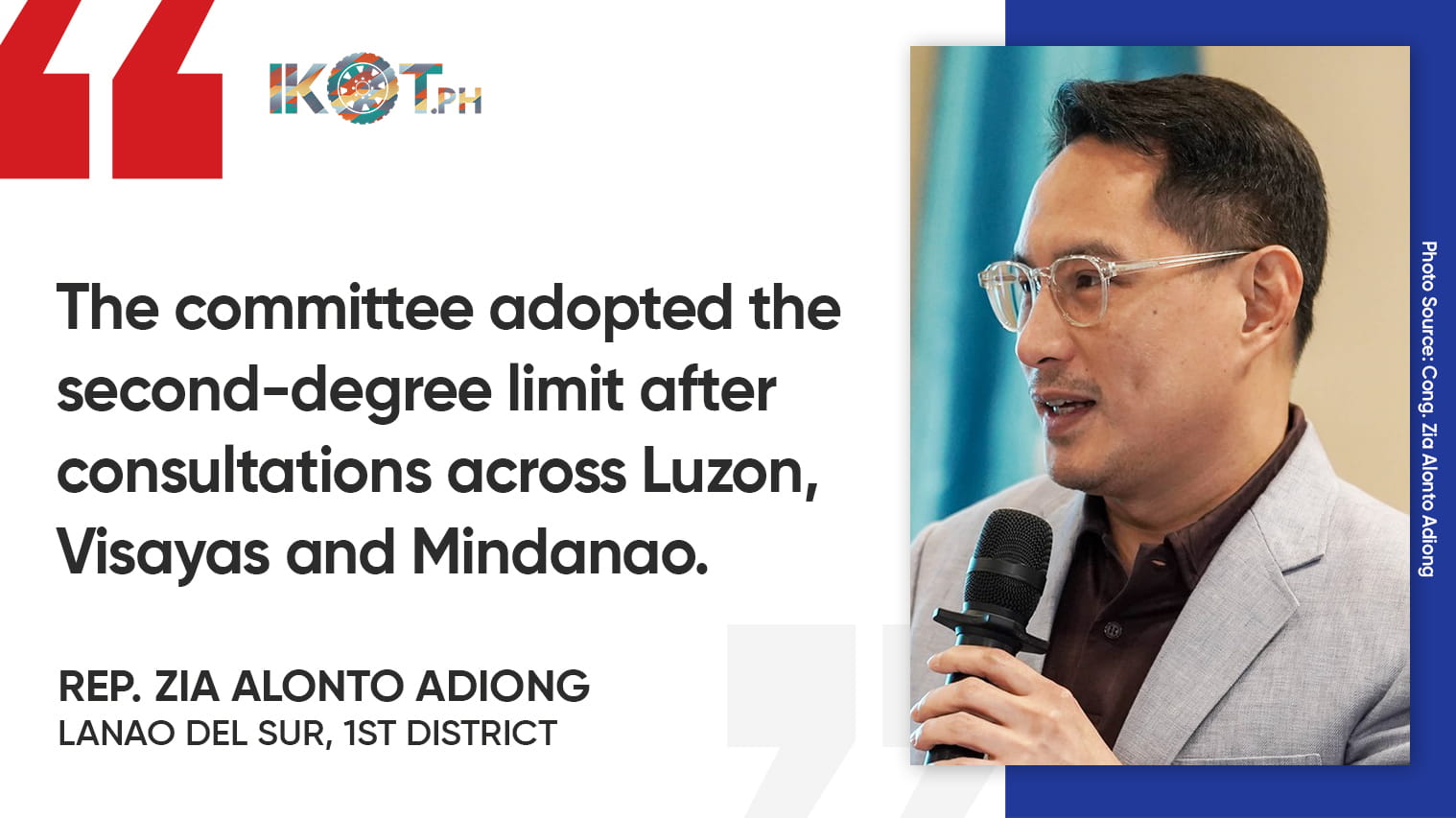
Lanao del Sur 1st District Representative Zia Alonto Adiong said the proposed Anti-Political Dynasty Act strikes a balance between reform and enforceability, defending the bill’s restriction on relatives within the second degree and warning that a broader fourth-degree prohibition would be difficult for the Commission on Elections (Comelec) to implement.
Adiong, who chairs the House Committee on Suffrage and Electoral Reforms, said the committee adopted the second-degree limit after consultations across Luzon, Visayas and Mindanao, where concerns were raised over practicality and implementation.
“The response from the Comelec is that it would be a logistical nightmare if we extend from the degree of prohibition from second degree to the fourth degree of consanguinity.”
“The response from the Comelec is that it would be a logistical nightmare if we extend from the degree of prohibition from second degree to the fourth degree of consanguinity,” the veteran legislator said.
The seasoned lawmaker made the statement during plenary interpellations by Mamamayang Liberal Party-list Representative Leila de Lima on House Bill No. 8389, or the proposed Anti-Political Dynasty Act, which he sponsored.
The bill seeks to implement Article II, Section 26 of the 1987 Constitution, which directs the State to prohibit political dynasties “as may be defined by law”.
The measure bars relatives within the second degree of consanguinity or affinity from simultaneously running for or holding office in the same locality. It is currently pending second reading approval in the House of Representatives.
Speaker Faustino “Bojie” Dy III and House Majority Leader Sandro Marcos are the principal authors of the bill, which has 173 other co-authors and has been endorsed as a priority measure by the Legislative-Executive Development Advisory Council and President Ferdinand Marcos Jr.
Adiong said the committee also considered the views of constitutional experts invited during hearings, including retired Supreme Court Justice Adolfo Azcuna, who favored the second-degree restriction for practical reasons.
The panel chair noted that most of the 25 anti-dynasty bills referred to the committee similarly adopted the second-degree framework.
Addressing various issues raised by De Lima, Adiong explained that the poll body warned that expanding the ban to fourth-degree relatives would require extensive tracing of family ties down to the barangay level, including cousins and relatives connected through marriage across provinces and regions.
“To even trace candidates who have shared the same family name, not to mention the consanguinity — we’re not talking about affinity alone — according to Comelec, it would be a logistical nightmare,” he pointed out.
The logistical concerns cited by Adiong were also reflected in a policy brief by the House think tank, the Congressional Policy and Budget Research Department (CPBRD), titled “Closing the Constitutional Gap: The Challenges of Implementing Anti-Political Dynasty Legislation”.
“Enforcing a broader anti-dynasty ban could impose substantial administrative and financial burdens on the Comelec.”
The paper, available on the House of Representatives website, warned that enforcing a broader anti-dynasty ban could impose substantial administrative and financial burdens on the Comelec, which would be tasked with verifying blood and marital relationships among candidates nationwide.
Citing 43,033 individuals who filed certificates of candidacy in the 2025 elections, the CPBRD estimated that the second-degree restriction under the current bill could require the processing of about 946,726 additional documents. A fourth-degree ban could raise that number to more than 2.84 million documents.