
Senator Bong Go urged Congress and the executive branch to ensure that the Philippine Health Insurance Corporation (PhilHealth) receives the funding legally earmarked for Universal Health Care, warning against repeating years in which billions of pesos in mandated health revenues failed to fully reach the state insurer.
During the Senate budget hearing, Go reviewed PhilHealth funding from 2024 onward and urged lawmakers to closely examine the proposed 2027 allocation.
“On sin tax earmarking, it is important to note that Republic Act No. 11346 and Republic Act No. 11467 provide for the earmarking of excise taxes on certain products,” the seasoned legislator said.
“These revenues are mandated by law to be allocated and used exclusively for PhilHealth for the implementation of the Universal Health Care Act,” the veteran lawmaker added.
The Supreme Court has likewise affirmed that earmarked sin tax receipts constitute special funds dedicated to Universal Health Care and cannot simply be converted into a general-purpose financing pool.
The senator pointed to 2024 as a particularly troubling example.
Official records show that around P79.01 billion was earmarked for PhilHealth from sin taxes that year, but only about P40.28 billion in sin tax-funded subsidy was reflected in the final GAA—a gap of roughly P38.73 billion.
He also recalled the controversial transfer of PhilHealth funds to the National Treasury, part of which was later ordered restored following the Supreme Court ruling against the fund-transfer mechanism.
“Nakakalungkot lang po, nung 2024, mayroon pong nai-transfer na sinasabing excess funds,” Go said.
“Sana po’y huwag itong maulit,” he stressed.
The problem became even more pronounced in 2025.
At least P69.81 billion in sin tax revenues was earmarked for PhilHealth, yet the final 2025 national budget gave the agency zero national government subsidy.
“Double whammy po ang tawag diyan.”
“Double whammy po ang tawag diyan,” Go said, referring to the fund transfer followed by the zero subsidy.
For 2026, Senate records showed a legally earmarked sin tax amount of around P69.78 billion, while the NEP initially carried only P53.26 billion, leaving a P16.52-billion gap.
Congress later restored the missing sin tax share and separately provided for the return of P60 billion previously transferred from PhilHealth, bringing its 2026 allocation to around P129.8 billion.
He said the two-year delay in restoring the P60 billion represented lost opportunities for patients.
“For two years, ilang pasyente po ang dapat nakinabang doon? Ilang buhay po ang mase-save doon?”
“Pero ang nangyari, for two years, ilang pasyente po ang dapat nakinabang doon? Ilang buhay po ang mase-save doon?” Go asked.
Looking ahead to 2027, he said the Senate should again carefully scrutinize whether PhilHealth’s proposed allocation complies with the amounts mandated by law.
The 2027 NEP currently provides about P74.448 billion for PhilHealth, far below the approximately P370-billion budget the insurer initially requested to sustain its expanded benefits.
Go said lawmakers should ensure that legally earmarked revenues are fully provided before debating how much additional support PhilHealth may need.
“Sana mahabol po natin dito sa Senado ’yung nakasaad talaga sa batas,” he said.
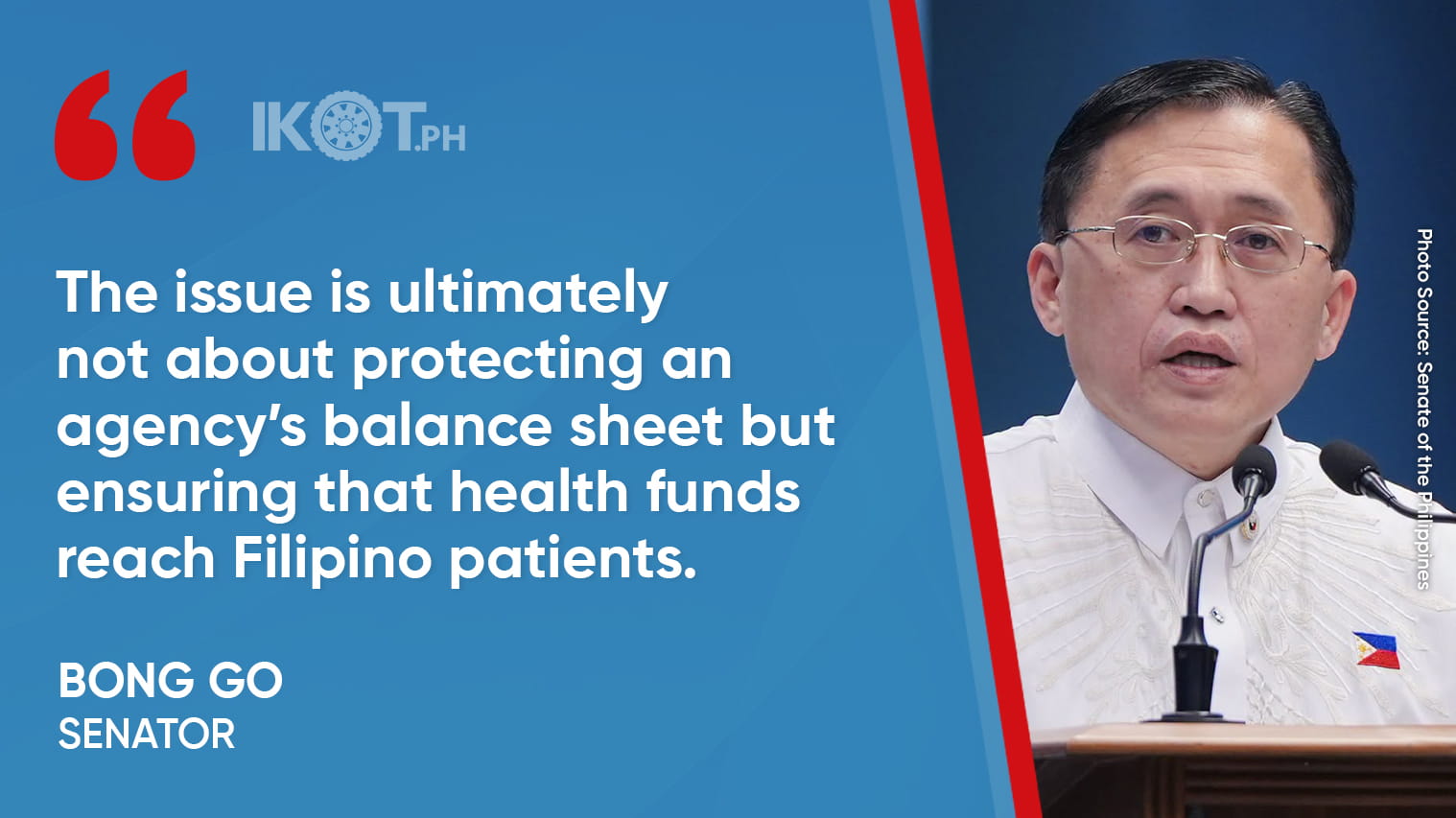
Go stressed that the issue is ultimately not about protecting an agency’s balance sheet but ensuring that health funds reach Filipino patients.
“Hanggang ngayon po napakalayo pa natin sa full implementation ng Universal Health Care. ’Yun po ang totoo. ’Yun po ang realidad,” he concluded.