Camarines Sur (CamSur) Reps. Migz Villafuerte and Luigi Villafuerte are upbeat about the timely approval of a measure imposing a tax on polluting single-use plastics, now that it has been identified by both the Congress and Malacañan Palace as one of the possible revenue measures intended to compensate for P66 billion in annual earnings that Government expects to lose once it implements fresh proposals by President Marcos on hefty tax cuts for middle-class Filipinos and small businesses.
Migz and Luigi were among House leaders who had backed the President’s push in his 5th State of the Nation Address (SONA) for: (1) exempting all Filipinos earning a maximum of P350,000 yearly from paying income taxes, and (2) exempting micro and small entrepreneurs from paying the corporate income taxes (CIT).
“With the Department of Finance (DOF) estimating foregone revenue to reach P60 billion from tax-free income tax payments of those earning P350,000 annually or below, and another P6 billion from the tax-free CIT payments of micro and small businesspersons,” Migz said “the House leadership, through its Committee on Ways and Means, is eyeing four new tax proposals to compensate for the projected losses.”
Migz, who chairs the House committee on information and communications technology (ICT), said, “These four revenue measures, which include taxing single-use plastics, are seen to make up for the DOF-estimated foregone revenues of P66 billion once the 20th Congress writes the President’s SONA-proposed tax cuts that would benefit 3.13 million workers and 78,000 owners of small businesses.”
Single-use plastic bags are secondary level plastics made of synthetic or semi-synthetic organic polymer like “ice,” “labo” or “sando” bags, with or without handles, that are used as packaging for goods or products in the Philippines.
Hence, added Migz, he and Luigi “are optimistic about the timely congressional approval of HB (House Bill No.) 1156, which is an environment-friendly measure that they introduced last year to impose an excise tax equivalent to P100 for every kilogram (kg) of single-use plastic bags, in the hope of curbing the use of this ubiquitous pollutant—and hopefully reverse our country’s sorry image as one of the world’s biggest ocean plastic polluters.”
The Villafuertes said that one source of their optimism is the post-SONA announcement by Presidential Communications Office (PCO) undersecretary and Palace Press Officer Claire Castro that President Marcos is considering several measures to offset the potential revenue losses, including additional taxes on vaping products, sugary drinks and single-use plastics.
“It is being considered. We simply hope that any potential revenue losses can be offset by tax increases on other items,” Castro said. “Right now, the specific details and all proposals are being reviewed and studied, as the President has expressed a strong desire to provide assistance—particularly to the middle-income sector.”
Later, Castro said at another press briefing that the DOF is “still studying” and “currently reviewing (it) thoroughly,” in reference to proposed new or higher taxes on sugar-sweetened beverages (SSBs), tobacco, alcohol and single-use plastics to offset revenue losses from the tax relief plan for workers and small businesses.
Castro said, “The President wants it to be passed this year, if possible,” referring to Mr. Marcos’ push in his 5th SONA for tax breaks for those with a maximum annual taxable income of P350,000 and for micro and small entrepreneurs.
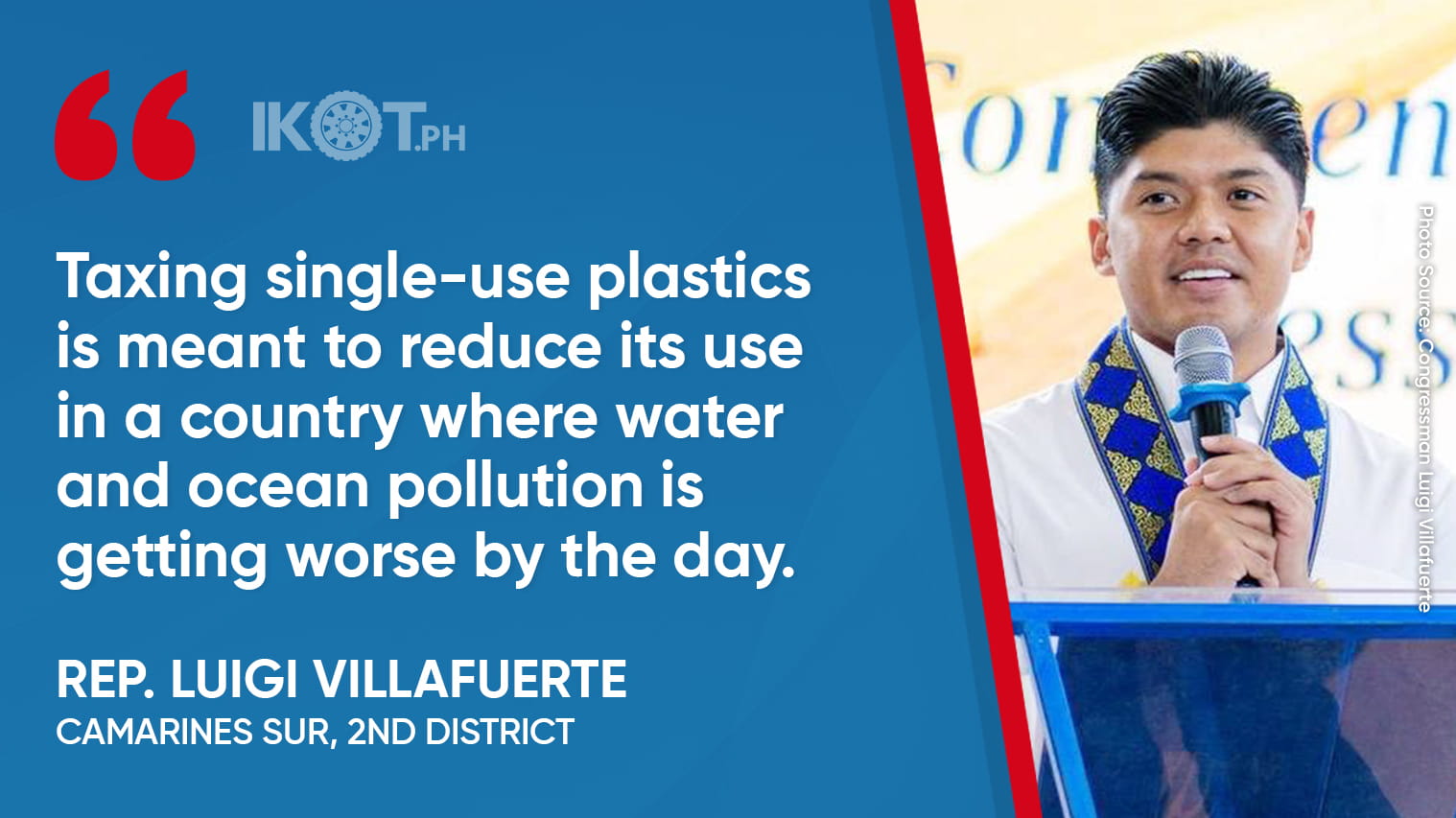
Luigi, a deputy majority leader, said that, “Taxing single-use plastics is meant not just to reduce its use in a country where water and ocean pollution is getting worse by the day, but also to raise as much as a government-estimated P10 billion yearly in extra revenue to help fund the PAPs (priority programs and projects) of the Marcos administration.”
HB 1556 “aims to reduce the use of single-use plastic, promote more sustainable alternatives, protect the health of communities, and support environmental protection efforts at the local level by proposing an excise tax of P100 per kg of single-use plastic bags removed from the place of production or released from the custody of the Bureau of Customs (BOC).”
Alongside these tax reform measures, the Villafuertes also backed the President’s proposal in his 5th SONA for an amendatory law to the Electric Power Industry Reform Act (EPIRA) to do away with the systems loss charge and the corresponding VAT (value-added tax) on this charge that distribution utilities (DUs) pass on to their customers via their monthly electricity bills.
The Villafuertes said the President’s SONA-proposed tax cuts and the removal of the systems loss charge tucked in the monthly bills of electricity consumers will cushion not only on low-income Filipinos but on the middle class and small entrepreneurs as well the fallout from the economic crunch touched off by the war-induced global oil shock.
DOF Secretary Frederick Go told the media that the President’s proposal to raise the annual income tax threshold to P350,000—from the current P250,000 under the Tax Reform for Acceleration and Inclusion (TRAIN) law—would reduce revenue by P60 billion, while exempting small businesses from paying the corporate income taxes would mean another P6-billion revenue loss.
“The proposal will benefit at least 3.13 million workers, including an additional 1.2 million workers at the minimum who will no longer pay personal income tax, increasing the total number of tax-exempt workers from at least 5.1 million to 6.3 million,” Go said.
As for the CIT exemption, Go said this will benefit owners of 78,000 micro and small businesses, including small coffee shops and bakeries, eateries or food stalls, sari-sari stores, repair shops and other family-run enterprises.
At present, qualified small businesses pay—under the Corporate Recovery and Tax Incentives for Enterprises Act (CREATE)—pay a 20% CIT based, provided that their net taxable income does not exceed P5 million and their assets, excluding land, are P100 million or less.
Speaker Bojie Dy III and Majority Leader and Ilocos Norte Rep. Sandro Marcos have jointly filed a bill (House Bill or HB No. 10345) raising the annual tax-free income threshold to P350,000, and another one (HB 10346) exempting small enterprises from the CIT.
Dy said the chamber will move quickly to meet the President’s timetable, so that his SONA-proposed tax relief package and its corresponding tax measures could be cleared soon enough in time for its effectivity in 2027.
In a House statement, ways and means committee chairman and Marikina City Rep. Miro Quimbo said the chamber hopes to offset the revenue loss from the President’s tax relief package in his 5th SONA through “higher taxes on vape products, tobacco, sugar-sweetened beverages and single-use plastics.”
Quimbo said “the government intends to recover the foregone revenues through taxes that also promote public health and environmental protection,” including “broader taxes on single-use plastic products, particularly sachets, to help curb plastic pollution and reduce flooding caused by clogged waterways.”
Migz and Luigi Villafuerte authored HB 1556 with Rep. Tsuyoshi Anthony Horibata and Bicol Saro Rep. Terry Ridon.
Single-use plastic bags are secondary level plastics made of synthetic or semi-synthetic organic polymer like “ice,” “labo” or “sando” bags, with or without handles, that are used as packaging for goods or products in the Philippines.
The Villafuertes said that HB 1556 “aims to reduce the use of single-use plastic, promote more sustainable alternatives, protect the health of communities, and support environmental protection efforts at the local level by proposing an excise tax of P100 per kg of single-use plastic bags removed from the place of production or released from the custody of the Bureau of Customs (BOC).”
Under the bill, the tax rate will increase annually by 4%.