
All local government units (LGUs) shall harmonize their respective land use plans with a science-based national framework, under a measure cleared recently by the House of Representatives to let the government carry out a unified “ridge-to reef” (R2R) approach to the protection and productive use of lands along with the development of infrastructure and settlements across the country, according to Camarines Sur (CamSur) Reps. Migz and Luigi Villafuerte.
The CamSur solons who had successively served as CamSur governors prior to being elected congressmen, said that House Bill (HB) No. 8466 was passed earlier this month as lawmakers sought to strike a balance in meeting the every so often conflicting needs of agricultural productivity, housing, environmental protection, infrastructure development and economic growth.
They said that a major concern of the bill is protecting farmlands against improper or unnecessary conversion to non-agricultural, especially areas crucial to palay production and food security.
As such, they said, the bill imposes penalties on the illegal conversion of croplands into industrial, commercial, residential or for other non-agricultural purposes without the needed conversion or clearance orders.
The areas to be covered by the National Land Use Plan (NLUP) that the NLUC is tasked to draw up and implement include critical watershed areas, habitats, ancestral domains, cultural heritage and property zones , ecotourism and energy resource lands, exhausted mineral resources sites, resettlement areas, flood-prone areas, foreshore and forest lands, national parks and geo hazard areas, among others.
Migz and Luigi Villafuerte are co-authors of HB 8466, which the House had passed on third and final reading by a vote of 224-3 with no abstention, on the view of Speaker Faustino “Bojie” Dy III that its urgent passage is needed in the absence of a “long-overdue blueprint for sustainable growth,” and be “a decisive step toward securing the country’s land resources … for the benefit of future generations.”
The Philippines faces longstanding and overlapping issues related to land use, including land registration, agrarian reform, ancestral domain, agricultural modernization, mining, taxation, urban development, housing, and local governance, they said.
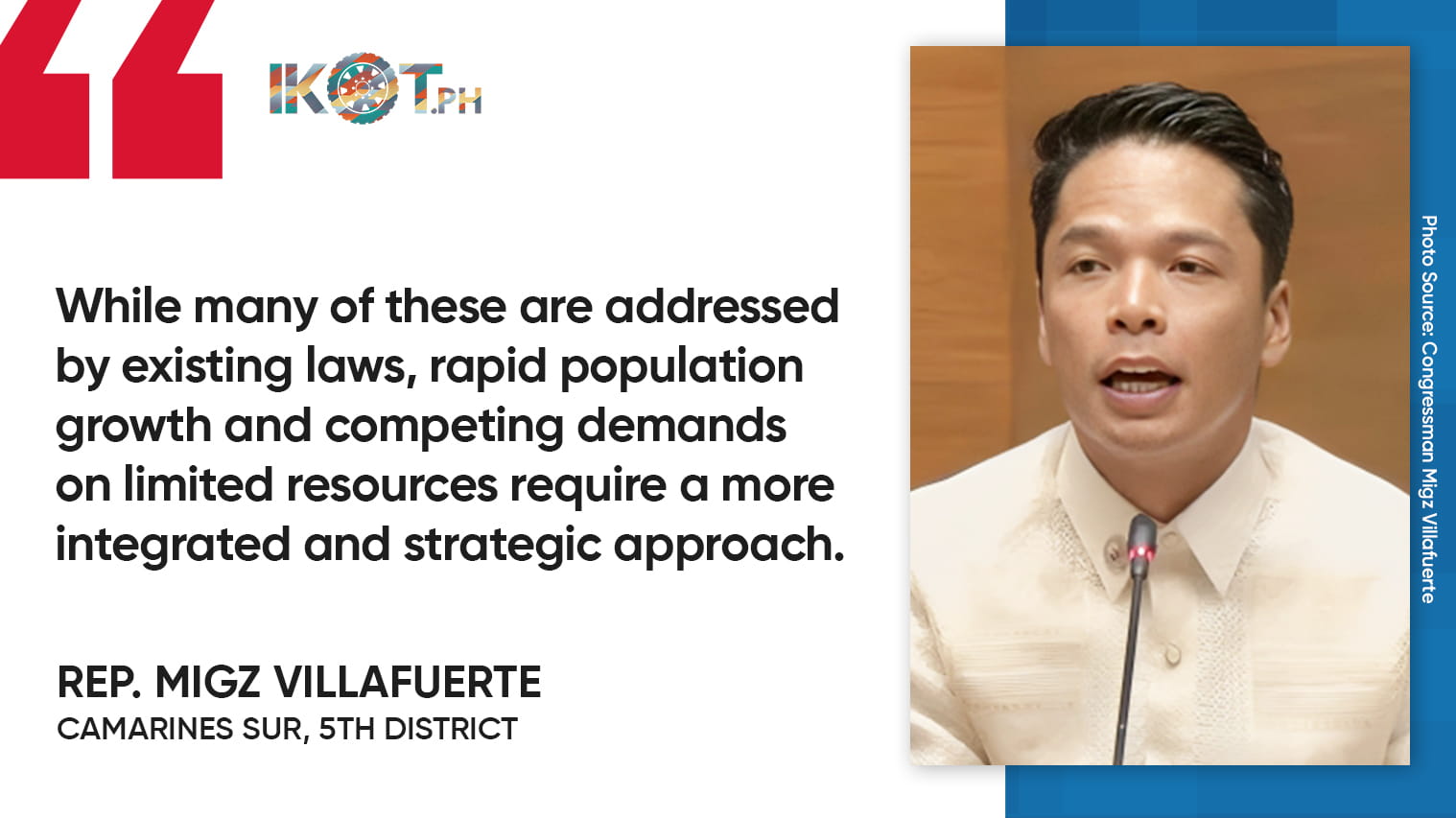
“While many of these are addressed by existing laws, rapid population growth and competing demands on limited resources require a more integrated and strategic approach,” Migz said.
Migz noted that current land-related laws “often conflict and lack coordination, resulting in inefficient land use, premature conversion of agricultural lands, and missed opportunities for sustainable development. The absence of a unified framework limits the capacity of national and local governments to make informed, balanced decisions on land allocation.”
Thus, said Luigi, the integration of existing laws, regulatory policies, and planning guidelines related to land use is “critical to the formulation of a comprehensive and coherent land use framework that will establish definitive parameters for land utilization and ensure the effective implementation and monitoring of land use plans across all levels of governance.”
He said that HB 8466 aims “to establish a unified and strategic framework for the rational allocation, sustainable utilization, and effective management of land resources to support diverse ecological and economic functions. It further seeks to regulate and prevent the untimely conversion of agricultural lands to non-agricultural purposes, thereby preserving their productive value.”
The Villafuertes had authored HB 1860, which was incorporated into the House-passed HB 8466.
One provision of HB 1860 calls upon provinces, cities and municipalities with existing land use plans to review, revise, reconcile and harmonize their respective plans in accordance with the guidelines and standards to be issued by the NLUC.
Migz said that to address the lack of a national land use policy, which is responsible for what the Speaker himself described as “fragmented planning and inefficiencies,” HB 8466 seeks to create the National Land Use Commission (NLUC) to serve as the highest and centralized policy-making institution on land use and physical planning.
To be placed under the Office of the President (OP), “this proposed NLUC shall prepare a 30-year National Framework Plan—for updating every 10 years—to guide nationwide planning for production areas, protection zones, transmission corridors, and settlements and infrastructure development, among other land uses,” Migz said.
Luigi said that “the bill requires the integration of regional, provincial, city and municipal land use plans into the national framework that the NLUC is tasked to craft, to make sure that all LGUs are on the same page with the national government on infrastructure, local development and zoning concerns.
The areas to be covered by the National Land Use Plan (NLUP) that the NLUC is tasked to draw up and implement include critical watershed areas, habitats, ancestral domains, cultural heritage and property zones , ecotourism and energy resource lands, exhausted mineral resources sites, resettlement areas, flood-prone areas, foreshore and forest lands, national parks and geo hazard areas, among others.
For integration and harmonization purposes, the Villafuertes said that the NLUC shall work with LGUs on dovetailing their respective land use plans with the NLUP through the bill-proposed Regional Physical Framework Plans (RPFPs), Provincial Physical Framework and Development Plans (PPFDPs), and Land Use Policy Councils (RLUPCs), and City and Municipal Land Use Plans (CLUPs and MLUPs).
All these local plans shall be anchored on the R2R or watershed ecosystem management (WEM) approach to the integrated management of land, water, forests, rivers and coastal ecosystems, they said.