
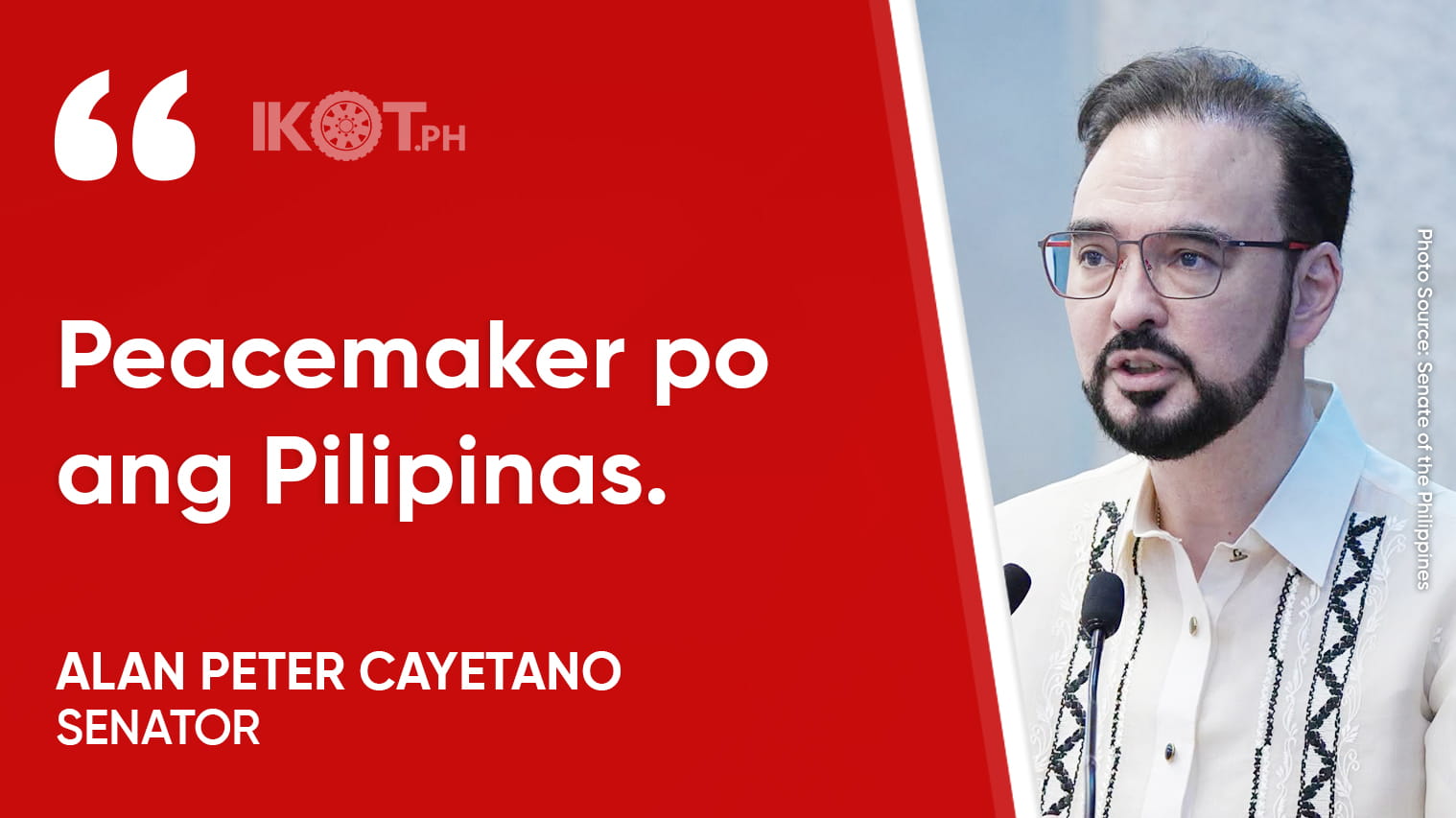
“Trouble should be seen as an opportunity for order, an opportunity for better relations, an opportunity for discussions, an opportunity for diplomacy.”
This was the message of Senate Minority Leader Alan Peter Cayetano as he called for a measured approach to disputes involving the Philippines and China, stressing that the country must defend its sovereignty and sovereign rights while preventing tensions from escalating into a bigger problem.
In a Facebook livestream, Cayetano addressed the broader issue of managing disputes with China, emphasizing the need to defend Philippine sovereignty and sovereign rights while preventing tensions from escalating into a bigger problem.
The veteran legislator’s remarks came amid reactions to Chinese Ambassador Jing Quan’s statement that China could easily win if it chose to use force against the Philippines, although Beijing preferred peace. The remark drew criticism from Philippine officials, with the Department of Foreign Affairs describing it as a “thinly veiled threat”.
“Hindi tayo dapat magpabully sa sarili po nating bansa.”
“Yes, we should stand up for our rights. Yes, hindi tayo dapat magpabully sa sarili po nating bansa. Having said that, there is always a way to be able to manage issues and problems. And there’s also a way of looking at countries where you have disputes. You don’t have a single focal point,” the seasoned lawmaker said.
A former Foreign Affairs Secretary, the senator stressed that defending the country’s rights should go hand in hand with preventing disputes from worsening, particularly when ordinary Filipinos could ultimately bear the consequences.
“If trouble will end up in bigger trouble, it’s the ordinary Filipino who will be in trouble.”
“If trouble will end up in bigger trouble, it’s the ordinary Filipino who will be in trouble,” he said.
Cayetano also warned against allowing the Philippines to be drawn too deeply into the broader rivalry between the United States and China, noting that excessive focus on geopolitical tensions could divert attention from pressing domestic concerns.
He said the country must simultaneously protect its sovereignty and sovereign rights while addressing El Niño, the cost of electricity and fuel, unemployment, investments, corruption, and problems in flood control.
“If we’re going to be dragged in to the US-China dispute and ang magiging paraan na ma-drag in tayo dyan ay ang West Philippine Sea, magsa-suffer tayo,” Cayetano said.
He pointed to Southeast Asia’s experience under the Association of Southeast Asian Nations (ASEAN), recalling how countries with significant political, cultural, religious, and ideological differences managed to avoid major conflict through regional cooperation.
Cayetano noted that the Philippines had historically played a leading role in promoting peace in the region.
“Through God’s grace and mercy, ‘yung ASEAN, the framework played a good role. And you know what? The Philippines was in the forefront — peacemaker po ang Pilipinas,” he said.
Ultimately, Cayetano urged the country to avoid viewing foreign policy through the lens of choosing between major powers and instead base its decisions on Philippine interests.
“Don’t be pro-US, don’t be pro-China, don’t be anti-China, don’t be anti-US. Be pro-Philippines. Kasi ‘pag pro-Philippines, hindi ka magkakamali,” he concluded.