
The Department of Agriculture has imposed a 60-day restriction on pork imports after a preliminary investigation found that rising foreign shipments have seriously injured the domestic hog industry.
The DA said falling farmgate prices have already cost local producers an estimated P27.9 billion in the first seven months of 2026.
Agriculture Secretary Francisco Tiu Laurel Jr. signed the department order authorizing a provisional safeguard measure under Republic Act 8800, or the Safeguard Measures Act.
The action follows a surge in pork imports even as local producers grapple with depressed prices, excess inventories, and the lingering effects of African Swine Fever (ASF).
The DA found that pork imports climbed 42 percent, from 589,675 metric tons in 2023 to 836,240 MT in 2025. Imports also accounted for an increasing share of domestic production, rising from 39 percent in 2021 to 61 percent in 2025 and 65 percent in the first half of 2026.
“The preliminary findings show that the surge in pork imports is putting severe pressure on our local producers.”
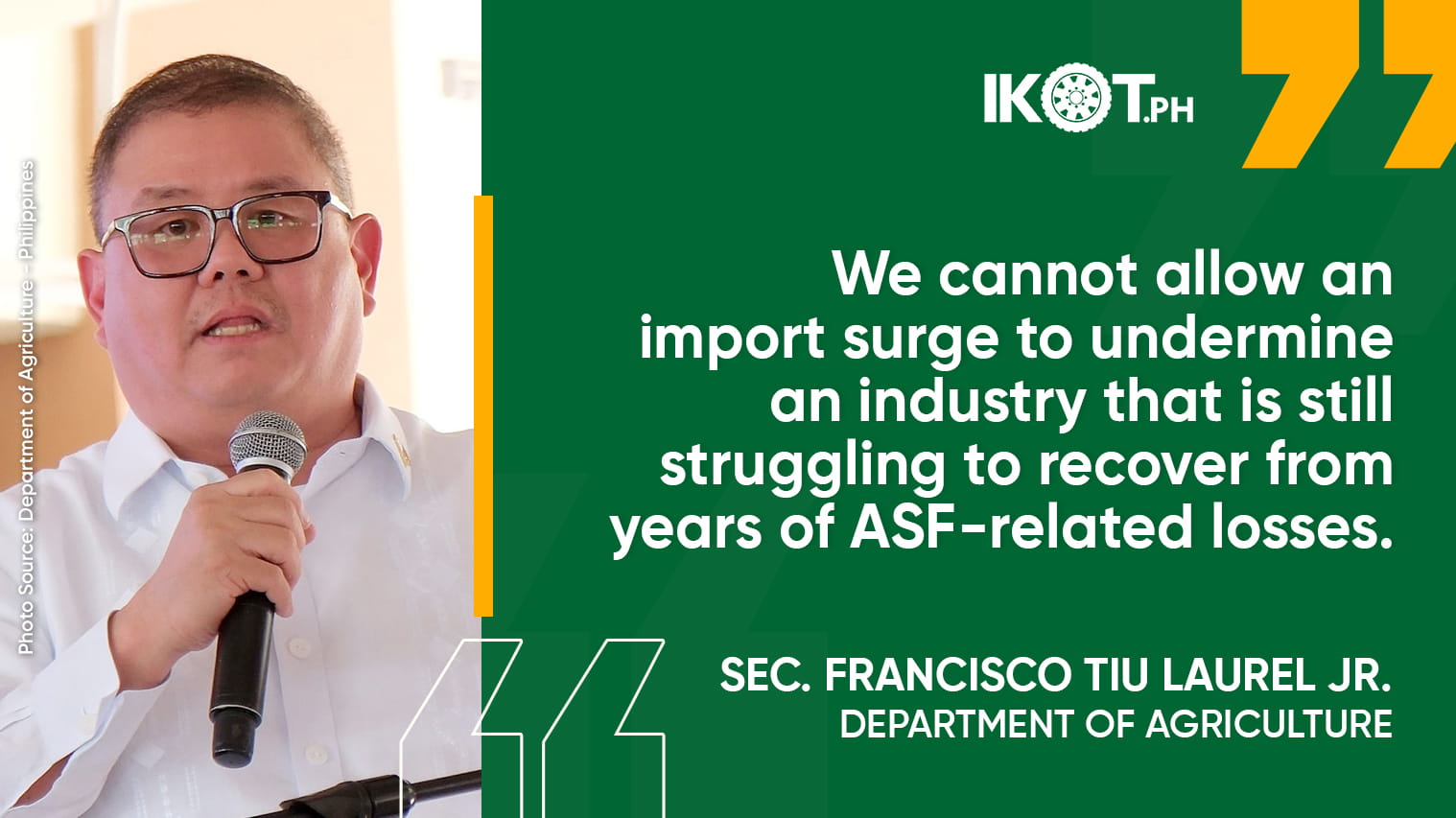
“The preliminary findings show that the surge in pork imports is putting severe pressure on our local producers. We cannot allow an import surge to undermine an industry that is still struggling to recover from years of ASF-related losses,” Tiu Laurel said.
The squeeze is evident in the country’s worsening dependence on imported pork. Domestic self-sufficiency fell from 74.3 percent in 2021 to 65.5 percent in 2025 and just 54 percent in January to August 2026. Imports’ share of domestic consumption, meanwhile, rose to 55 percent.
Frozen pork inventories reached about 121,000 MT in July, up 38 percent from a year earlier and more than double their level in 2024. Imported products accounted for 94 percent of these stocks.
The inventory buildup coincided with a sharp decline in farmgate prices. The average price dropped from P198.30 per kilogram in 2025 to P175.75 in the first half of 2026, with some producers reporting a 50-percent plunge from P240 to P120 per kg.
The DA estimates that producers lost P27.9 billion from January to July. The figure could double to P55.8 billion by year-end if weak prices persist, while industry submissions point to potential losses of as much as P100 billion.
The restriction is the latest intervention in a hog industry battered by ASF since 2019. Other measures include efforts to make the ASF vaccine commercially available, the passage of the Animal Industry Development and Competitiveness Act, expanded minimum access volume for corn imports to help reduce feed costs, and requests for higher pork tariffs inside and outside the quota.
The DA also approved a maximum suggested retail price for major pork cuts last year to help temper food inflation, while continuing consultations with industry stakeholders on supply and price stability.
“Rebuilding the hog industry requires more than short-term price interventions.”
“Rebuilding the hog industry requires more than short-term price interventions. We are working through the necessary legal, regulatory, and industry reforms to bring the national hog population back to its pre-ASF level of about 13 million heads by the end of 2028,” Tiu Laurel said.
The 60-day provisional measure covers specified fresh and frozen pork cuts, carcasses, and edible offal under the relevant ASEAN Harmonized Tariff Nomenclature codes. It takes effect upon issuance of a Bureau of Customs order or 15 days after publication in two newspapers of general circulation, whichever comes first.
The agriculture chief acknowledged industry groups’ concern that the 60-day import restriction may be too short, saying the government could consider extending the measure, as it did with last year’s rice import ban.
“We can extend the period, just as we did with the rice import ban last year. But this requires a delicate balancing act because we also have to consider the needs of consumers and meat processors,” the agriculture head said.
The case will proceed to the Tariff Commission for a formal investigation to determine whether a definitive safeguard measure is justified.
Tiu Laurel reiterated his support for the increase in pork tariff to 30 percent for in-quote and 40 percent for out-quota, from the current 15 percent and 25 percent, respectively.