
The Department of Agriculture, through its Regional Field Office in the Cordillera Administrative Region, has intensified interventions to help farmers and fisherfolk cope with rising fuel costs and ongoing market disruptions.
Leading the response are fuel subsidies, expanded Kadiwa market linkages, truck deployments for hauling, and strengthened coordination with government agencies and private partners.
DA-CAR has also accelerated market mapping to identify the most affected areas, extended financial aid to farmers, and initiated integrated farming systems to diversify livelihoods. Longer-term measures, including cold storage, processing facilities, and low-cost preservation technologies, are also being rolled out to reduce post-harvest losses.
The spike in fuel prices has forced many fisherfolk to scale down or suspend fishing operations, cutting into daily income and affecting fish supply.
For fisherfolk, the spike in fuel prices has forced many to scale down or suspend fishing operations, cutting into daily income and affecting fish supply.
To cushion the impact, the DA, through the Bureau of Fisheries and Aquatic Resources, has allocated P75 million in fuel assistance for more than 15,000 fishermen, with additional funds set to expand the program under the Presidential Assistance Program for Farmers and Fisherfolk.
Agriculture Secretary Francisco Tiu Laurel Jr. said the interventions are part of directives from President Ferdinand Marcos Jr. to shield the agriculture sector from the effects of the energy crisis.
“Under the guidance of President Marcos Jr., we are implementing immediate and sustained interventions to assist our farmers and fisherfolk in overcoming the challenges brought about by the energy emergency,” Tiu Laurel explained.
“These initiatives are designed not only to provide timely relief through fuel subsidies and logistics support.”
“These initiatives are designed not only to provide timely relief through fuel subsidies and logistics support, but also to strengthen our food systems by improving supply chain efficiency and expanding direct market access,” the agri chief added.
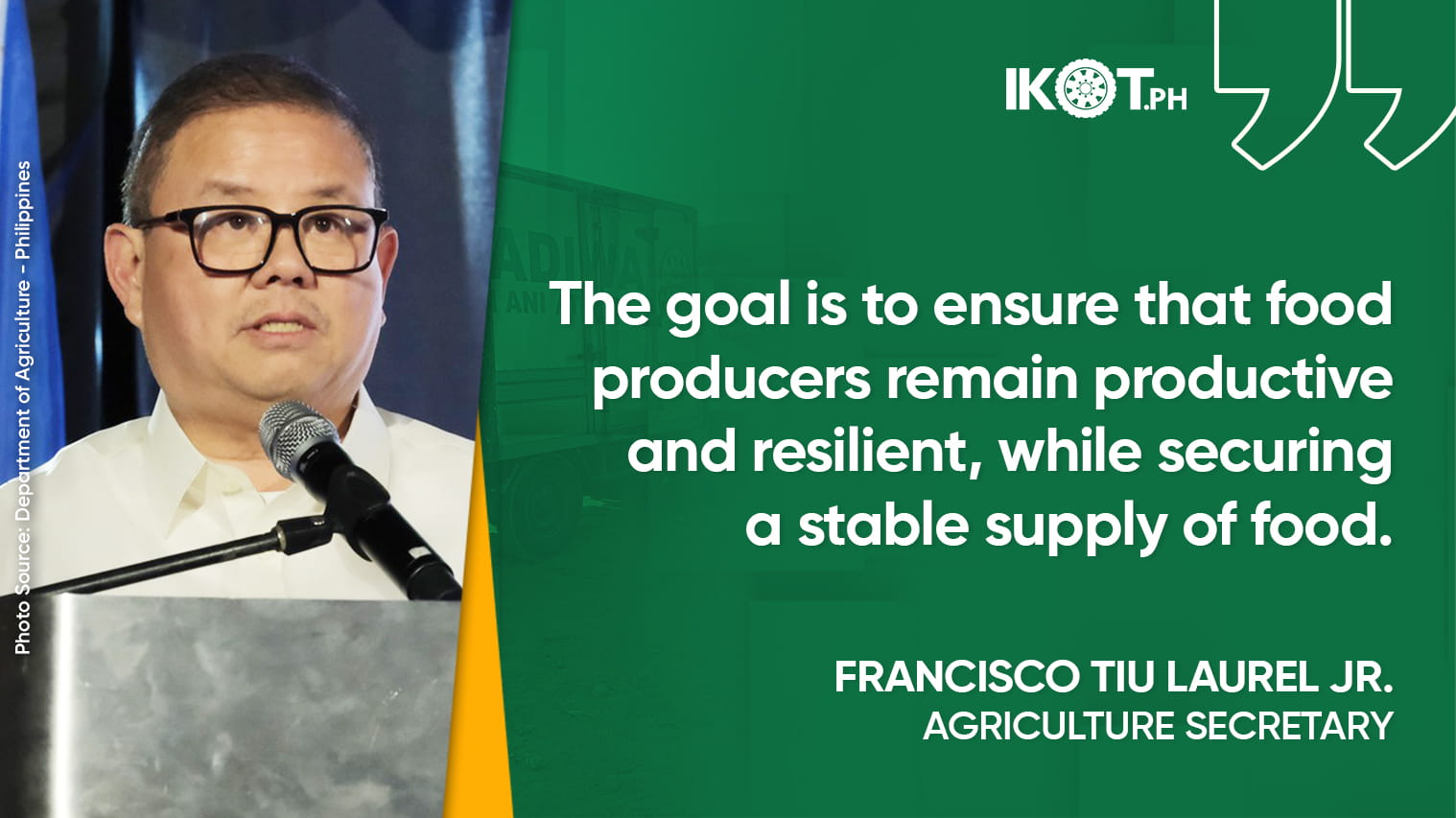
Tiu Laurel said the goal is to ensure that food producers remain productive and resilient, while securing a stable supply of food that remains accessible and affordable for all Filipinos.
Meanwhile, vegetable farmers in Benguet and nearby provinces are grappling with oversupply and weak market absorption—problems worsened by high transport costs.
Because vegetables are highly perishable, delays in distribution often lead to spoilage and income losses. DA-CAR estimates that at least 590 metric tons of produce currently require urgent market intervention.
To address this, the agency has intensified Kadiwa selling activities and trade fairs, generating over P1.3 million in sales from March to early April. It has also requested that 38 trucks given to FCAs and LGUs be used to support hauling of farmers produce should such need arises, in addition to the 5 Kadiwa trucks of DA RFO CAR.
The office also coordinated with the OCD as head of the regional disaster risk reduction council for other government agencies such as DSWD, DOH, DPWH, PNP and BFP to assist in the logistics for “pasabay” or shared transport arrangements to move produce faster and more efficiently.
Additional efforts include seeking new institutional buyers, relaunching promotional campaigns, and providing fuel assistance to farmers. The agency is also exploring livestock projects as part of integrated farming systems to help stabilize incomes.
While some stakeholders have proposed setting a minimum price for vegetables, the DA has opted against it, citing risks of market distortion.
Instead, it is focusing on improving logistics, enhancing farm-to-market coordination, and investing in technologies that extend shelf life. These actions aim to ensure both farmer sustainability and a steady, affordable food supply.