To bridge the gap between classroom learning and evolving market demands, the Department of Education (DepEd) joined forces Tuesday with over 170 leaders across government, industry, and strategic economic sectors to align the Strengthened Senior High School (SSHS) Curriculum and Work Immersion Program with emerging workforce trends.
The high-level DepEd-Industry Dialogue on Global Competitiveness, Innovation, and Preparing Senior High School Learners for the Jobs of the Future convened key decision-makers from manufacturing, semiconductors , IT-BPM, creative industries, healthcare, construction, automotive, energy, logistics, agribusiness, financial services and tourism. These industries collaborated to establish practical pathways making Senior High School graduates immediately job-ready.
The initiative supports the directive of President Ferdinand R. Marcos Jr. to build a globally competitive Filipino workforce that can adapt to a rapidly changing tech-driven economic landscape.
Education Secretary Sonny Angara emphasized that closing the gap between school and industry requires urgent, ground-level execution.
DepEd will next roll out sector-specific industry cluster discussions to map out emerging job roles, update work immersion guidelines, and integrate real-time labor market information into the national curriculum.
“Our graduates must enter the workforce with genuine hands-on experience and real competencies. By sitting down directly with our industry leaders, we are ensuring that what we teach in school matches what the real world actually demands,” Secretary Angara said in a statement.
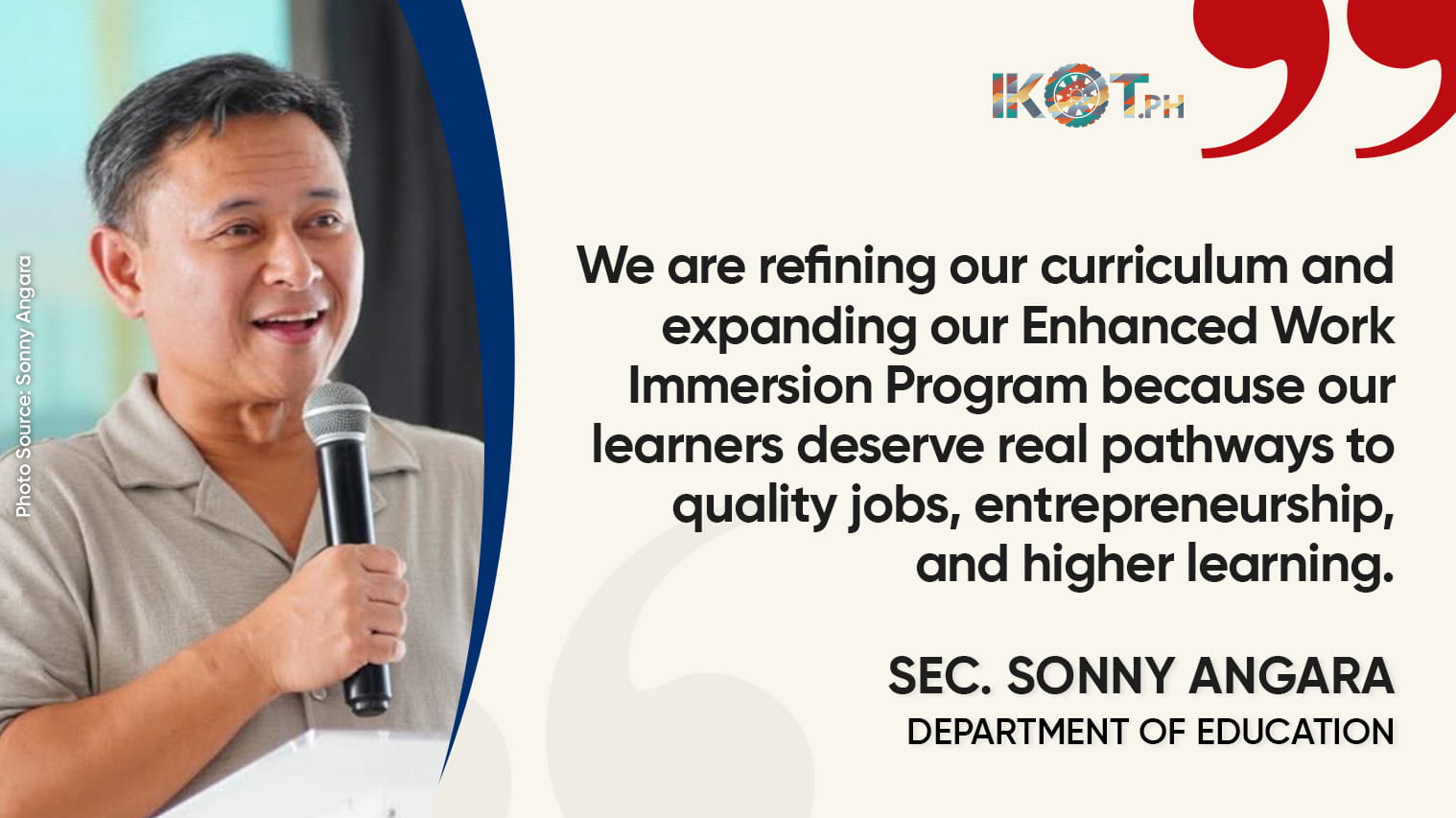
“We are refining our curriculum and expanding our Enhanced Work Immersion Program because our learners deserve real pathways to quality jobs, entrepreneurship, and higher learning. We cannot build a future-ready economy with yesterday’s skills framework,” Angara added.
Under Secretary Angara’s direction, DepEd is streamlining the Senior High School framework from four tracks into two—Academic and Technical-Professional (TechPro)—giving learners greater subject flexibility while embedding intensive, industry-guided work immersion options.
For TechPro learners, this enhanced work immersion features structured, joint training plans, hands-on mentoring, and industry assessments tied directly to national skills certifications. By combining the Philippine Qualifications Framework (PQF) with industry skills standards, the initiative aims to bridge the labor market’s “missing middle,” filling essential roles for skilled technicians, technologists, and associate professionals.
Highlighting the urgency of bridging national policy with actual private-sector needs, Undersecretary Rafaelita M. Aldaba, who heads the PQF Secretariat, Policy and Planning Service, and Education Center for AI Research, noted that broad discussions on education must now translate into concrete labor market alignment.
“Our graduates must enter the workforce with genuine hands-on experience and real competencies. By sitting down directly with our industry leaders, we are ensuring that what we teach in school matches what the real world actually demands.”
“I hope today’s dialogue can help us move from the very broad language of skills mismatch toward much more concrete questions: what jobs are changing; which roles can SHS graduates realistically enter; what skills, qualifications, and work experience do they need; and where can those roles lead after three, five, ten years?,” Aldaba said.
“Whether we are talking about construction, EV servicing, tourism, food processing or logistics, we should begin making these pathways explicit. And this is particularly important for young people. They should not only know what job they can get after graduation, they should also be able to see where that job can lead,” Aldaba also said.
During the open discussions, sector representatives pointed to rapid technological disruption, noting that entry-level requirements are shifting toward complex decision-making, critical thinking, and advanced digital capability.
Industry leaders also underscored the necessity of embedding strict workplace safety standards, essential soft skills, and ethical values into early career training to ensure learners succeed in high-demand environments. The event was livestreamed, attracting over 31,000 online views.
Partner associations expressed strong support for structured immersion models, with initial industry commitments already pledging around 31,000 work immersion slots, reaching over 60 percent of DepEd’s 50,000-slot target across over 1,100 distinct job roles.
DepEd will next roll out sector-specific industry cluster discussions to map out emerging job roles, update work immersion guidelines, and integrate real-time labor market information into the national curriculum.