
Camarines Sur (CamSur) Reps. Migz Villafuerte and Luigi Villafuerte are asking agriculture and transport authorities to look into possibly expanding the scope and duration of a novel month-long government initiative on the toll-free transport of farm produce, as a way to stabilize for a longer period both the supply and retail cost of rice and other food items amid the elevated global fuel prices resulting from the war in the Middle East.
The Villafuertes lauded the month-long exemption from tollway fee payments of truckers hauling food items, under a newly launched project facilitated by the Departments of Agriculture (DA) and of Transportation (DOTr), and expressed hopes these agencies could work with toll operators on making this initiative last for longer than a month and cover as many as 4,000 trucks that transport a combined 16,000 metric tons (MT) of farm goods to markets on a daily basis.
Launched last Monday (April 20), this “Agri-Trucks Toll Free Program” was facilitated by the DA, DOTr and the DOTr-attached Toll Regulatory Board (TRB) with toll concessionaires Metro Pacific Tollway Corp. (MPTC) and the SMC Tollway Corp. (SMCTC), and covers 1,162 trucks that are already accredited under the DA’s Food Lane program, which was initiated during the pandemic to ensure the continuous transport of goods amid the then-Covid 19 mobility lockdowns nationwide.
“We commend the DA, DOTr and TRB along with toll concessionaires MPTC and SMTC for this month-long project that would benefit farmers, traders and consumers, given that the toll-fee transport of goods not only guarantees the faster delivery of agricultural commodities from farms to markets, but also cuts transportation expenses that should redound to cheaper foodstuffs on retail,” said Migz, a member of the multi-committee Legislative Energy Action and Development (LEAD) Council as chairman of the House committee on information and communications technology (ICT).
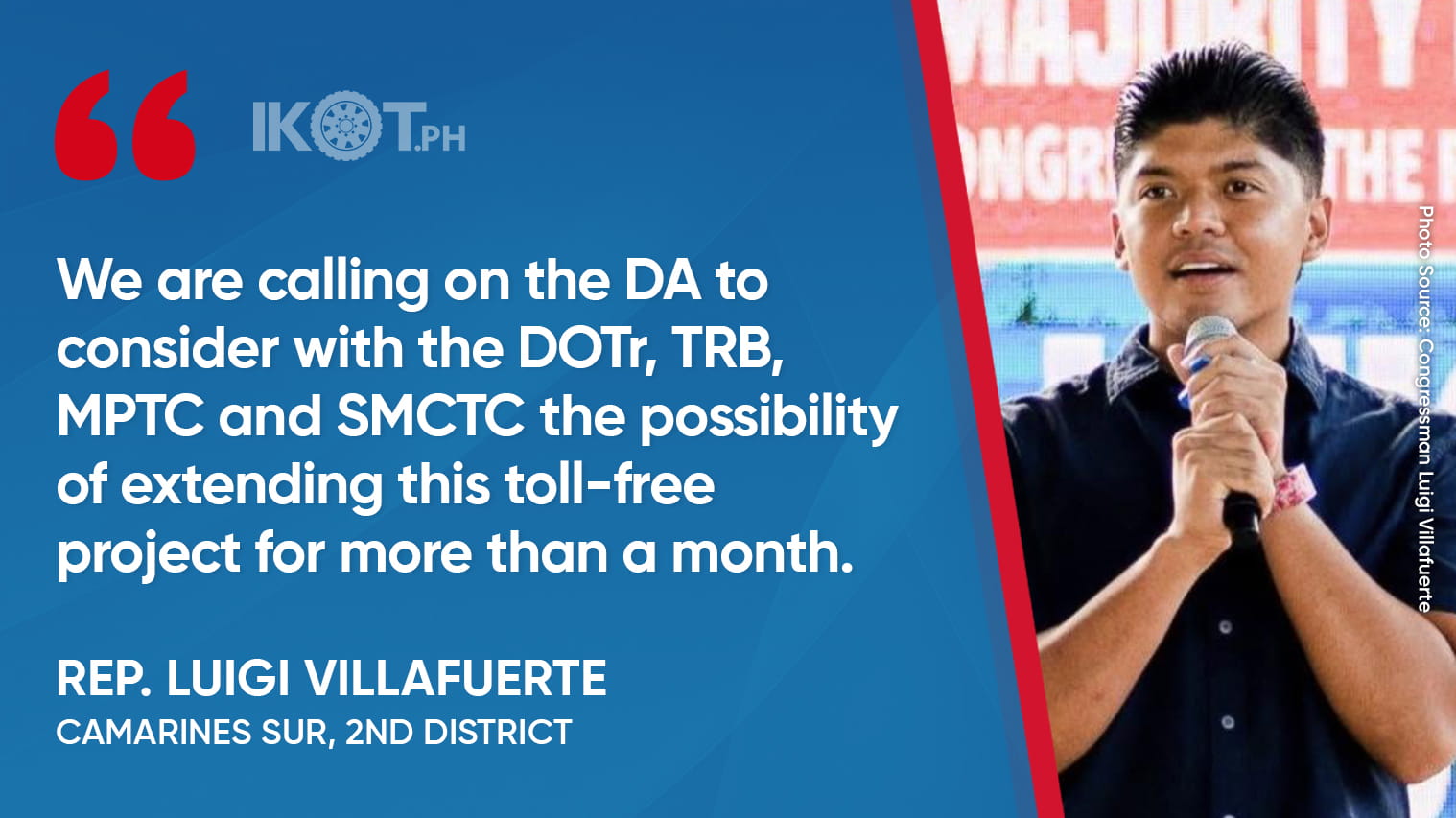
Luigi, a deputy majority leader, said that, “To help ensure stable supplies and retail prices of farm goods for a much longer period for the benefit of farmers, traders and consumers, we are hoping that the DA, DOTr and TRB would consider exploring with toll operators MPTC and SMTC the possibility of extending the toll-free exemption of haulers beyond one month and to cover as many as 4,0000 truckers.”
Migz Villafuerte said the toll-free transport of agricultural foodstuffs from farms to markets cuts the logistics costs for farmers or producers, traders and food distributors, which results in the faster hauling of these goods across the expressways or tollways as well as cheaper farm
The LEAD Council, which has House ways and means committee chairman and Marikina City Rep. Romero “Miro” Quimbo as overall chairperson, was created by Speaker Faustino “Bojie” Dy III earlier this April to tackle and craft new legislation addressing the war-induced global economic crisis.
In step with Executive Order (EO) No. 110 that President Marcos had issued to facilitate the whole-of-government approach to dealing with the negative impact of the war-triggered global oil shock, the DA implemented the Agri-Trucks Toll Free Program with the DOTr, TRB and toll operators granting 100% fee exemptions to accredited agricultural transport vehicles passing through the tollways of MPTC and SMTC.
The MPTC tolls are the North Luzon Expressway (NLEX), Subic-Clark Tarlac Expressway (SCTEX), NLEX Connector, NLEX Harbour Link, Manila-Cavite Expressway (CAVITEX), CAVITEX-C5 Link, Cavite-Laguna Expressway (CALAX), and the Cebu-Cordova Link Expressway (CCLEX) in Cebu.
The SMCTC are the Skyway System, South Luzon Expressway (SLEX), STAR Tollway, NAIA Expressway (NAIAX), and Tarlac-Pangasinan-La Union Expressway (TPLEX).
Migz said the toll-free transport of agricultural foodstuffs from farms to markets cuts the logistics costs for farmers or producers, traders and food distributors, which results in the faster hauling of these goods across the expressways or tollways as well as cheaper farm commodities in retail markets, especially in urban centers.
The DA said that although there are actually 4,0000 registered truckers, only 1,162 have valid accreditation at present.
The DA and DOTr said this toll-free project will last for one month.
“Hence, we are appealing to the DA to take extra effort to onboard the rest of the 4,000 registered truckers as a way to expand the scope of this novel initiative by streamlining its registration process, expanding enrollment on-site and/or online, and faster approvals of interested or would-be applicants,” Luigi said.
“Also, we are calling upon the DA to consider with the DOTr, TRB, MPTC and SMCTC the possibility of extending this toll-free project for more than a month,” he added.
This initiative is part of the Unified Package for Livelihoods, Industry, Food, and Transport (UPLIFT) program of President Marcos for the agricultural sector, to ensure that food items remain accessible and affordable despite surging oil prices arising from the Mideast war and supply disruptions at the Strait of Hormuz, where 20% of petroleum shipments from the oil-producing Persian Gulf countries pass en route to world markets.
This project integrates digital registration, QR-coded accreditation and RFID enrollment to ensure smooth verification across the tollways.
According to reports, the 1,162 truckers thus far accredited under this project could save P52 million to P152 million in transport expenses.
Every trucker can reportedly save ₱1,500 to ₱6,000 per trip.
Earlier, Migz Villafuerte backed a LEAD Council proposal on a two-month suspension of the collection of the Value Added Tax (VAT) on petroleum products, “to relieve the burden of the now outrageous fuel prices, which, unless eased, could possibly shove as many 1.34 million to 3.5 million near-poor Filipinos into poverty.”
Migz said he supports Quimbo’s proposal “to put off for two months the collection of VAT on petroleum products, to give Filipinos a badly-needed respite from the rocketing pump prices of diesel and gasoline brought about by the Middle East war that broke out in end-February.”
“I agree with Rep. Miro that a two-month VAT suspension is feasible, in light of the projected P20 billion windfall profits that the government has thus far collected from the outrageously high diesel and gasoline prices at the pump after the US-Israel joint attack on Iran began nearly two months ago,” Migz said.
He explained that a substantial and quick reduction of fuel prices is necessary to prevent a spike in the country’s poverty rate, given that the government think tank Philippine Institute for Development Studies (PIDS) projects as many as 1.34 million to 3.5 million more Filipinos could become poor owing to the economic shocks arising from the sky-high oil prices amid the Mideast war.
From a per-barrel average of $60 to $70 for crude oil at the onset of 2026, global prices soared to $110 to $120, and even peaking briefly at $128, after the US-Israel joint air strikes on Iran started on Feb. 28.
From a pre-war average of P48 to P65 per liter of diesel and P49 to P63 for gasoline, such rates went up in Metro Manila to P110 to P150 for diesel and P82 to P105 for gasoline before the start of the Pakistan-brokered ceasefire between the US and Iran on April 8.
Crude oil prices eased to $80 to $86 a barrel this week because of the two-week ceasefire, leading to price cuts in diesel and gasoline.
Because of the big-time price rollbacks over the past two weeks, pump prices now range from P80.06 to P111.76 per liter for diesel and from P72.59 to P98.69 for gasoline.
Even before the US-Israel war on Iran began last February, Migz and Luigi Villafuerte already expressed concern about the steady pre-war spike in fuel prices, and pushed the congressional approval of a measure—House Bill (HB) No. 3388—on a monthly fuel subsidy of ₱1,000 to municipal fisherfolk plus their automatic enrollment in the National Health Insurance Program (NHIP).
In HB 3388, the Villafuertes proposed the establishment of a subsidy program dubbed “Pantawid Pambangka Program,” to help defray our fisherfolk’s fuel expenses, which eat up as much as 60% to 80% of the daily income they earn from their fish catch.
With the high cost of fuel, small-scale fishers reportedly spend P800 to P1,000 on diesel per fishing trip, forcing them to earn as low as P300 to P500 when their fish catch is low.
To save on fuel costs, small fishers either cut their fishing trips from 6-8 hours down to 4-5 hours, limit their trips from 5-6 days per week to only 3-4 days, or look for alternative livelihoods.