
The House of Representatives concluded nine days of plenary deliberations on House Bill No. 10858, or the proposed Fiscal Year 2027 General Appropriations Bill, completing the line-by-line examination of the government’s proposed ₱7.2-trillion national budget.
245 departments, agencies, attached agencies, and government-owned and controlled corporations, as well as 113 State Universities and Colleges underwent hours of plenary scrutiny as lawmakers examined their proposed appropriations, program requirements, implementation capacity, and alignment with national priorities.
The nine-day deliberations covered key sectors and agencies, including education, agriculture and food security, higher education, social protection, health, energy, transportation, and infrastructure. Among the major discussions were the proposed budget for basic education; funding for agriculture and irrigation amid climate risks; the proposed budgets of the Commission on Higher Education and State Universities and Colleges; social welfare programs; health services; energy resilience; mass transportation; and stricter project evaluation and accountability measures for infrastructure projects.
At the center of the final day’s deliberations was House Committee on Appropriations Chairperson Representative Mikaela Angela Suansing, who led the plenary discussion on lump-sum funds for three hours.
Suansing emphasized that the House will consider additional safeguards as it crafts the 2027 General Appropriations Act, particularly on the rules and standards governing the use and evaluation of funds.
The veteran legislator also underscored the importance of establishing clear reportorial requirements and continuing coordination with the Department of Budget and Management, including on the Local Government Support Fund.
The Appropriations Chairperson further assured that, for projects included in the House General Appropriations Bill and ultimately in the General Appropriations Act, documentary requirements emanating from the Department of Public Works and Highways will adhere to the same standards. The final-day discussion also emphasized climate resilience and fiscal discipline, with Suansing assuring that the proposed spending plan is being examined in light of the country’s anticipated climate and fiscal requirements.
“The 2027 budget is El Niño ready.”
“The 2027 budget is El Niño ready. We will do our best; I give you my assurance,” the lady lawmaker committed.
She also pointed to the level of unprogrammed appropriations in the 2027 National Expenditure Program, noting that it represents the lowest unprogrammed appropriations-to-total-expenditure ratio in decades.
“Ito po ang pinakamababang unprogrammed appropriations level sa mahabang panahon.”
“It’s also noteworthy that the current level of unprogrammed appropriations, as stated in the 2027 NEP, is the lowest in terms of the unprogrammed appropriations-to-total-expenditure-program ratio. Ito po ang pinakamababang unprogrammed appropriations level sa mahabang panahon. Dahil po, ’yun din po ang pananaw ng DBM: kapag programmable siya, identifiable po siya, nilalagay po nila sa programmed appropriations instead of unprogrammed appropriations,” Suansing stressed.
The Department of Budget and Management has placed the proposed 2027 unprogrammed appropriations at ₱111.984 billion, equivalent to about 1.6 percent of the Total Expenditure Program — the lowest proposed share since 1991 and the lowest proposed amount at the NEP level since 2019.
The nine-day plenary review builds on the transparency and accountability measures Suansing laid out at the opening of deliberations, where she emphasized that the budget must go beyond figures and serve as a framework for responsible public spending. The House has likewise continued efforts to make the budget process more open to the public, including publishing budget documents and schedules and livestreaming proceedings.
To recall, Suansing highlighted in her sponsorship speech that the House must craft a budget that balances fiscal realities with the country’s most urgent needs.
“Our goal over the course of these deliberations is to craft a 2027 budget that would accelerate growth despite this challenging fiscal landscape, which would give due consideration and prioritization to the pressing needs of our most salient social and economic sectors,” the Chairperson of the Committee on Appropriations said.
The statement underscored the central objective that guided the nine-day deliberations: to examine the proposed spending plan not only in terms of allocations, but also in terms of its capacity to respond to the country’s pressing social and economic priorities.
Echoing House Speaker Faustino “Bojie” G. Dy III’s call for transparency and accountability in the budget process, Suansing also highlighted the House’s commitment to opening the budget process to greater public scrutiny.
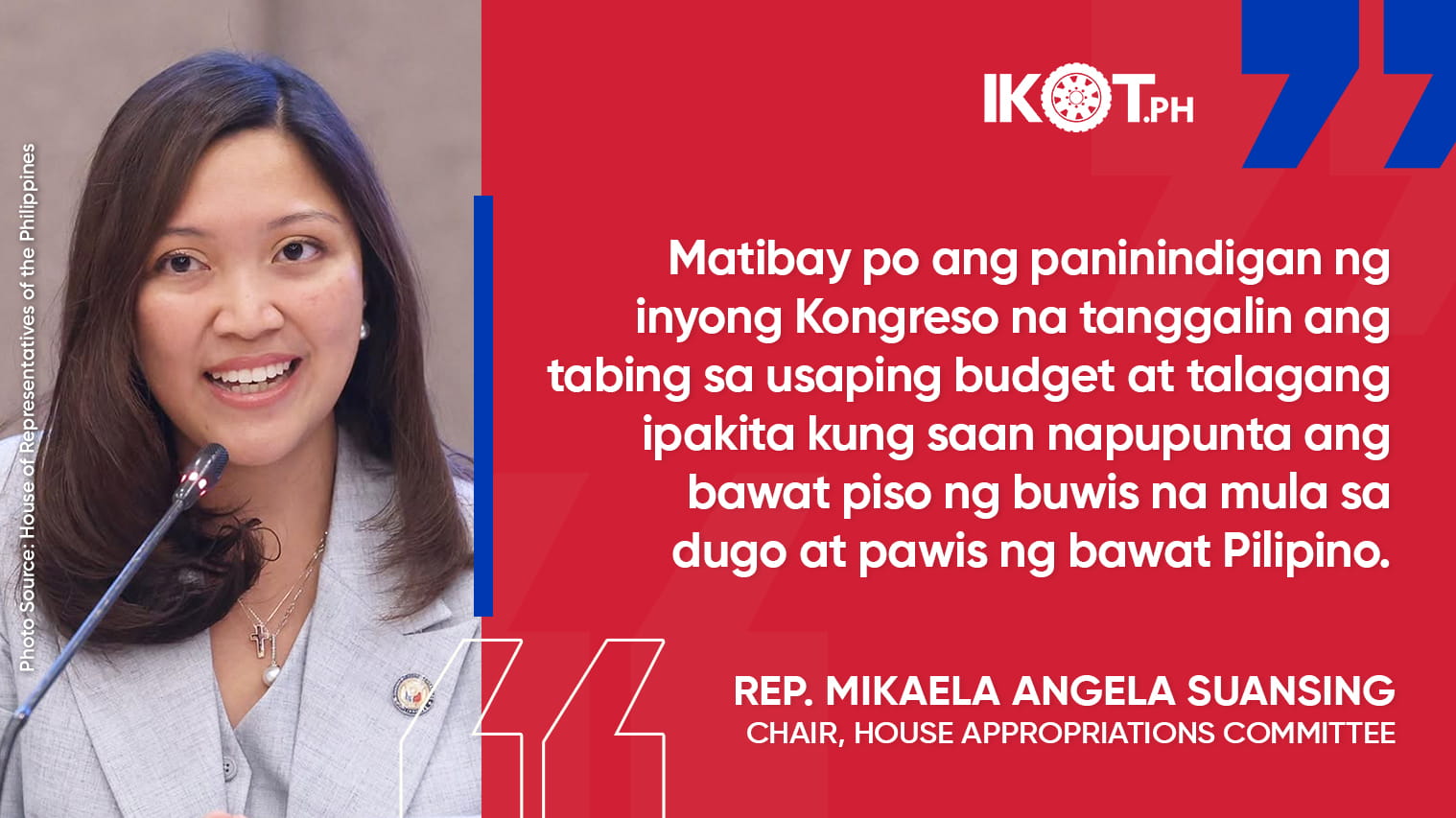
“Matibay po ang paninindigan ng inyong Kongreso na tanggalin ang tabing sa usaping budget at talagang ipakita kung saan napupunta ang bawat piso ng buwis na mula sa dugo at pawis ng bawat Pilipino,” she stressed.
With the completion of plenary deliberations, the House has concluded the scheduled line-by-line examination of the proposed 2027 national budget, as the legislative process proceeds to the succeeding stages of deliberation on the General Appropriations Bill.