
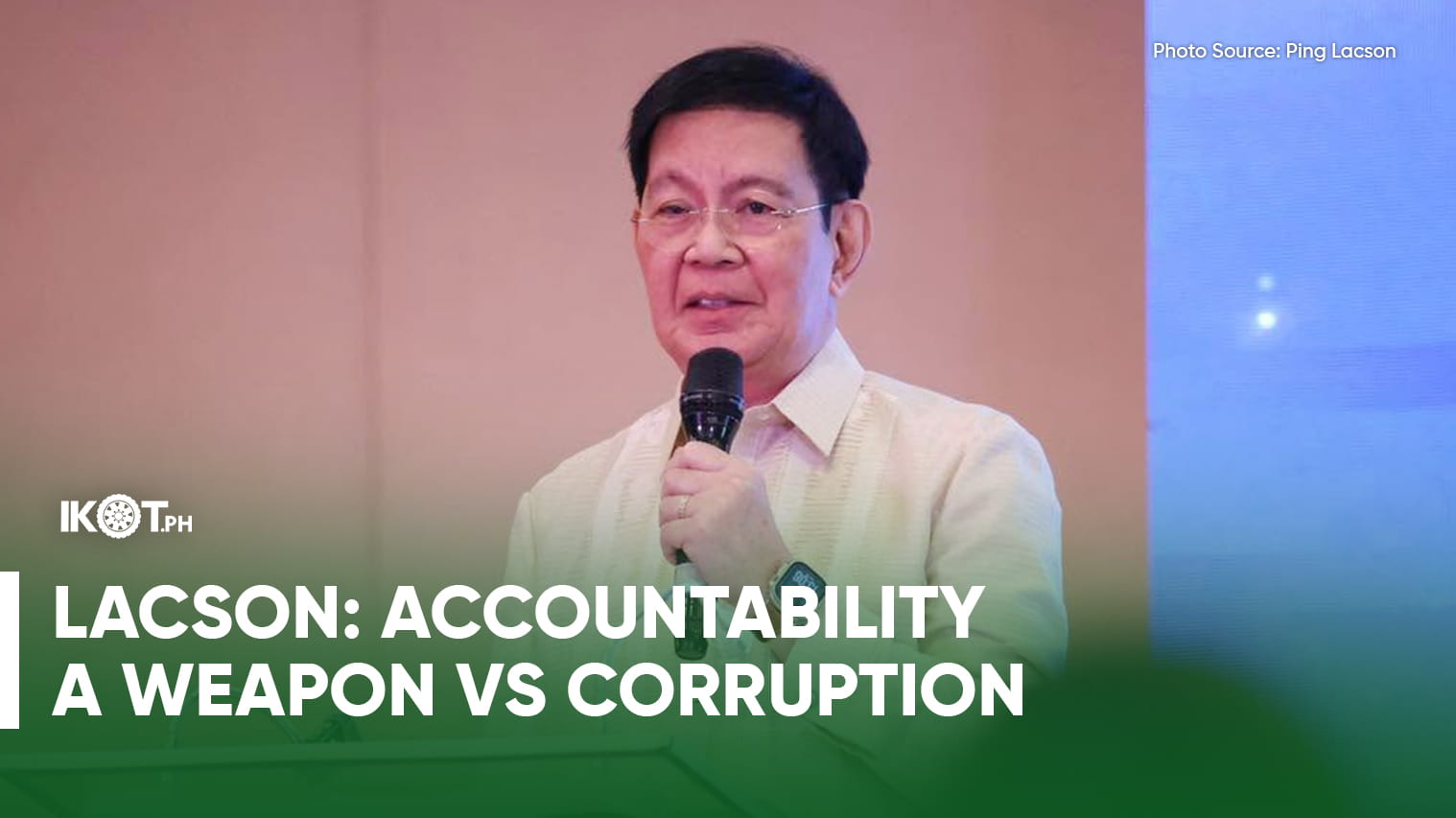
Accountability, as enshrined in the 1987 Constitution, is both a weapon against corruption and a shield for honest public servants – and this principle applies amid controversies such as the current flood control mess, Senator Panfilo Lacson stressed.
Lacson, in his speech before the Philippine Constitution Association’s 65th anniversary in Makati City, said the Constitution’s provision that “Public office is a public trust” is a principle that cannot be compromised or negotiated.
“If your decisions are proper, let the records speak; If your actions are lawful, let the evidence establish it; if your conscience is clear, scrutiny should not frighten you.”
“If there is one thing that continues to ring true, especially in this whole flood control mess, it is this: accountability is the enemy of corrupt public officials, but a shield of honest public servants. If your decisions are proper, let the records speak; If your actions are lawful, let the evidence establish it; if your conscience is clear, scrutiny should not frighten you. In fact, the honest public servant should be able to say: ‘Go ahead. Audit me,’” the veteran legislator said.
“The person who fears accountability, however, may have a different reaction. He or she may say, ‘Why single me out?’ Someone would even cry, ‘This is political persecution and intimidation and pressure’ – which, by the way, sounds very familiar,” the seasoned lawmaker added.
During an informal forum after his speech, the senator added that accountability “is only one word but it is the most powerful word in the Constitution.”
He noted that corruption has taken many forms and styles across multiple administrations, constantly mutating, adapting and exploiting public trust.
Lacson said scandals involving public funds across several administrations —particularly the unprecedented pork barrel scam — showed how power can not only corrupt the insatiably greedy but also tempt even good people to believe that the rules should “bend just a little—for them.”
“That is why our Constitution does not ask us simply to trust the character of those in power. It creates institutions designed to check power itself — through every crisis, shift in leadership, and changing tide,” he stressed.
“We go where the evidence takes us.”
When he chaired the Senate Blue Ribbon Committee and led its investigation into the flood control mess after delivering two privilege speeches on the issue, Lacson upheld accountability by making a single, non-negotiable vow: “we go where the evidence takes us”.
As a result, the Blue Ribbon hearings he chaired did not just expose wrongdoing but also laid the foundation for the cascade of cases now facing the corrupt inside and outside government.
But Lacson said there can be no true accountability or justice if honesty is demanded only from subordinates, while those in authority are exempted.
“To my mind then and now, there can be no genuine accountability if honesty is demanded only from subordinates while those in authority excuse their own misconduct. There can be no justice if the law is enforced against the weak but negotiated with the powerful,” he said.
“At all times, we must be careful not to allow the language of public administration to become a convenient vocabulary for avoiding responsibility. Sometimes, when we say – ‘I exercised my discretion,’ what we really mean is – ‘I did what I wanted.’ Sometimes, when we argue – ‘It was a collective decision,’ we actually mean – ‘Nobody wants to take responsibility’,” Lacson added.
Many even try to justify their actions by using the oldest excuse in the book: “I was only following orders,” he stressed.
Lacson said integrity, accountability and character – three must-have values for public servants – can be taught at home and at an early age, citing a childhood experience that inspired him to adhere to these values, especially integrity.
He recalled the story of his older brother Eli, who as a pupil in the 1950s found a one-centavo coin, which carried real weight and value at the time, while on his way home from school.
When he got home and told his mother Maxima, who worked as a market vendor, she sternly admonished him and told him to look for the owner of the coin the next day.
Lacson pointed out, however, that it is in the possession of power and authority that can truly test one’s character. For public servants, he said every day is a test of whether they are worthy of the trust that the Filipino people have placed in them.
He recalled his own experience of upholding accountability even when it led to conflicts with those in power – over allowing jueteng to continue during the Estrada administration, various corruption scandals during the Arroyo administration, the Disbursement Acceleration Program and the Napoles pork barrel scam during the Aquino administration, and the Pharmally scandal during the Duterte administration.
“Real accountability teaches us that one cannot be simply answerable to the person above him. Rather, it is about being responsible to your oath and ultimately, to the people… Holding someone accountable is not necessarily an act of revenge. It is an act of respect—for the law, for public institutions, and most of all, for the people who have entrusted us with authority,” Lacson said.
“Accountability must follow responsibility; responsibility must follow authority. If you have the authority to decide, you must have the courage to answer for that decision, no matter your political color,” he added.
Lacson said public servants must remind themselves every day that the power they wield “was never ours to begin with,” and that it is only “borrowed, entrusted to us no less by the people we serve”.
“It demands that every public servant be prepared to explain, defend, and, when necessary, answer for every decision made and every action taken in the exercise of public authority,” he said.
“Corruption and those behind it will definitely find their way to exploit our trust. But as public servants, we are called to stand on the same ground – the Constitution, and our commitment to upholding it,” Lacson added.
He also pointed out that while many lawyers with different persuasions may have varying views in interpreting any legal fact, only the principle of accountability “stands absolute”.
“(W)hile the many lawyers with different persuasions in this room can surely find as many different ways to interpret any legal fact, there is one principle that stands absolute – one truth we cannot compromise or negotiate. Above all legal debates, we must remain bound by the foundational principle we are sworn to uphold for our people and our nation, that is, ‘Public office is a public trust’,” he concluded.