
Senator Ping Lacson filed a resolution seeking a Senate inquiry into the continuing increase in electricity rates and the “bill shock” experienced by consumers, amid concerns over unexplained charges, alleged irregularities in meter readings, and system losses ultimately shouldered by law-abiding consumers.
Under Senate Resolution No. 511, Lacson urged the appropriate Senate committee to conduct an inquiry in aid of legislation, to strengthen transparency, accountability and consumer protection in the power industry.
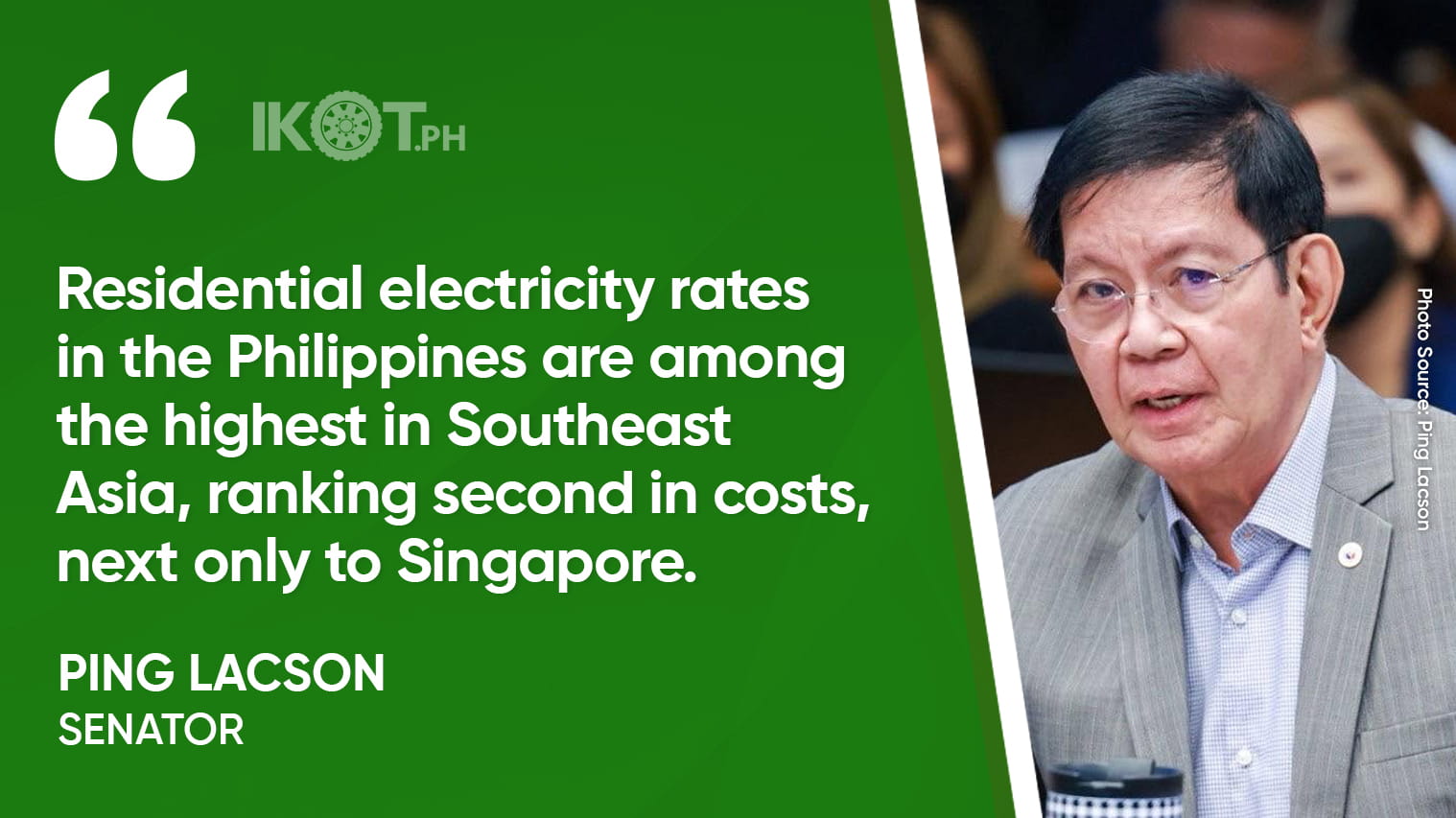
“(While) access to affordable and reliable electricity is fundamental to promoting Filipinos’ welfare, national productivity, and economic development … residential electricity rates in the Philippines are among the highest in Southeast Asia, ranking second in costs at approximately US$0.18–US$0.21 per kilowatt-hour (kWh), next only to Singapore’s average of US$0.23 per kWh, thus placing a disproportionate financial burden on Filipino families, workers, and enterprises,” the veteran legislator said in his resolution filed.
Such high electricity costs place a disproportionate financial burden on Filipino families, workers, and businesses, the seasoned lawmaker said.
“It is incumbent upon the legislature to exercise its oversight function to determine whether existing regulatory mechanisms effectively protect consumers from excessive, unreasonable, or avoidable increases in electricity charges.”
“While fluctuations in electricity prices may be attributed to supply constraints due to geopolitical tension, higher generation costs, foreign exchange rates, mandatory charges, and other market factors, it is incumbent upon the legislature to exercise its oversight function to determine whether existing regulatory mechanisms effectively protect consumers from excessive, unreasonable, or avoidable increases in electricity charges,” the senator added.
He pointed out that Section 9, Article II of the 1987 Constitution provides that the shall promote a just and dynamic order that will “free the Filipino people from poverty through policies that provide, among others, a rising standard of living and improved quality of life for all.”
Yet, Lacson noted that over the past months, consumers of Manila Electric Company (Meralco) have reported “substantial and unexplained increases” in their electricity bills or “bill shock.”
He also cited reports that the Energy Regulatory Commission (ERC) authorized Meralco and four power generation companies last January to recover P31.34 billion in costs due to various changes in circumstances (CIC), which was expected to result in higher electricity rates beginning March 2026.
In April, Meralco raised electricity rates by P0.5335 per kWh. While power rates declined in May, they increased again by P0.1488 per kWh in June with Meralco citing high wholesale electricity prices, rising fuel costs, and the depreciation of the peso.
Overall, Meralco’s residential rate from January to July 2026 saw an increase from P13.2730 per kWh to P14.8261 per kWh.
Beyond these increases, Lacson said consumers have raised concerns over alleged irregularities in meter readings, as well as costs associated with system loss charges, which cover technical and non-technical losses incurred in the transmission and distribution of electricity.
He added consumers have questioned as well non-technical system loss charges, particularly those arising from electricity pilferage through meter tampering, illegal connections, and the use of jumpers, “which are being covered by law-abiding and paying consumers.”
On the other hand, Lacson said advocates have argued that system losses should not be passed on to consumers, as this seems to unfairly reward operational inefficiency while giving distributors less incentive to strengthen measures against electricity pilferage.
“System losses should not be passed on to consumers.”
His resolution thus resolved to “direct the appropriate Senate Committee to conduct an inquiry, in aid of legislation, into the continuing increase in electricity rates with the end in view of strengthening transparency, accountability, and consumer protection in the power industry.”