
The Right to Information (RTI) bill cleared by the House of Representatives seeks to require all government offices, including local government units (LGUs), to each assign an RTI officer (RIO) and RTI decision maker (RDO) to process and keep track of all requests for information in their respective workplaces, according to Deputy Majority Leader Luigi Villafuerte.
Substitute House Bill (HB) No. 9397, which was one of the priority bills passed by the House before the 20th Congress adjourned sine die this June, “establishes the constitutional right of Filipinos to access official records, contracts, expenditures, policy papers and other information of public concern that are held by the government,” said Villafuerte, one of this measure’s main authors.
Villafuerte said this RTI bill, which has been pending in the Congress for decades, “aims to create a centralized online RTI portal where Filipinos can file and track requests for official information or documents; and an RTI Commission to hear appeals, probe violations and enforce compliance with this proposed Act.”
“Aiming to put flesh into the provision of Article III, Section 7 of the 1987 Constitution on the people’s right to information on matters of public concern, the RTI bill covers the executive, legislative and judicial branches, constitutional commissions, GOCCs (government-owned or -controlled corporations), SUCs (state universities and colleges), and all other government instrumentalities, including LGUs,” said Villafuerte.
This substitute bill, which was passed by a 284-0 vote, had incorporated several measures, including HB 6617, which Luigi Villafuerte had authored with CamSur Reps. Migz Villafuerte—the chairman of the House committee on information and communications technology (ICT)—and Tsuyoshi Anthony Horibata along with Bicol Saro Rep. Terry Ridon.
All covered agencies and instrumentalities shall prepare and adopt their respective RTI Manuals within one hundred eighty (180) days from the issuance of the guidelines by the RTI Commission.
HB 9397 is on the priority list of legislative measures that President Marcos had drawn up with the Legislative-Executive Development Advisory Council (LEDAC).
It was principally authored by Speaker Bojie Dy III and House Majority Leader Sandro Marcos III with Reps. Lordan Suan (Cagayan de Oro City) and Mikaela Angela Suansing (Nueva Ecija), who are the respective chairpersons of the House committees on public information and on appropriations.
Within 60 days from the effectivity of this Act, all government agencies, including their regional or local offices, are required to designate one RIO and one RDM per office, Luigi said.
RIOs and RDMs shall be designated from among the existing officials or employees holding plantilla positions, and they shall hold such assignments in concurrent capacity, he said, subject to existing rules of the Civil Service Commission (CSC) and the Department of Budget and Management (DBM).
However, given the autonomy accorded our LGUs under the Constitution and the Local Government Code (LGC) of 1991, the bill allows LGUs to determine the appropriate organizational arrangement for the selection of their respective RIOs and RDMs, said Luigi, who, like Migz, had served as CamSur governor prior to election to the House.
As stated in the bill, the creation of new plantilla positions for the RIO and RDM of every LGU shall be within the discretion of the concerned local government to create such positions when it deems necessary and consistent with its organizational requirements and fiscal capacity, subject to applicable civil service laws, budgetary regulations, and personnel services limitations, Luigi said.
The RIOs shall receive, acknowledge, track, and monitor all RTI requests and appeals in their respective offices, while the RDMs shall be officials occupying positions of sufficient rank and authority, not lower than a Division Chief or its equivalent, or, if unavailable, the highest-ranking official authorized to decide on disclosure matters, he added.
Through HB 9397, constituents can have clearer access to information regarding government projects, infrastructure developments, public programs and services, budget allocations and expenditures, and other transactions involving public interest.
He said the detailed roles, responsibilities and reporting procedures of the RDMs and RIOs shall be prescribed in the Implementing Rules and Regulations (IRR) of this Act.
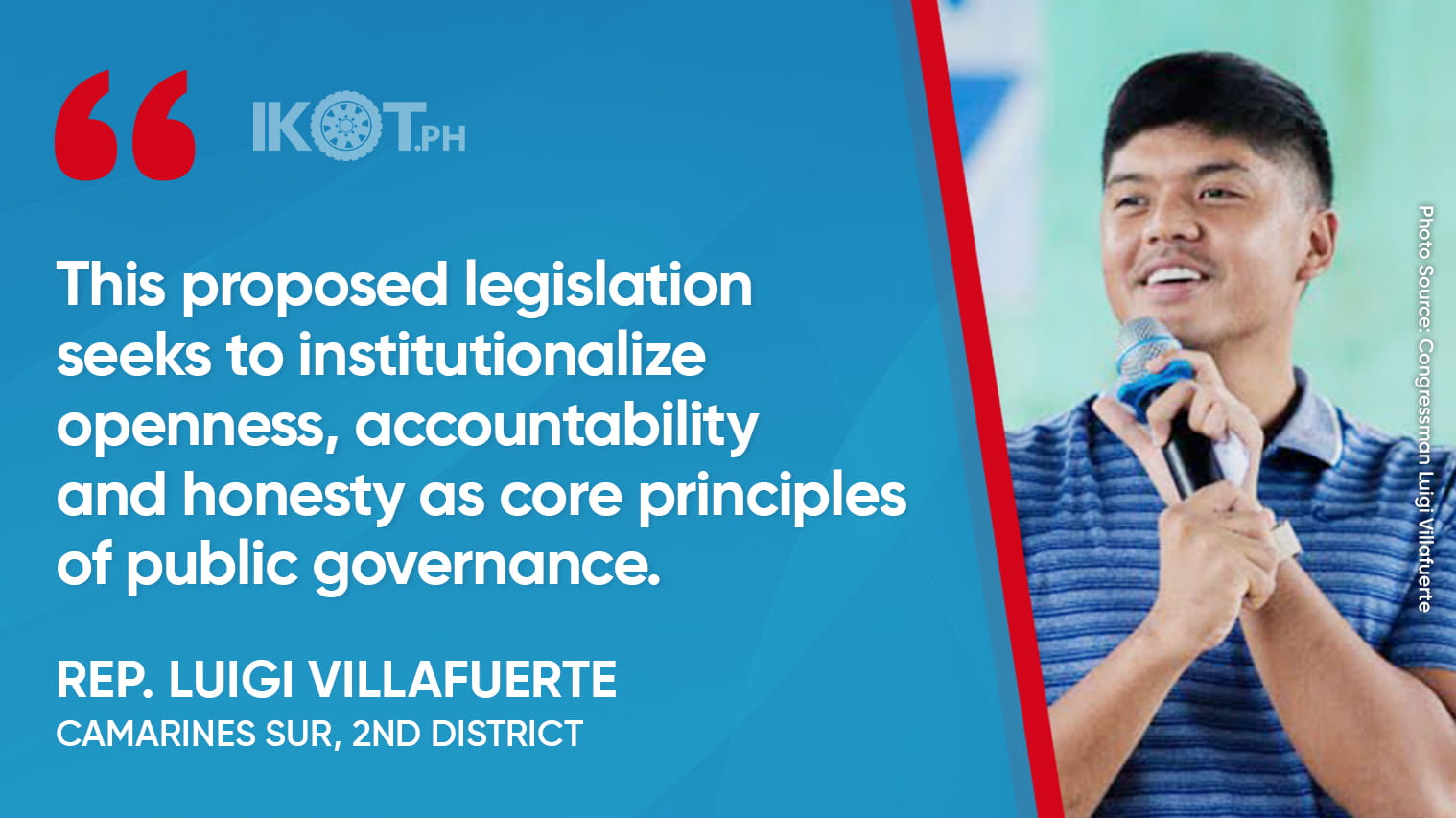
As pointed out by Speaker Dy, Luigi said this proposed legislation seeks to institutionalize openness, accountability and honesty as core principles of public governance.
Migz Villafuerte said, meanwhile, that the bill “establishes a default rule in favor of disclosure, which means that information or public records should be released unless it clearly falls under defined exceptions such as national security and privacy.”
Also, said Migz, the bill “requires government bodies to automatically publish key public interest information, such as agency budgets, procurement plans, and contracts, among others, to enable easier public access without needing to file a request.”
Moreover, he said, it “standardizes request procedures where agencies must publish an RTI manual, track requests, and respond within a fixed timeframe.”
The bill imposes administrative, civil and/or criminal penalties for officials proven to have illegally withheld or destroyed information, Migz said.
Posting on Facebook, Luigi said that, “Through HB 9397, constituents can have clearer access to information regarding government projects, infrastructure developments, public programs and services, budget allocations and expenditures, and other transactions involving public interest.”
Luigi said in the same post that this bill “seeks to institutionalize the constitutional right of Filipinos to access government information and records,” and that its key provisions intend “to strengthen government transparency and accountability.”
HB 9397 separates requests into:
· Simple requests, which refer to readily available information or records, including those already published on its website or maintained in its records management system, and which require minimal review or processing;
· Complex requests, which refer to requests for information that involve the retrieval, review or extraction of existing records or data from a single office or source, including those requiring the identification and compilation of existing information from voluminous records; and
· Highly technical request, which refers to information involving the retrieval, review or extraction of existing records or data from multiple offices or sources, large volumes of documents, or records covering multiple years, and which may require specialized technical skills for purposes of format conversion, data extraction or reproduction.
Through their RIOs, government agencies shall respond to requests for information within three (3) working days for simple requests, seven (7) working days for complex requests, and twenty (20) working days for highly technical requests from receipt of the requests.
All covered agencies and instrumentalities shall prepare and adopt their respective RTI Manuals within one hundred eighty (180) days from the issuance of the guidelines by the RTI Commission.
These covered offices shall establish internal review mechanisms to review and monitor every denial of a request for access to information.
The existing electronic Freedom of Information (eFOI) Portal (www.foi.gov.ph) managed by the Freedom of Information-Program Management Office (FOI-PMO) of the Presidential Communications Office (PCO) shall be transferred to the Commission, and it shall be renamed as the “Online RTI Portal.”