
President Ferdinand Marcos Jr. has signed into law the Basic Education Voucher Assistance Act, or Republic Act No. 12327, institutionalizing a nationwide voucher program that will help qualified learners enroll in private schools with available capacity and ease overcrowding in public schools.
The Second Congressional Commission on Education (EDCOM 2) welcomed the measure, which also establishes a Bureau of Private Education under the Department of Education (DepEd).
The law comes amid a persistent classroom shortage, with the current national backlog at around 147,000 classrooms.
According to the Commission there are 1,889 public schools operating on double or triple shifts in School Year (SY) 2024–2025, requiring an estimated 52,871 additional classrooms to eliminate shifting. The Commission also estimates that 51,222 classrooms will be due for condemnation by 2028 as they reach more than 50 years of age.
Signed on November 12, 2026, the law consolidates House Bill No. 4744 and Senate Bill No. 1981. It extends government assistance across all years of basic education, from Kindergarten to Grade 12, and replaces the basic education provisions of the Government Assistance to Students and Teachers in Private Education Act (RA 6728).
“Vouchers are not a substitute for building classrooms.”
“Through this law, we are directing vouchers to learners who need them most, in communities where public schools are most congested, and linking government assistance to measurable learning outcomes. Vouchers are not a substitute for building classrooms. Used strategically, however, they can help decongest public schools while the government continues to address the classroom backlog,” EDCOM 2 Executive Director Dr. Karol Mark Yee said.
“The success of this law will not be measured simply by the number of vouchers distributed, but by the number of Filipino children who are given greater freedom to pursue quality education and better opportunities to succeed. Genuine educational choice means that a child’s future should not be limited by what a family can afford, but expanded by what that child can become,” said EDCOM 2 Co-Chairperson Representative Jude Acidre, one of the law’s principal authors and chairperson of the House Committee on Higher and Technical Education.
“For decades, government assistance to private education has operated under a framework that needs to keep pace with the changing demands of our education system. This law provides an opportunity to strengthen that framework—not only by expanding access to subsidies, but also by establishing clearer standards, stronger oversight, and more sustainable support for private education institutions. We must ensure that both public and private schools are equipped to contribute to delivering quality basic education,” explained EDCOM 2 Co-Chairperson Representative Roman Romulo.
EDCOM 2 has consistently called for voucher expansion to complement investments in public school infrastructure, with subsidies targeted according to actual school congestion and available private school capacity.
In its earlier assessment of the proposed expansion to elementary learners, EDCOM 2 estimated that the program could support approximately 121,035 aisle learners, equivalent to 22.5% of this population, by providing an alternative to overcrowded public schools.
Expanded voucher assistance
Prioritizes learners who need assistance most.The program covers Filipino students from middle-middle-income households and below. Priority goes first to learners attending public schools identified by DepEd as congested, including those operating multiple shifts; those living in areas without a nearby public school within a three-kilometer walk, or without a school offering their preferred senior high school pathway; and those residing in communities with congested public schools. Within each priority group, learners from poor and low-income households receive further priority and higher voucher amounts.
Ensures fair and timely voucher payments.DepEd will determine voucher amounts based on commissioned research and review them at least every three years, taking inflation and other relevant factors into account. Subsidies cannot fall below current government assistance, and learners from poor and low-income households will receive higher amounts. The government must also disburse payments to participating schools within 60 days of receiving complete documentary requirements.
Links government assistance to learning outcomes. Participating private schools will be covered by a strengthened quality assurance system, including participation in national assessments and the regular publication of school performance data. The academic performance, retention, and completion rates of learners from vulnerable and disadvantaged households must also be tracked and reported separately.
Requires nationwide congestion mapping. Within one year of the law’s effectivity, DepEd must publish an online map identifying congested schools, including those operating multiple shifts, congested schools without nearby private institutions that can help absorb learners, and areas with insufficient school facilities. An annually updated decongestion framework will guide the allocation of vouchers and other interventions.
Strengthens safeguards against fraud and misuse of funds. The law requires a centralized system for verifying learner eligibility and school compliance, alongside regular audits, field inspections, and whistleblower protection. Fraudulent claims and misrepresentation carry criminal liability equivalent to estafa, while participating schools that violate learner protections may face administrative fines ranging from P100,000 to P500,000.
Establishes a Bureau of Private Education. The new bureau under DepEd will serve as the focal office for regulating and supporting private basic education institutions, setting quality standards, and developing a unified investment plan that identifies complementary targets for voucher assistance, classroom construction and repair, and public-private partnerships.
Provides additional support for private school teachers. DepEd may provide participating schools with in-service teacher training, scholarships for graduate studies and the Certificate in Teaching Program, and a Teachers’ Salary Subsidy (TSS) of up to 80% of the salary of their public school counterparts. The subsidy will be reviewed at least every three years.
The program will undergo a comprehensive review every three years, in coordination with the Department of Economy, Planning, and Development (DepDev) and the Department of Budget and Management (DBM), to assess its effectiveness in addressing congestion, improving learning outcomes, expanding access to quality education, and ensuring cost-effectiveness and sustainability. Results will be submitted to Congress, together with recommended adjustments to the program.
Subject to the availability of funds, implementation for Kindergarten and elementary levels will begin in School Year 2027–2028. Current beneficiaries of the Educational Service Contracting scheme and the Senior High School Voucher Program will continue receiving assistance until they complete basic education. DepEd is required to issue the implementing rules and regulations within 60 days of the law’s effectivity.
“Bubuksan nito ang mas maraming pagkakataon para sa mga batang nagsisiksikan sa pampublikong paaralan na makapag-aral sa pribadong paaralan.”
“Mahalagang hakbang ang pagsasabatas ng Basic Education Voucher Assistance Program. Bubuksan nito ang mas maraming pagkakataon para sa mga batang nagsisiksikan sa pampublikong paaralan na makapag-aral sa pribadong paaralan. Sa pamamagitan na ito, luluwag ang mga silid-aralan at bubuti ang kalagayan ng mga bata sa pag-aaral. Ngayon, babantayan natin ang pagpapatupad ng batas upang maiwasan ang katiwalian at matiyak na uunahin ang mga batang higit na nangangailangan.” said EDCOM 2 Co-Chairperson Senator Bam Aquino.
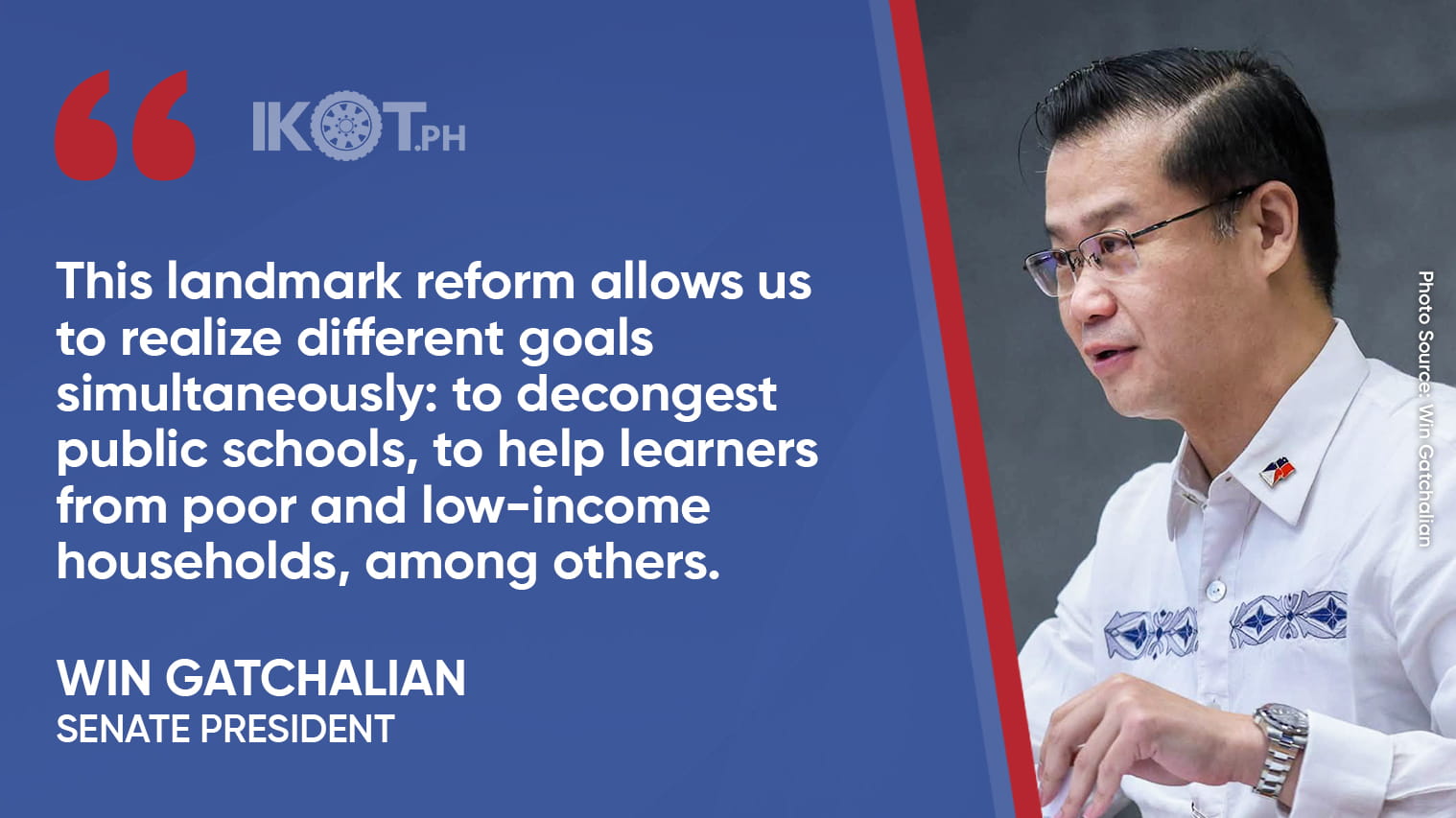
“This landmark reform allows us to realize different goals simultaneously: to decongest public schools, to help learners from poor and low-income households, among others. It is also worth pointing out that this law provides anti-fraud mechanisms to help us address challenges such as leakages and ghost students,” Senate President Win Gatchalian concluded.