
Filipinos stand to benefit from better government services and stronger safeguards against ghost projects and corruption under the proposed Philippine Budgeting Code approved by the House Committee on Revision of Laws.
The committee, chaired by Batangas 3rd District Representative King Collantes approved the bill authored by Bataan 2nd District Representative Albert Garcia and Rizal 2nd District Representative Emigdio Tanjuatco III.
The measure consolidates the country’s budgeting laws into a single framework governing how public funds are planned, spent, monitored, and accounted for.
“At its heart, it is a direct answer to two of the most persistent problems that have long plagued our public finances: ghost projects and corruption.”
“This bill is not just another technical law about numbers and forms. At its heart, it is a direct answer to two of the most persistent problems that have long plagued our public finances: ghost projects and corruption,” Collantes said.
The bill is among the 60 priority measures identified by the Legislative-Executive Development Advisory Council (LEDAC). The House has so far passed 28 of these measures.
The measure advances the commitment of Speaker Faustino “Bojie” Dy III to greater transparency and accountability in the use of public funds.
“The budget is the people’s money. They have the right to know where it will go, why it is needed, and what results they can expect,” Speaker Dy said during the turnover of the proposed 2027 National Expenditure Program.
Collantes pointed out that the designation of the Philippine Budgeting Code as a LEDAC priority bill “is a clear and deliberate signal that this Administration and its leadership are serious in the fight against corruption”.
Central to the measure is the Philippine Cash Budgeting System, which allows the government to pay only for goods, services, and projects that have been delivered, completed, and formally accepted.
“No delivery, no acceptance therefore no payment,” Collantes stressed.
Unspent funds and unpaid obligations for unfinished or nonexistent projects would revert to the National Treasury after the prescribed period.
The bill also mandates a government-wide digital system that would allow public funds to be tracked from appropriation to actual payment. Key budget documents and performance information would be made available in searchable, machine-readable formats.
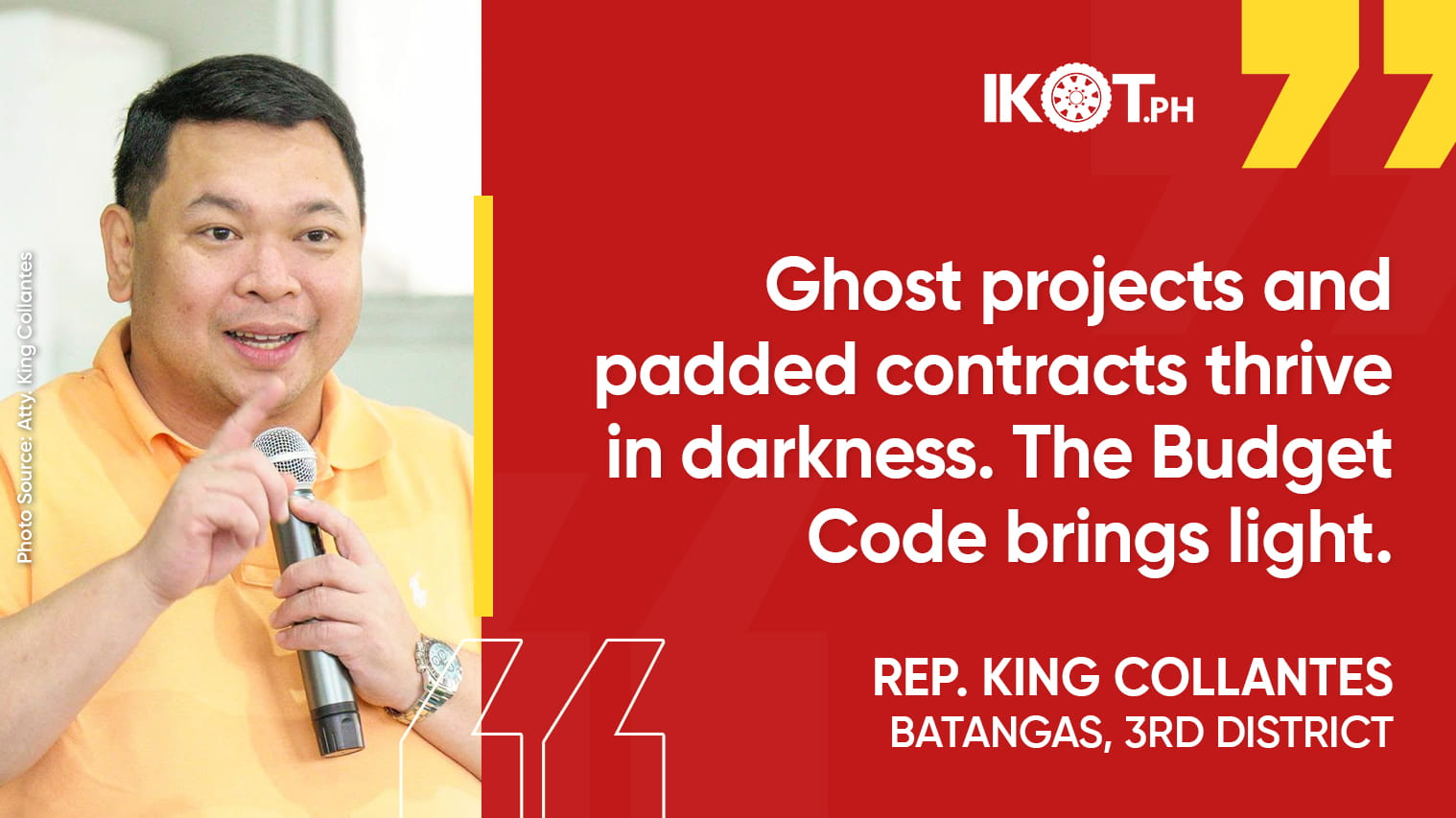
“Ghost projects and padded contracts thrive in darkness. This Code brings light,” the legislator said.
The measure also tightens the rules on savings to prevent agencies from using unspent funds for projects not authorized in the budget. It strengthens congressional oversight and makes agency heads directly accountable for the proper use of public funds.
It also institutionalizes public participation in budgeting through consultations with regional and local development councils and civil society organizations, helping ensure that government projects address the actual needs of communities.
“More eyes mean fewer opportunities for abuse.”
“More eyes mean fewer opportunities for abuse,” the lawmaker emphasized.
“The Filipino people deserve a budget system that delivers results and not one that allows waste, inefficiency, or corruption to thrive,” he added.
Speaker Dy earlier stressed that preventing the misuse of public funds would allow the government to devote more resources to programs that directly improve people’s lives.
“Every peso saved from waste, misspending, and corruption is a peso that can be allocated to classrooms, hospitals, food, jobs, agriculture, and other services directly needed by our people,” he concluded.