
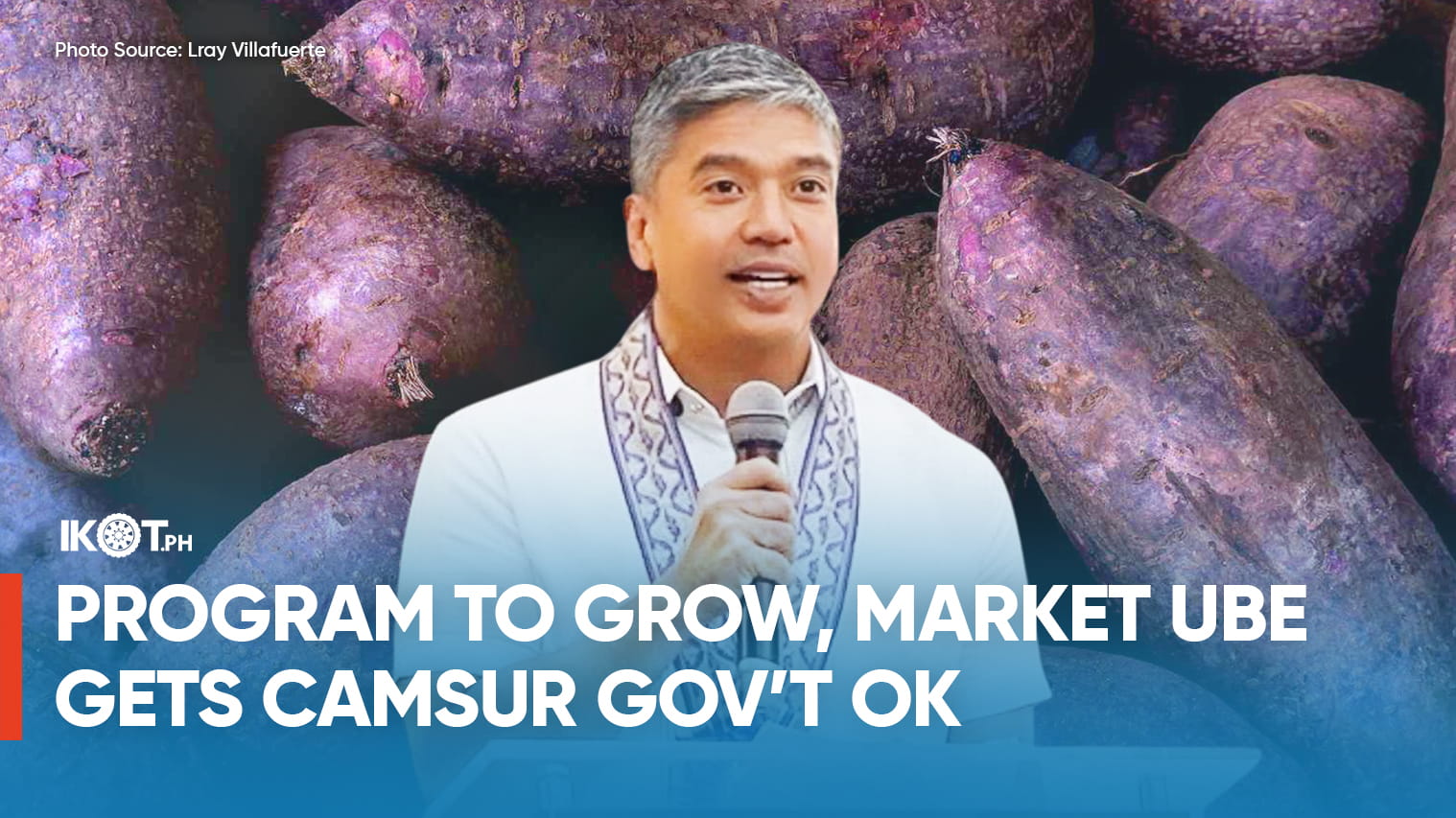
The provincial government of Camarines Sur (CamSur) is embarking on a premier value chain program from the commercial production to the export of priority crop purple yam or “ube,” cashing-in on the domestic and international sale of this tuber that has an ever-growing market here in Asia as well as in the United States (US), Europe and the Middle East.
In its most recent session, the Sangguniang Panlalawigan (SP) approved Ordinance No. 040 series of 2026 declaring purple yarn (scientific name: Dioscorea Alata) as the province’s priority crop, and establishing the CamSur Ube Development Program as the blueprint for developing “a comprehensive ube value chain from farm to export” to harness the full economic potential of this crop as another driver of the province’s rapid growth and catalyst for better lives for its small farmers.
CamSur Governor LRay Villafuerte said this SP-approved program aims to “replicate—and even surpass—the success of Japan in transforming matcha or green tea powder into a superb export winner by assigning purple yarn with preferential consideration in the agricultural support programs, technical assistance, extension services, enterprise development initiatives and value chain investments of the provincial LGU (local government unit).”
In Ordinance 40, its sponsor, Sanggunian member Regin Oliver Oliva noted that their province is “endowed with fertile volcanic soil, favorable climate conditions and agricultural expertise that makes it ideally suited for the cultivation of ube with its significant potential for economic development and global market expansion.”
This CamSur Ube brand shall consist of an official logo and seal, a tagline or slogan to be developed by the CamSur Ube Council in consultation with branding professionals, and a certification mark indicating compliance with CamSur quality standards and production protocols to be affixed on certified products.
Citing recent market data, Oliva said that exports of ube and ube-based products reached $3.06 million in 2025, with a huge demand in the US, Europe, the Middle East and Asia, “demonstrating its substantial international commercial viability and market acceptance.”
The global success of Japan’s matcha industry, which grew from a regional specialty to a multibillion-dollar global market—thanks to strategic government support, quality standardization, geographic branding, and coordinated promotion—is a blueprint that CamSur can follow for transforming a local agricultural product into an internationally recognized premium ingredient, Oliva said.
The SP session, which was held at the legislative building of the Provincial Capitol Complex in Cadlan, Pili, was presided over by Vice Gov. and presiding officer Salveo Patrick Edmund Fortuno Jr.
Ordnance 40 was approved on the motion of Oliva, and seconded by fellow SP members Jesha Aina Noble, Sofia Charis Hernandez-Palmero and Darius Nopra.
Like matcha powder, ube powder represents the most scalable and commercially viable format for global distribution, offering extended shelf life, stable natural color, ease of use in industrial applications, and compatibility with food, beverage, bakery, nutraceutical, and cosmetic manufacturing.
CamSur already has an existing and operational CamSur Fruits and Vegetables Facility in Pili, which can be immediately utilized and upgraded to serve as the anchor processing hub for ube powder production with appropriate certifications and equipment enhancements.
Villafuerte said this SP-approved program will raise the income of ube farmers by way of guaranteed buyback arrangements and provision of stable employment in processing and logistics, and at the same time boost CamSur’s provincial revenues as well through increased agricultural productivity and export earnings.
He said this program aligns with the Local Government Code of 1991, which mandates LGUs to grant aid and incentives for agricultural and agro-industrial development; and likewise with the national government’s export promotion strategies under the Departments of Trade and Industry (DTI) and of Agriculture (DA), particularly the Philippine Export Development Plan and the High-Value Crops Development Program.
Otherwise known as the “CamSur Ube Development and Global Promotion Ordinance of 2026,” this SP initiative declares as a policy of the provincial LGU the promotion of agricultural development, agro-industrialization, countryside investment, employment generation and sustainable livelihood opportunities through the development of ube as a priority agricultural commodity of the province.
For policy and program guidance and supervision, this Ordinance shall establish a CamSur Ube Development Council as a multi-stakeholder governance body responsible for standards-setting, certification, promotion, and industry coordination; develop and protect the “CamSur Ube” geographic indication and brand identity for long-term commercial advantage; and integrate CamSur ube into provincial tourism, culinary heritage, and economic development strategies.
This Council shall be chaired by the provincial governor or a designated representative, and the provincial agriculturist or a designated representative, as vice chairperson.
Among the Council’s 12 members are the chair of the SP committee on agriculture, representatives of the DA and DTI regional offices, president or representative of the would-be CamSur Ube Growers Federation, manager of the Pili Ube Powder Processing Facility, and a representative from the private sector food processing or export industry.
Among the main goals of this ube program are to:
Establish a comprehensive “CamSur Ube Growers Program” that shall provide farmers with planting materials, technical training, climate-resilient cultivation practices, and guaranteed market access;
Use and upgrade the existing CamSur Fruits and Vegetable Processing Facility as the flagship hub for processing ube powder and other by-products with international export certification; and
Create and implement clear product grades, quality specifications, and standards for CamSur ube powder and other by-products that shall enable premium pricing and market differentiation;
The Provincial Agriculture Office (PAO), which shall serve as the Council’s Secretariat, is tasked to conduct and maintain a comprehensive suitability assessment identifying municipalities, barangays, and land classifications within CamSur that are the most conducive for ube cultivation—based on soil type, elevation, rainfall patterns, temperature ranges, and drainage characteristics.
Like matcha powder, ube powder represents the most scalable and commercially viable format for global distribution.
To encourage the conversion of suitable agricultural land to ube production, the provincial LGU shall provide the following incentives:
Free or Subsidized Planting Materials: Distribution of certified ube planting materials (seed tubers, vine cuttings) to qualified farmers at no cost or heavily subsidized rates;
Farm Input Support: Provision of or subsidy for organic fertilizers, soil amendments, pest management inputs, trellising materials, and other farm inputs necessary for quality ube production;
Technical Assistance and Training: Free access to training programs, field schools, extension services, and agronomic advisory support covering, among others, best practices in ube cultivation, climate-smart and sustainable agricultural techniques, and organic and good agricultural practices (GAP) certification pathways;
Access to Irrigation and Infrastructure: Priority allocation of provincial irrigation projects, farm-to-market road improvements, and other infrastructure investments in ube-growing areas;
Credit and Financial Assistance: Facilitation of access to low-interest agricultural loans, livelihood financing, and crop insurance programs through partnerships with agricultural banks, cooperatives, and government financial institutions; and
Investment and Fiscal Incentives: Qualified program participants may avail of such investment incentives, fiscal incentives, tax reliefs, exemptions, reductions, subsidies, and other lawful benefits as may be provided under applicable laws, rules, and regulations.
The “CamSur Ube” brand is created under Ordinance No. 40 as the official collective mark representing ube, ube powder, and other ube by-products produced in CamSur under certified quality standards.
This CamSur Ube brand shall consist of an official logo and seal, a tagline or slogan to be developed by the CamSur Ube Council in consultation with branding professionals, and a certification mark indicating compliance with CamSur quality standards and production protocols to be affixed on certified products.
The provincial LGU shall actively coordinate with the DTI, DA, Philippine Trade and Investment Centers (PTIC) abroad, and export promotion agencies to align CamSur ube development with national export targets and priority market initiatives.