
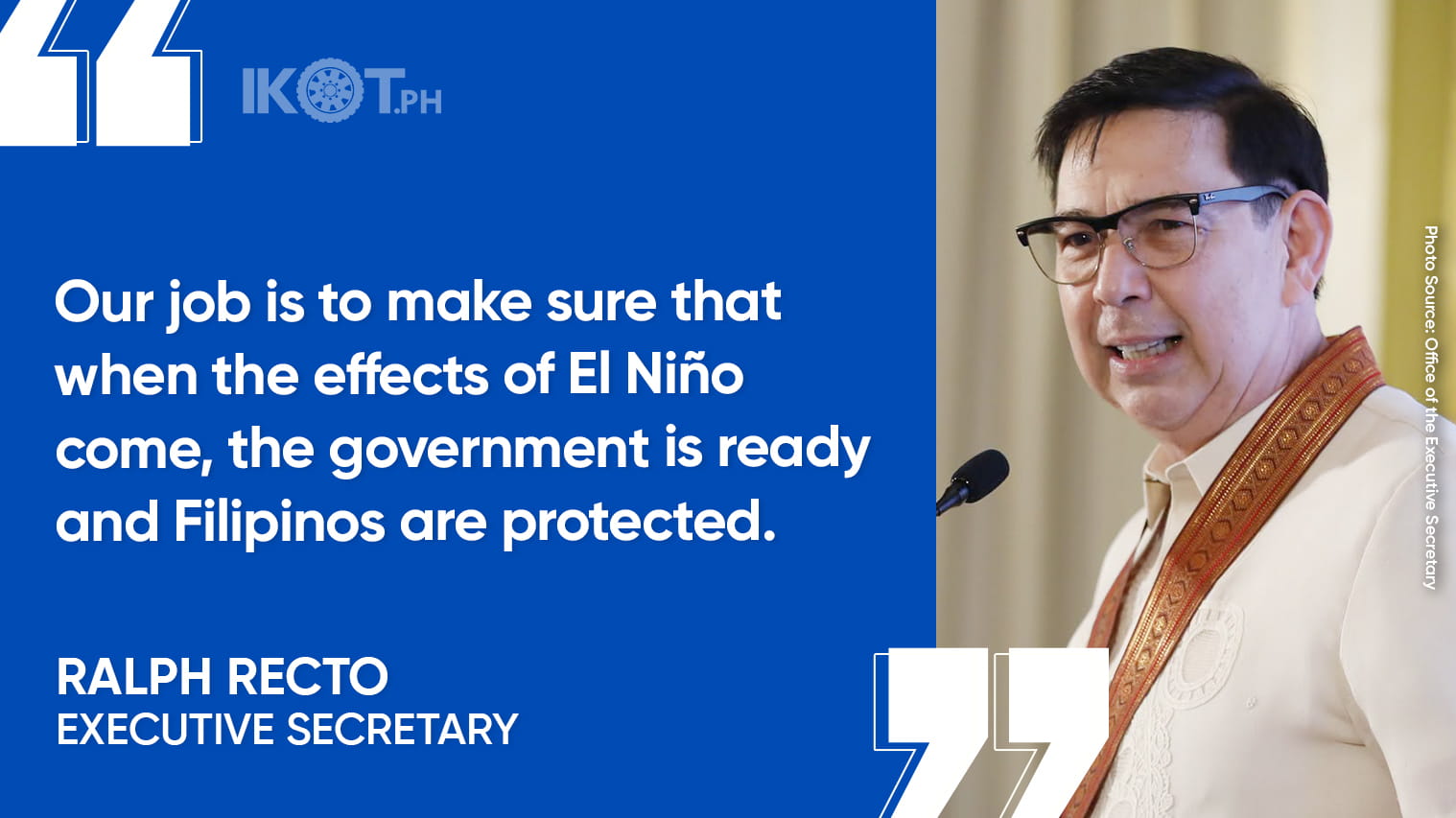
Upon the directive of the President, Executive Secretary Ralph Recto convened key departments to strengthen preparations for the anticipated Super El Niño, with agencies assuring ready measures to ensure sufficient food, water, and power supply and protect communities from its potential impacts.
“Preparedness is not a reason to panic. It is a reason to act early. Our job is to make sure that when the effects of El Niño come, the government is ready and Filipinos are protected,” Recto stressed.
“Preparedness is not a reason to panic. It is a reason to act early.”
He also said he would meet with key local government units (LGUs) to ensure that national preparations are responsive to conditions on the ground.
“El Niño will not affect every area in the same way. The risks and needs of one community may be different from those of another. We need to know where the risks are greatest and make sure our response matches the situation in each area,” Recto added.
“We need to know where the risks are greatest and make sure our response matches the situation in each area.”
The Department of Agriculture (DA) assured adequate supplies of rice, meat, and vegetables while implementing measures to protect agricultural production and support farmers and fisherfolk who may be affected by prolonged dry conditions.
These include production assistance, crop insurance indemnification, livestock support, and water supply interventions. The DA has also funded cloud-seeding operations in Regions II, III, VII, VIII, and the Negros Island Region.
The government is also pursuing climate-resilient investments to help sustain food production, including solar-powered irrigation systems and solar-powered seed cold storage facilities.
The Department of Environment and Natural Resources (DENR) is already preparing water-allocation strategies as well as measures to manage reservoir levels and prioritize water for households and irrigation based on established triggers.
Additional water supply facilities are expected by the end of 2026 and in the first quarter of 2027. The government is also preparing to reactivate 59 deep wells and optimize water treatment plants and other facilities in Cavite, Rizal, Laguna, and San Mateo, among other areas. For emergency response, 135 stationary and 105 mobile water tankers are on standby.
Meanwhile, the Department of Energy (DOE) assured sufficient electricity supply. It will expedite the grid integration and operationalization of new power plants scheduled to be completed before the end of 2026. It is working closely with generation companies to prevent unplanned outages, especially in Visayas.
The Department of Health (DOH) is already intensifying surveillance for heat-related and climate-sensitive diseases while preparing essential medicines, medical supplies, and water, sanitation, and hygiene resources.
It is also assessing the readiness of hospitals and health facilities, identifying equipment and resource requirements, and coordinating with other agencies to strengthen hospital power resilience and ensure reliable water access, particularly in high-risk areas.
The Department of Labor and Employment (DOLE) and the Department of Social Welfare and Development (DSWD) both assured that cash assistance and emergency livelihood support is ready for affected workers and vulnerable families.
The government will continue monitoring conditions and coordinating its response, with particular attention to localities most exposed to drought, water shortages, and extreme heat.
Present at the meeting were DA Secretary Francisco Tiu Laurel Jr., DENR Secretary Juan Miguel Cuna, DBM Secretary Kim Robert de leon, DSWD Secretary Rex Gatchalian, DPWH Secretary Vince Dizon, DOLE Secretary Francis Tolentino, and senior representatives from the DOE, DOH, Department of Economy, Planning, and Development (DEPDEV), Department of Science and Technology (DOST), the Philippine Atmospheric, Geophysical and Astronomical Services Administration (PAGASA), the Office of Civil Defense (OCD), and the National Irrigation Administration (NIA).