
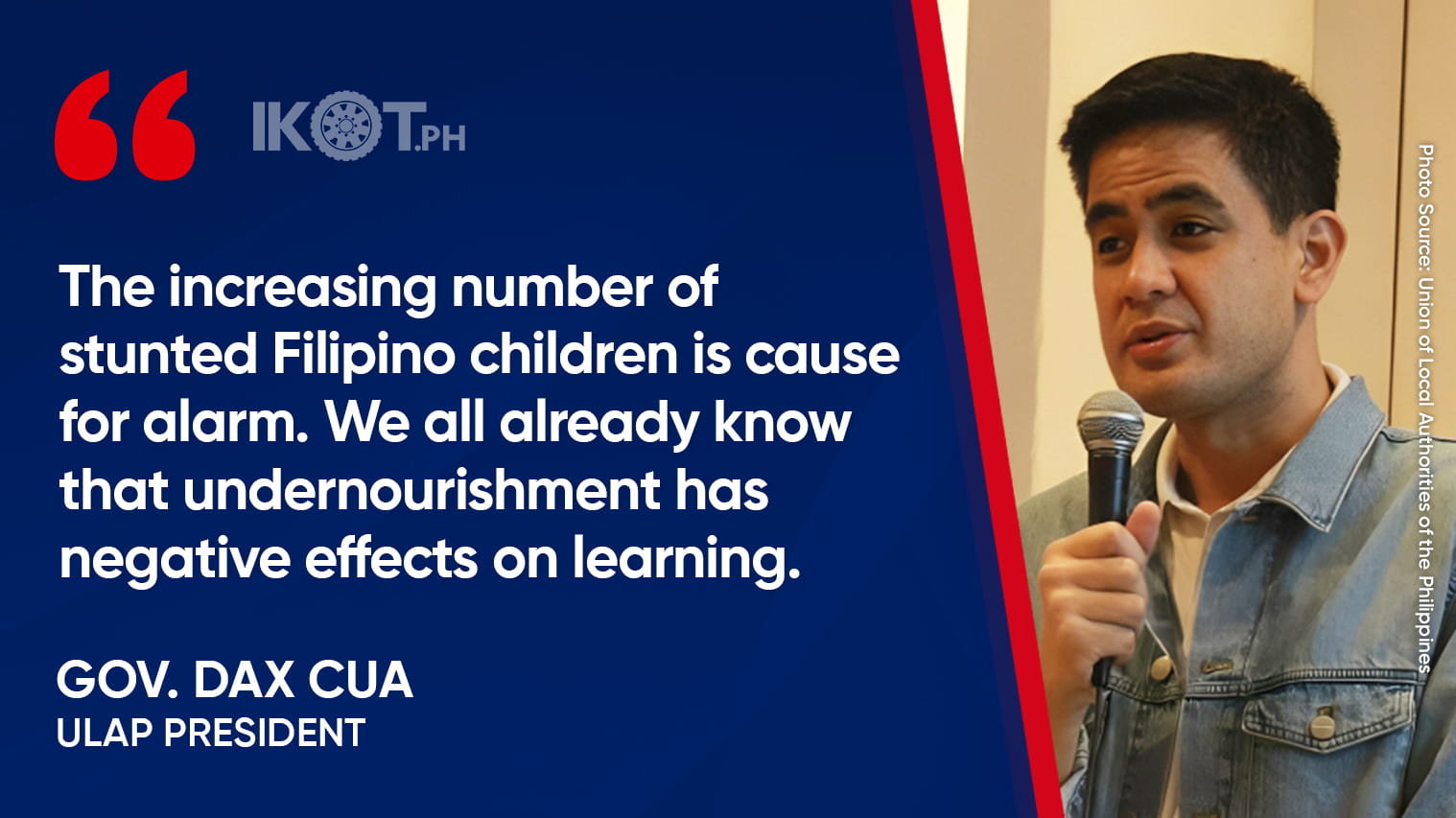
As the country observes Nutrition Month this July, the Union of Local Authorities of the Philippines has expressed its alarm over the reported rise of stunting among Filipino children, as it urged local government units to do their part in addressing this “grave public health problem.”
“The increasing number of stunted Filipino children is cause for alarm. We all already know that undernourishment has negative effects on learning—that is why we must urgently implement strategic interventions to stop this grave public health problem from further worsening,” ULAP president and Quirino Governor Dax Cua said.

“As we observe Nutrition Month this July, I hope that we in government be reminded of our crucial role in ensuring that the food requirements of our people, especially children, are met,” he added.
Cua urged his fellow local leaders to set aside funds to supplement the Department of Education’s school-based feeding program.
According to the 2025 Updating Survey Results released by the Department of Science and Technology-Food and Nutrition Research Institute (DOST-FNRI), the stunting rate among under-five children, especially those aged 0 to 59 months, has reached 25.3 percent, or roughly one in four children.
The updating survey, conducted every two-three years, was carried out from April 23, 2025, to March 31, 2026. It covered 91.5 percent of the targeted households across all 118 provinces and highly urbanized cities in the country.
The Second Congressional Commission on Education noted in its studies on Early Childhood Care and Development that malnutrition in the earliest years of life severely impairs cognitive development, language acquisition, and readiness to learn. It added that stunting remains one of the strongest predictors of poor educational outcomes later in life.
Cua urged his fellow local leaders to set aside funds to supplement the Department of Education’s school-based feeding program.
“We have the power to allocate for nutrition from our national tax allocation, or even access funds such as the Local Government Support Fund, to create supplementary programs ensuring that children’s nutritional needs are targeted,” said the governor.
He also raised the possibility of LGUs helping the DepEd in its issues with logistics and absorptive capacity with regard to the P25.6-billion SBFP’s implementation.
“I believe the DepEd are having issues with their absorptive capacity for the SBFP for this year. Baka maaaring pag-usapan ng DepEd at LGUs kung paano kami makatutulong para maresolba ang mga isyung ito upang maging matagumpay ang implementasyon ng SBFP,” Cua said.