
Camarines Sur Representatives (CamSur) Migz Villafuerte and Luigi Villafuerte have welcomed sustained action taken by the Presidential Communications Office (PCO) to check the proliferation of fake news, as they lauded the PCO’s joint efforts with the Departments of Justice (DOJ) and of Information and Communications Technology (DICT) on checking disinformation and artificial intelligence (AI)-generated deepfakes.
The two CamSur solons also backed the PCO’s opening of an online government platform where people can flag misinformation and disinformation reports being passed off by partisan groups as legitimate news to dupe the public.
Migz Villafuerte, who chairs the House committee on information and communications technology (ICT), called upon “the PCO to expedite its plan to set up an official website on fake news for flushing out bogus or spurious reports online and cracking down on their purveyors.”
Luigi Villafuerte, who is a deputy majority leader, meanwhile urged the Philippine National Police (NP), through its Anti-Cybercrime Group (ACG), to work with the PCO, DOJ and DICT on “identifying and taking legal or punitive steps against these vested interest groups that intentionally peddle sham information for the purpose of hoodwinking, unsettling or alarming the public.”
“We hope the PCO will be relentless in broadening this initiative by engaging many other institutions in legacy media and going ahead on its plan to coordinate with digital platforms.”
Migz and Luigi issued this joint statement as they cited the PCO, DOJ and DICT for their signing last month of a Memorandum of Agreement (MOA) on strengthening their inter-agency coordination to fight false information threatening public safety, national security and democratic institutions.
In an April news briefing, Undersecretary and Palace Press Officer Claire Castro said the PCO is launching its website to counter fake news circulating on social media (socmed) and digital channels, but added that the official launch of this online platform is still being finalized.
As for the MOA, it was signed by PCO Acting Secretary Dave Gomez, DICT Secretary Henry Aguda and DOJ Acting Secretary Frederick Vida in support of a whole-of-government approach to fighting fake news.
Under the MOA, the PCO will lead government communications, advisories and media literacy campaigns, while the DICT will engage technology platforms, beef up cybersecurity, and help enhance reporting systems and digital platforms like the DICT-led eGovPH.
As for the DOJ, it will evaluate cases for prosecution and coordinate international action against cross border disinformation.
The solons said that for its part, the House of Representatives has taken action to uphold responsible journalism and fend off disinformation and misinformation now pervading the internet and undermining democratic governance, by crafting proposed legislation meant to strike a balance between outlawing fake news and protecting the democratic tenet of free speech.
Earlier, Migz Villafuerte also backed the PCO’s Oplan Kontra Fake News initiative wherein the major publishers of Philippine Daily Inquirer, Philippine Star, Manila Bulletin, BusinessMirror, BusinessWorld, Daily Tribune, Malaya Business Insight, Manila Standard and the Manila Times signed a Memorandum of Understanding (MOU) with the PCO to intensify efforts against misinformation and disinformation.
The CamSur solons said that the PCO’s tri-agency MOA with the DOJ and DICT, its planned launch of a website against fake news, and its MOU with nine (9) broadsheets in the country will go a long way in beefing up efforts by the government and the private sector to check fake news that are intentionally being passed off to the public by interest or partisan groups as legitimate reportage.
“We hope the PCO will be relentless in broadening this initiative by engaging many other institutions in legacy media and going ahead on its plan to coordinate with digital platforms such as Meta and Google in pursuit of a unified drive against disinformation and misinformation that are undermining public discernment of what are legitimate or fake news,” Migz said.
Together with the House committee on public information, the ICT panel chaired by Migz has been crafting a substitute bill against disinformation and misinformation peddled over the media.
In a 2025 survey by the Social Weather Stations (SWS), the bill said that 65% of Filipinos admitted they found it difficult to distinguish fake from real news, while 59% saw disinformation on the internet as a “serious” issue.
The publishers or representatives of these broadsheets comprising the so-called legacy or traditional media signed on Feb. 4 at the Palace an MOU with the PCO on strengthening efforts to fight disinformation and misinformation.
For the Congress to do its part in this campaign, Migz said the ICT and public information committees of the House of Representatives had formed, before the Lenten break of the Congress, a technical working group (TWG) to hammer out a substitute bill on the proposed ‘Fake News and Digital Disinformation Act”—in place of over 10 similar measures that aim to outlaw fake news.
Migz said in a joint hearing of the public information and ICT committees before the congressional break that, “Alongside imposing punitive action against peddlers of disinformation or misinformation, this proposed anti-fake news bill is also about fostering an environment where truth prevails, and trust in our sources of legitimate information is enhanced or restored.”
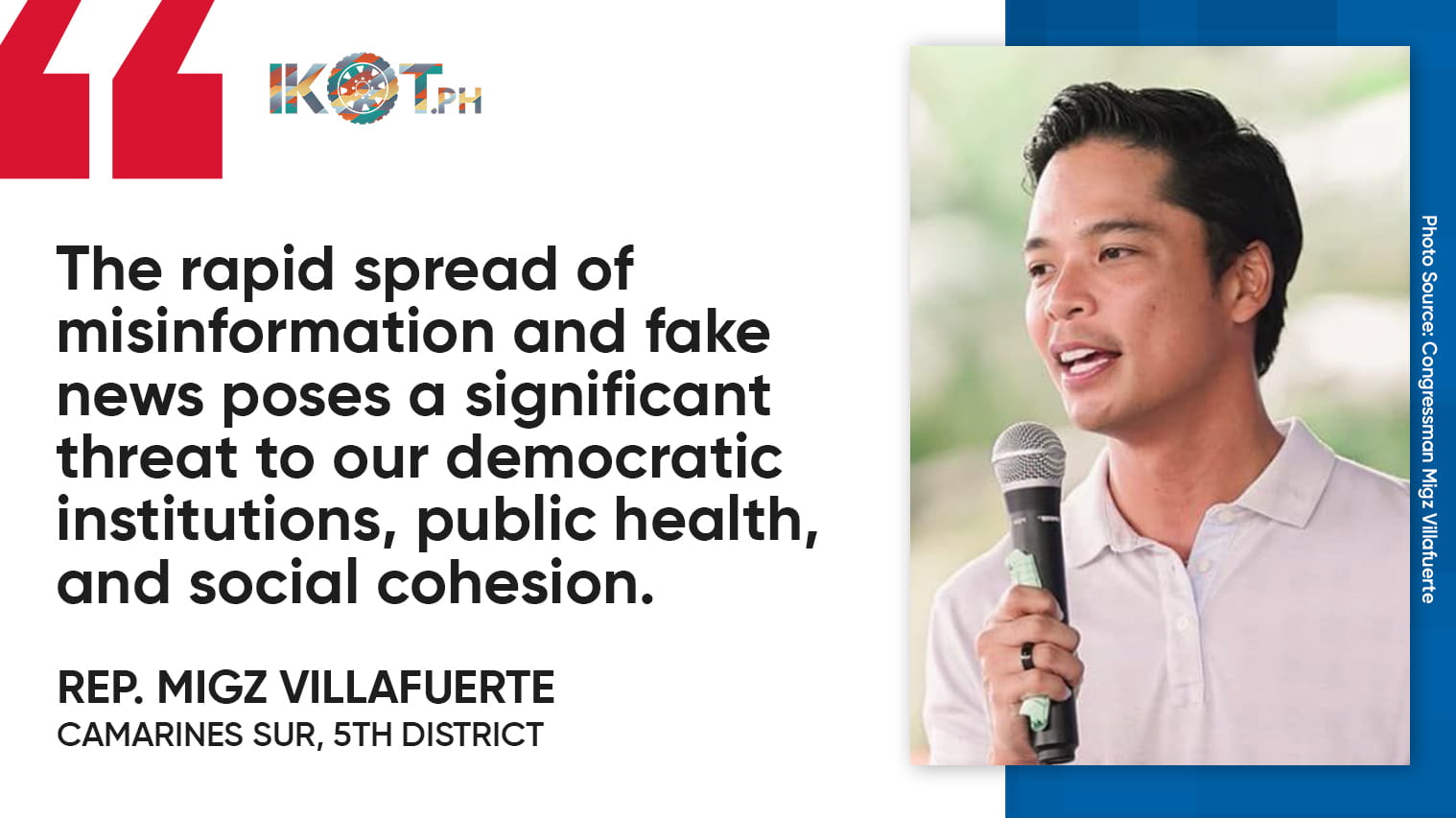
“The rapid spread of misinformation and fake news poses a significant threat to our democratic institutions, public health, and social cohesion,” Migz said.
Migz had co-presided over that joint hearing as ICT panel chairman with Parañaque City Rep. Brian Raymund Yamsuan, who is vice chairman of the House public information committee.
The House public information committee is chaired by Cagayan de Oro City Rep. Lordan Suan, while the TWG formed by the two panels to work on a substitute bill is headed by Bulacan Rep. Agatha Paula Cruz.
President Marcos drew up with Congress leaders in the third Legislative-Executive Development Advisory Council (LEDAC) meeting of the 20th Congress a new batch of 12 priority bills, including the “Anti-Fake News and Digital Disinformation Act.”
House Bill (HB) No. 6314, which Villafuerte had authored with four more congressmen, noted that, “The proliferation of fake news and disinformation across media platforms, especially social media (socmed), has dramatically impacted the socio-political landscape of communication, security, elections, public health and democracy worldwide.”
In a 2025 survey by the Social Weather Stations (SWS), the bill said that 65% of Filipinos admitted they found it difficult to distinguish fake from real news, while 59% saw disinformation on the internet as a “serious” issue.
Further, the prevalence of fake news and disinformation has also significantly affected public trust in mainstream media, as 68% of respondents of a separate 2025 survey by Publicus Asia said they used internet search engines as their main source of political and current affairs information, followed by 66% and 65% who used Facebook and television (TV), respectively.
Villafuerte had introduced HB 6314 with Deputy Majority Leader Luigi Villafuerte along with fellow CamSur Rep. Tsuyoshi Anthony Horibata and Bicol Saro Rep. Terry Ridon.