
Camarines Sur (CamSur) solons led by Deputy Majority Leader Luigi Villafuerte have a fine proposal on transforming the local cultivation and international sale of purple yam or “ube,” of which Bicol is a major producer, into a multibillion-dollar global industry for the Philippines—in the same way that matcha or green tea is now a major dollar-earner for Japan.
For starters, these lawmakers want the government to include ube or purple yam (scientific name: Dioscorea Alata) on its list of national priority crops and strategic exports, amid the fast-growing demand for our ube and ube products in North America, Europe, the Middle East and Asia.
After that, Luigi and Migz Villafuerte, along with their two other fellow authors, also seek in House Bill (HB) No. 8814 the creation of a Philippine Ube Industry Council, which shall (1) set standards, guide investments, coordinate agencies; and (2) steward a long-term Philippine Ube Industry Development Program to do for our country the kind of money-making global success that matcha powder has done for Japan.
The two other HB 8814 authors are CamSur Rep. Tsuyoshi Anthony Horibata and Bicol Saro Rep. Terry Ridon.
Luigi said that in the Philippines, Bicol is known for producing ube, especially in CamSur, Camarines Norte, Albay and Sorsogon, for both local consumption and commercial markets.
“Ube stands out as a distinctly Filipino ingredient with rapidly growing international appeal in food, beverage, dessert and specialty product markets.”
In fact, he said, 35% of the country’s ube production is in Bicol, with exports of ube and ube-based products hitting $3.06 million in 2025.
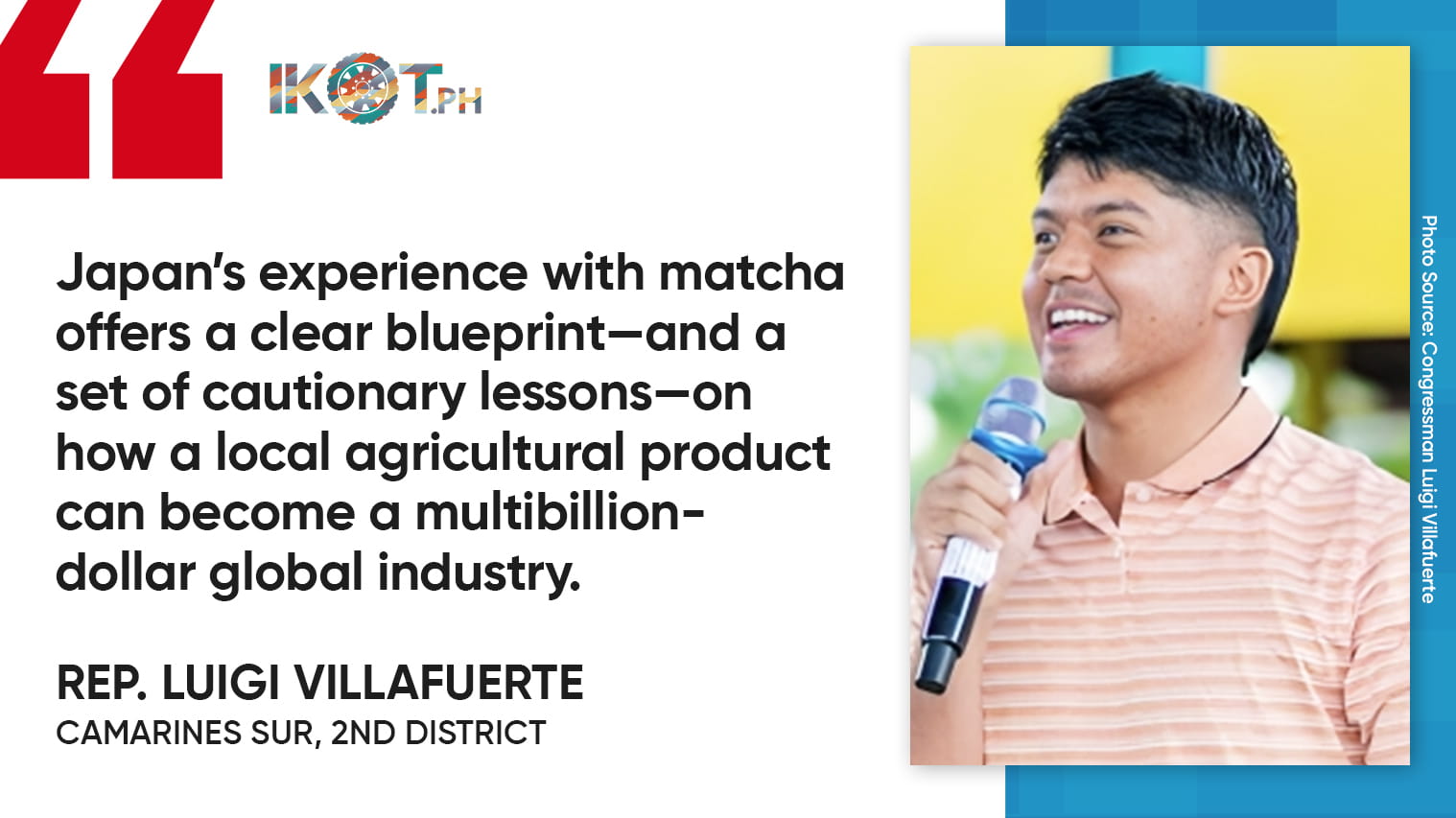
“Japan’s experience with matcha offers a clear blueprint—and a set of cautionary lessons—on how a local agricultural product can become a multibillion-dollar global industry,” Luigi, a former CamSur governor, said.
“Strategic government support, strong geographic branding and high quality standards enabled matcha’s rise,” he said. “However, the national strategy that we want the proposed Philippine Ube Industry Council to craft and implement should eschew these vulnerabilities that have trailed the global matcha boom: supply shortages, aging farmer populations, climate impacts, price spikes, counterfeit products, and competition from lower-quality substitutes.”
Hence, with HB 8814, said Luigi, this Council is tasked to establish an ube development blueprint that will “learn from and surpass” Japan’s experience with its match boom by:
· Declaring ube as a national priority crop and strategic export under the High-Value Crops Development Act (Republic Act or RA No. 7900), Export Development Act (RA 7844), and related laws;
· Structuring the industry to avoid shortages, volatility, counterfeit risks, and sustainability issues now challenging the global matcha supply chain;
· Building robust systems for geographic indication (GI) and intellectual property protection under the Intellectual Property Code of the Philippines (RA 8293), to make sure that “Philippine Ube” and regional GIs such as “CamSur Ube” become globally protected origin brands; and
· Promoting the Philippine Ube Industry in coordination with the DTI, DOST, Intellectual Property Office of the Philippines (IPOPHL), Bangko Sentral ng Pilipinas (BSP), local government units (LGUs) and the private sector.
This Council shall have the Department of Agriculture (DA) as chairperson, and the Secretary of the Department of Trade and Industry (DTI) sa vice chairperson.
It shall have 11 Council members, including the Secretary of the Department of Science and Technology (DOST), Director of the Philippine Root Crops Research and Training Center (PhilRootcrops), President of the Land Bank of the Philippines (LandBank), Administrator of the Philippine Crop Insurance Corp. (PCIC), and the Chairperson of the Union of Local Authorities of the Philippines (ULAP) or a designated representative from ube-producing LGUs, as a member.
Its other Council members shall be three (3) representatives from the private sector, nominated by recognized ube farmers’ federations, processors’ associations, and exporters’ groups as members, which shall be appointed by the President of the Philippines for a term of three (3) years; two (2) representatives from civil societies or the academe with expertise in agriculture, food science, export marketing, or rural development as members, which shall be appointed by the President of the Philippines for a term of three (3) years; and one (1) representative from the Philippine Trade and Investment Centers (PTICs) abroad, to be designated by the DTI Secretary.
The Council shall have an Executive Director appointed by the President of the Philippines upon the recommendation of the Council Chairperson. The Executive Director shall serve as the Council’s Chief Operating Officer (COO) and Secretariat head.
Migz Villafuerte, chairman of the House committee on information and communications technology (ICT) and also a former CamSur governor like Luigi, said that: “HB 8814 envisions the Philippines as the undisputed global leader in ube—with a more resilient, sustainable, and inclusive framework than that experienced by early matcha development.”
The “CamSur Ube” brand is created under Ordinance No. 40 as the official collective mark representing ube, ube powder, and other ube by-products produced in CamSur under certified quality standards.
Migz said that ube is among the unique crops of the Philippines, which is globally recognized for its rich biodiversity, culinary heritage and agricultural potentials.
“Ube stands out as a distinctly Filipino ingredient with rapidly growing international appeal in food, beverage, dessert and specialty product markets,” he said. “In the Philippines alone, ube is highly used as ube jam that we regularly incorporate in food such as our famous dessert—Halo-Halo—and in ice cream, cakes and cookies.
With the proposed Council, Migz said, “Our goal is to establish the Philippines as the premier global source of ube and ube-derived products, particularly ube powder, by ensuring quality excellence, geographic indication protection, and unified brand promotion.”
The bills aims to guarantee that smallholder ube farmers and rural communities are primary beneficiaries through improved market access, fair pricing, technical support and strengthened linkages to domestic and international value chains, Migz said.
HB 8814 seeks to put up an Ube Industry Development Fund (UIDF), which shall be administered by the Council to support ube industry development programs and projects.
The UIDF shall be tapped for farmer support programs (planting materials, inputs, training, extension services, etc.), processing facility development grants and subsidies; research and development (R&D) projects; quality infrastructure (laboratories, testing equipment, certification systems); brand development, trademark registration, and GI applications; and marketing, trade fair participation, and export promotion activities.
The Landbank and the Development Bank of the Philippines (DBP) are tasked by the bill to develop and offer preferential credit programs for ube industry development programs, including production loans for ube farmers at concessional interest rates, and investment and working capital loans for processors, traders and exporters.
Tax breaks also await stakeholders, including exemption from the payment of local business taxes, reduced corporate income tax (CIT) payments, exemption from customs duties and value-added taxes (VAT) for certain specialized imports, and 100% deduction from the donor’s gross income of those who donate to the UIDF.
Earlier, the Sangguniang Panlalawigan (SP) of CamSur approved Ordinance No. 040 series of 2026 declaring ube as the province’s priority crop, and establishing the CamSur Ube Development Program as the blueprint for developing “a comprehensive ube value chain from farm to export” to turn this crop into another driver of the province’s rapid growth and catalyst for better lives for its small farmers.
Gov. LRay Villafuerte said this SP-approved program aims to “replicate—and even surpass—the success of Japan in transforming matcha into a superb export winner by assigning purple yarn with preferential consideration in the agricultural support programs, technical assistance, extension services, enterprise development initiatives and value chain investments of the provincial LGU.”
In Ordinance 40, its sponsor, Sanggunian member Regin Oliver Oliva, noted that CamSur already has an existing and operational CamSur Fruits and Vegetables Facility in Pili, which can be immediately utilized and upgraded to serve as the anchor processing hub for ube powder production with appropriate certifications and equipment enhancements.
To encourage the conversion of suitable agricultural land to ube production, the provincial LGU shall provide incentives, including free or subsidized planting materials; free or subsidized organic fertilizers and other farm inputs; free access to training programs and extension services; access to irrigation and infrastructure such as farm-to-market roads (FMRs); access to low-interest farm loans; and fiscal incentives like tax reliefs, exemptions, reductions and subsidies.
The “CamSur Ube” brand is created under Ordinance No. 40 as the official collective mark representing ube, ube powder, and other ube by-products produced in CamSur under certified quality standards.
The governor said that the provincial LGU shall actively coordinate with the DTI, DA, PTICs abroad, and export promotion agencies to align CamSur ube development with national export targets and priority market initiatives.