
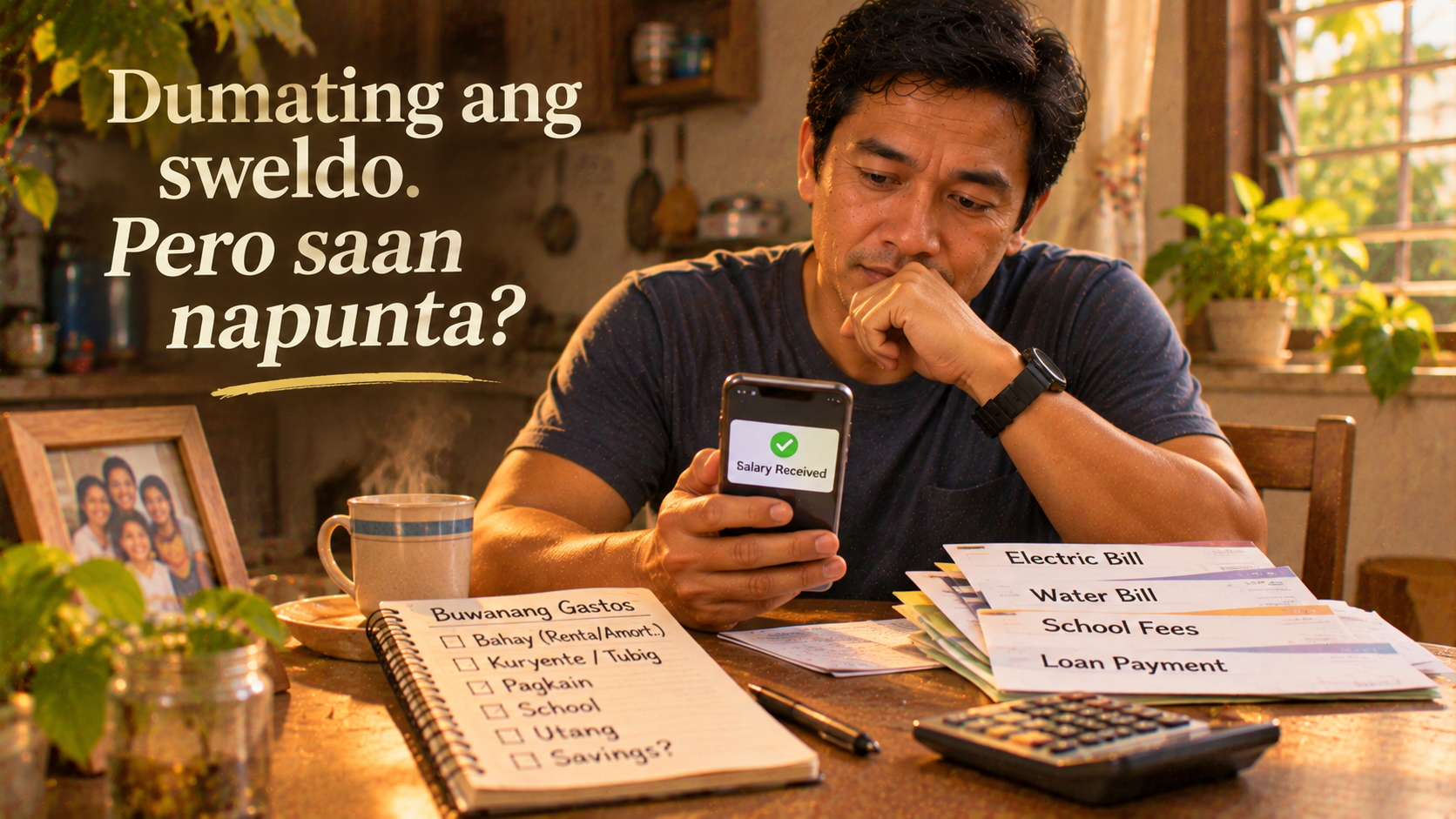
There is a familiar moment in many Filipino households when payday arrives.
For a few minutes, the bank balance looks comforting.
Then the calculations begin.
Electricity. Water. Groceries. Transportation. Tuition. Loan payments. A little something for Nanay. Medicine for someone at home.
Before the money has even settled in the account, most of it already has somewhere to go.
And somewhere between paying the bills and preparing for the next payday, a familiar question appears:
“Paano naman ako makakaipon nito?”
It is a question many Filipinos have asked themselves, sometimes with frustration, sometimes with guilt, and sometimes with the quiet resignation of someone who has tried many times before.
Because saving money sounds simple.
Until you have to do it with money that is barely enough.
When Good Advice Meets a Difficult Reality
We have all heard the advice.
Save 20% of your income.
Pay yourself first.
Cut unnecessary expenses.
Be disciplined.
There is wisdom in some of these ideas. Saving regularly can build financial security, and spending thoughtfully certainly helps.
But advice becomes difficult when it assumes everyone has the same room to make adjustments.
Consider a worker earning ₱20,000 a month.
After transportation, food, utilities, rent, and contributions to the household, perhaps only ₱1,000 remains.
That remaining amount may still need to cover school projects, medicine, or an unexpected family expense.
Now imagine telling that person to save ₱4,000 every month.
The mathematics may be straightforward.
The life behind those numbers is not.
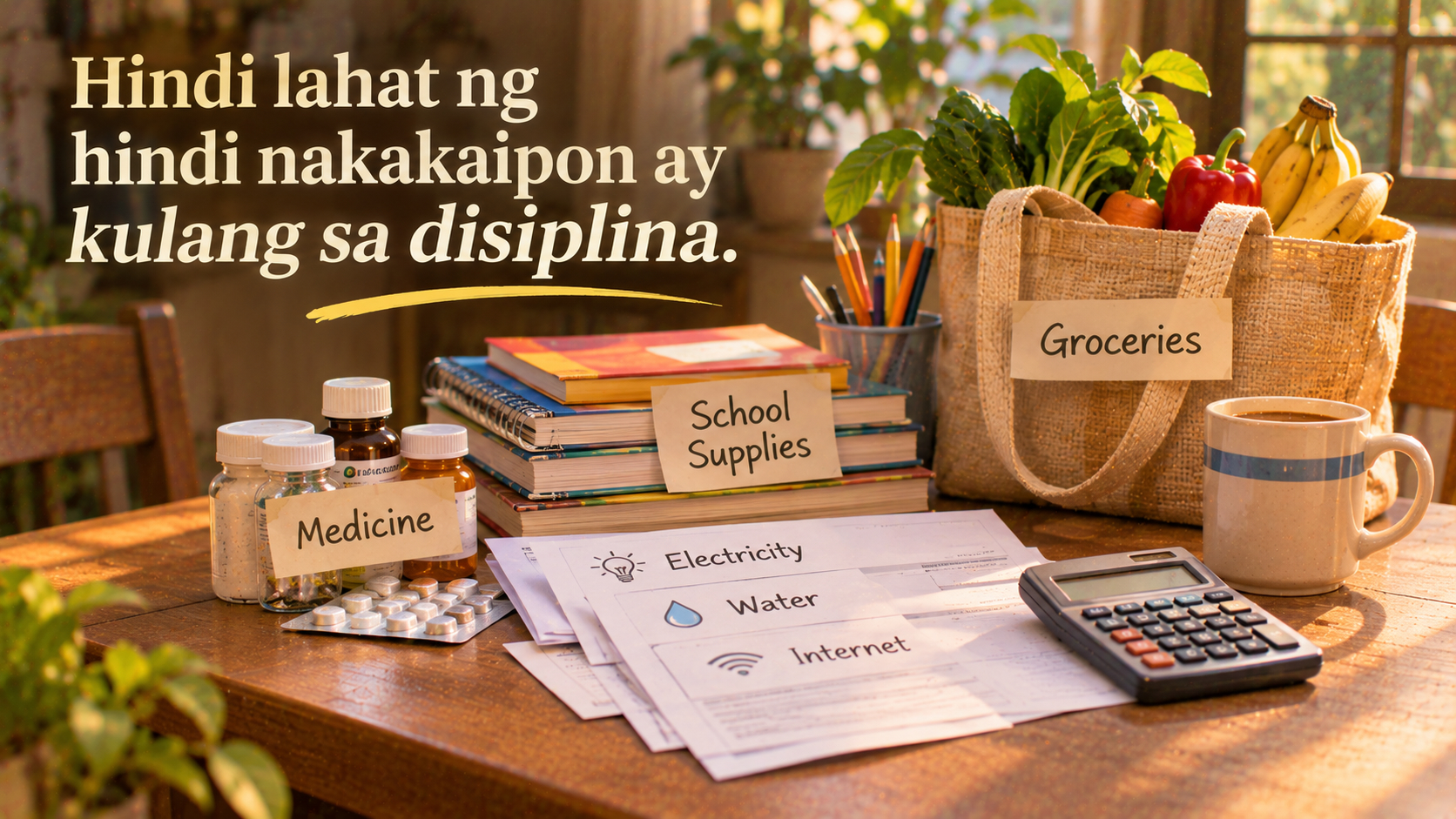
For many Filipino families, the problem is not that they refuse to save.
It is that nearly every peso is already performing an essential job.
And when financial advice fails to recognize this, something unfortunate happens.
People begin mistaking a lack of financial room for a lack of personal discipline.
They feel guilty for not meeting savings targets designed around circumstances very different from their own.
But perhaps the first question should not be:
“Why can’t you save more?”
Perhaps it should be:
“What would need to change for saving to become possible?”
That is a very different conversation.
And it is where our first stop on this Pinoy Money Road Trip begins.
The Difference Between Income and Breathing Room

Two people can earn the same salary and have very different capacities to save.
One supports only themselves.
The other supports aging parents, contributes to a sibling’s education, and helps maintain a household of six.
On paper, their incomes are equal.
In real life, their financial responsibilities are not.
This is why income alone does not tell us how much someone can reasonably save.
What matters is the amount left after essential expenses and unavoidable commitments.
We can call this financial breathing room.
It is the money that remains available for savings, preparation, and future choices without sacrificing basic needs.
And sometimes, that breathing room is painfully small.
Sometimes, it does not exist at all.
When this happens, saving more cannot simply be a matter of trying harder.
Something in the financial arrangement must change.
Perhaps an expense can be reduced.
Perhaps a payment can be renegotiated.
Perhaps an additional source of income becomes necessary.
Or perhaps the honest answer is that the household needs more income before a meaningful savings target becomes realistic.
There is no shame in recognizing that.
A financial plan should begin with the resources actually available, not the resources we wish we
had.
The First Savings Target Is Not Always an Amount
Imagine two people trying to save.
The first decides to put aside ₱3,000 every month because that is what a financial expert recommended.
But after two months, the savings are repeatedly withdrawn to cover essential expenses.
Eventually, the person gives up.
“Hindi talaga ako marunong mag-ipon.”
The second person begins differently.
Instead of choosing a target immediately, they review their last few paydays.
They identify which expenses are essential, which are irregular but predictable, and which might be adjusted.
They discover that ₱300 can be set aside during an ordinary payday without compromising necessities.
Not every payday.
Not perfectly.
But often enough to begin.
After several months, they have a small amount that has remained untouched.
It may not look impressive.
But something important has happened.
Saving has become possible.
The difference between these two experiences is not necessarily discipline.
It is the relationship between the savings target and the reality of the household.
The first person started with an ideal number.
The second started with an honest assessment.
And sometimes, that honesty is what makes consistency possible.
Give Your Savings a Job Before Giving Them a Target
One reason saving becomes difficult is that we often treat all the money in our accounts as one large pool.
The same balance must cover groceries, school expenses, emergencies, family requests, and future plans.
So whenever a new need appears, savings become the easiest source of money.
This is why it helps to begin identifying what each portion of our money is supposed to do.
Money for everyday needs must remain available.
Money for predictable expenses should be prepared before those expenses arrive.
And money intended for emergencies or future goals needs protection from ordinary spending whenever possible.
You do not need multiple bank accounts to begin.
A notebook, a simple spreadsheet, or separate envelopes can help make these distinctions visible.
The important part is knowing which money is genuinely available to save.
Because money that will be needed for next week’s groceries is not really spare money, even if it is still sitting in your account today.
And transferring it into a savings account does not automatically make the household more financially secure.
Sometimes, it merely postpones the problem.
Saving should protect your future without unnecessarily endangering your present.
That principle matters especially when resources are limited.
Start With What Your Life Can Sustain
If you are beginning this journey, consider trying something simple during your next payday.
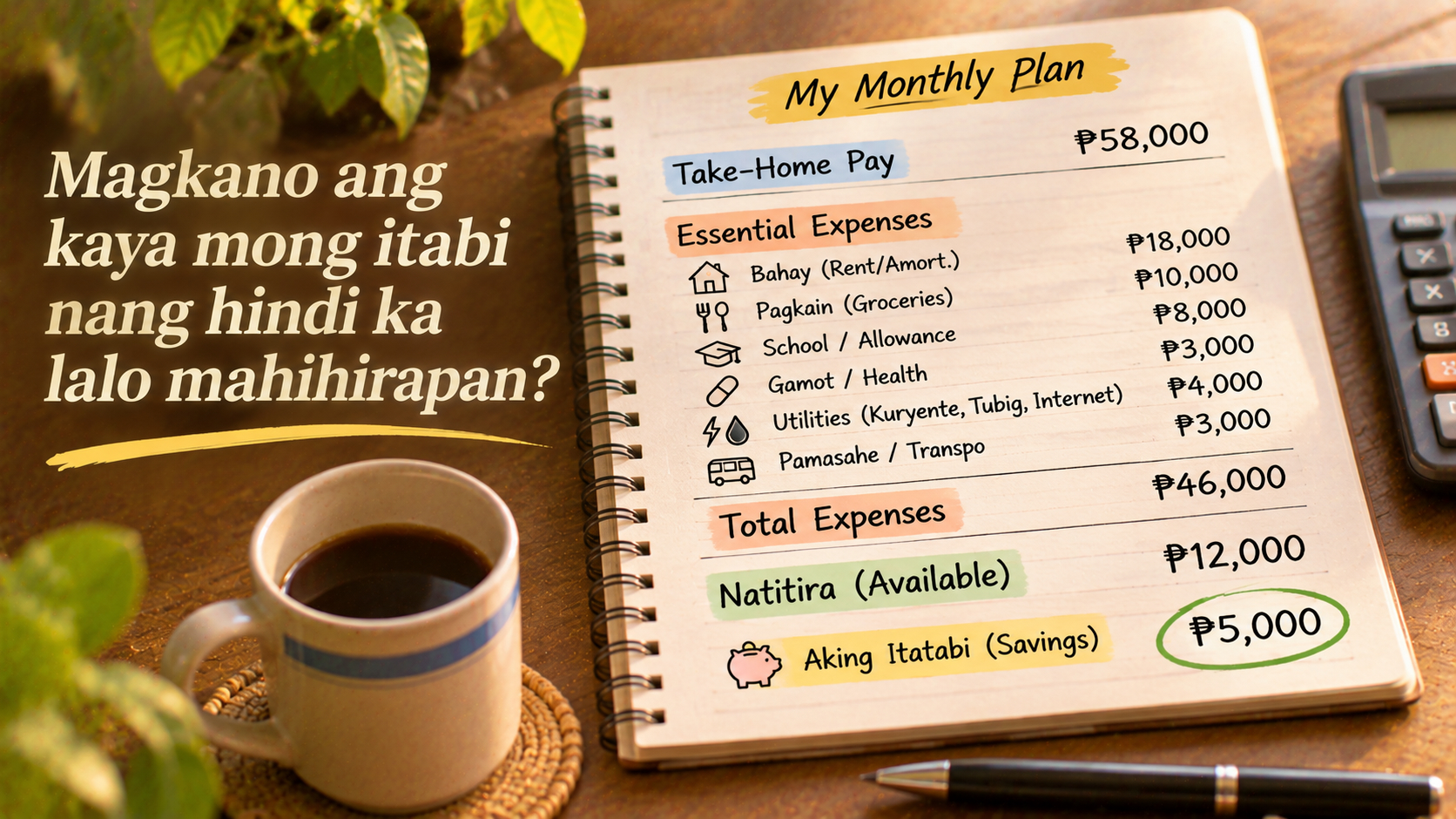
Before deciding how much to save, look at where your money must go.
Write down your take-home income.
List the expenses necessary to keep your household functioning.
Include a reasonable allowance for irregular obligations that you already know will eventually arrive.
Then look at what remains.
If there is ₱500 that can safely be reserved, begin there.
If there is only ₱100, that may be your starting point.
If nothing remains, do not force a savings transfer that will leave you borrowing for food or transportation.
Instead, make your first goal creating even a little financial room.
That might mean reviewing a recurring expense, changing a payment arrangement, or exploring a realistic way to improve income.
And if your circumstances change from month to month, allow your savings plan to adjust.
A household with irregular income may need a flexible savings arrangement rather than a fixed monthly commitment.
The point is not to make the number look impressive.
The point is to create a system that can survive ordinary life.
Because a savings habit that works only during your best months is not yet a dependable system.
Small Savings, Real Protection
There is something deeply encouraging about the first amount you manage to keep.
Perhaps it is only ₱200.
Perhaps ₱500.
Perhaps the first ₱1,000 that remains in your account when the next payday arrives.
That money will not solve every financial problem.
It will not replace an emergency fund or eliminate the need for a more stable income.
But it represents something worth recognizing.
For once, a small part of your income has not already been claimed by yesterday’s obligations.
It is available for tomorrow.
And as that amount gradually grows, so does your ability to handle small disruptions without immediately borrowing.
A minor repair.
An unexpected transportation expense.
A household need that might otherwise require another loan.
This is where savings begin serving their real purpose.
Not to prove that you are financially disciplined.
Not to impress anyone with an account balance.
But to make life a little less vulnerable.
In The Digits Way, this is part of what we call Stability — Makaraos Muna.
Before chasing higher returns, bigger investments, or financial freedom, we must first make sure that ordinary difficulties do not repeatedly push us back into crisis.
Survivability comes before optimization.
And for many Filipino households, the first step toward survivability is simply finding a way to keep a little money available for the days when life does not go according to plan.
A Different Kind of Beginning

Perhaps you have tried saving before.
Perhaps you have started and stopped more times than you can remember.
Perhaps every amount you managed to set aside eventually went to something important.
That does not mean those attempts were worthless.
Sometimes, the money you saved did exactly what savings were supposed to do.
It helped you get through a difficult moment.
And sometimes, those experiences reveal that your household needs a better system, a larger financial margin, or more protection before savings can remain untouched.
Both are useful lessons.
The important thing is to stop treating every withdrawal as a personal failure.
Financial stability is not built by pretending life will always cooperate.
It is built by preparing for the fact that sometimes, it will not.
So as we begin this Pinoy Money Road Trip, I hope you carry one thought with you:
You do not need to prove that you deserve financial stability by meeting someone else’s savings target.
You need a starting point that respects your actual circumstances.
One that allows you to care for your family, meet your responsibilities, and gradually protect a little of tomorrow without making today impossible.
Because saving should not become another burden you carry.
It should eventually become one of the things that helps carry you.
And perhaps that is where the journey from bitin toward ginhawa truly begins.
Not with a large bank balance.
Not with a perfect budget.
But with the quiet realization that even a small amount of money, given a clear purpose and protected by a realistic system, can begin creating something precious.
A little less uncertainty.
A little more control.
And eventually, a little more room to choose.
Your Road Trip Reflection
Before your next payday, ask yourself:
After covering our essential needs and responsibilities, how much can I realistically protect for tomorrow without making today more difficult?
If the answer is zero, ask what would need to change to make the first small amount possible.
That is a valid place to begin.
Next Stop: The Money You Hope You’ll Never Need
Next week, we will explore why ordinary emergencies become financial crises, and how a small financial buffer can help protect your household from having to start over whenever something unexpected happens.
The Pinoy Money Road Trip is a special IKOT.PH series inspired by The Digits Way, a Filipino approach to money, dignity, resilience, and peace.
For readers who want to explore the thinking behind this journey, Book 1, The Digits Way: Mindset & Money Flow, examines how our beliefs, responsibilities, emotions, and everyday money decisions shape the financial lives we build.
Because the goal is not wealth. The goal is dignity.
Catch Thanjo’s personal finance column every Tuesday at 7 p.m. on IKOT.PH and across Facebook, X (Twitter), and Instagram.
DISCLAIMER:
The views and opinions of our partners and contributors expressed in this article are exclusively their own and are made in their personal capacities. They do not reflect the views, policies, or official stance of IKOT.PH, its editors, officers, or affiliates. As such, nothing contained herein shall be construed as professional advice or as an official declaration, endorsement, or position of IKOT.PH.