
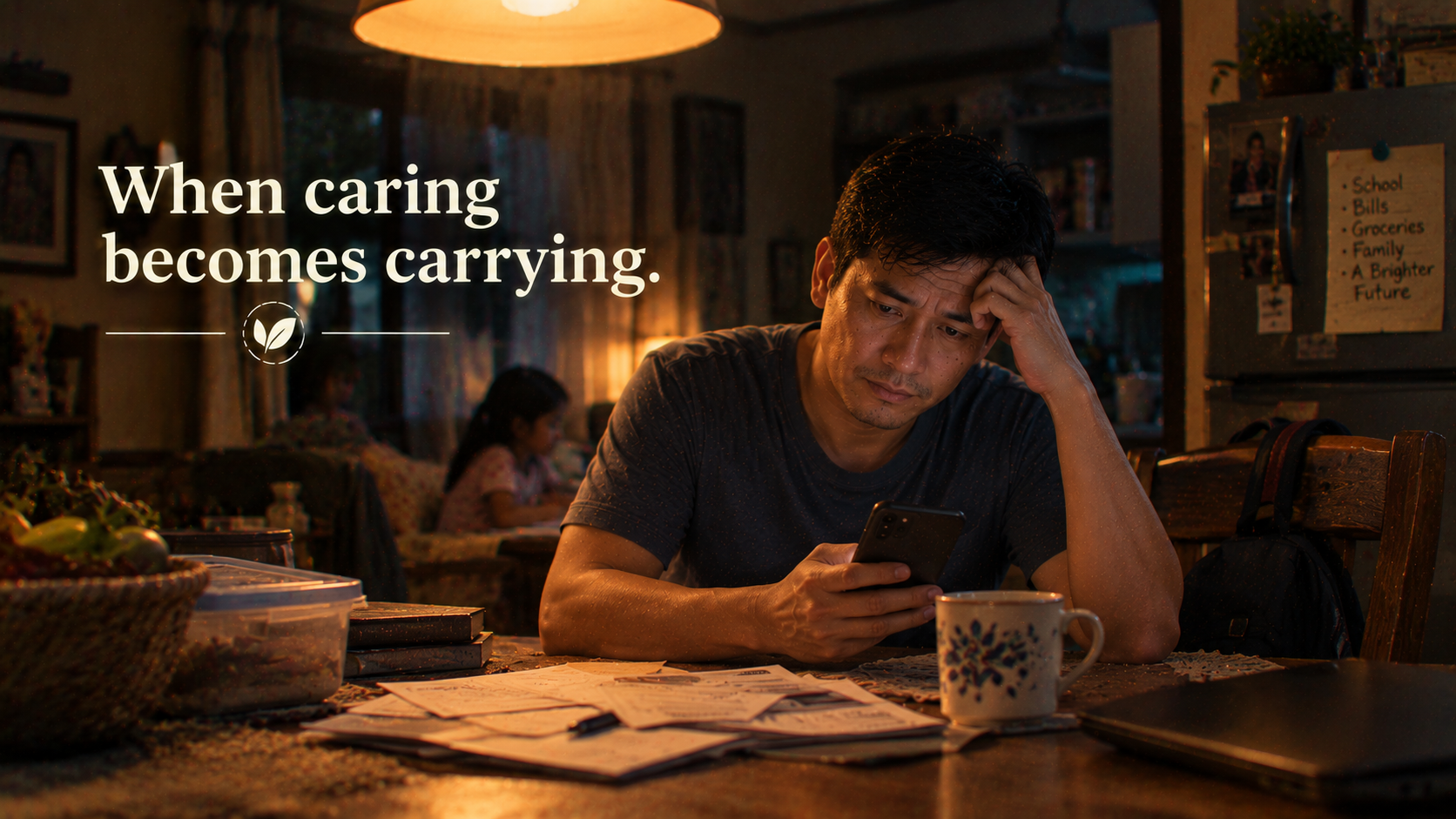
Many Filipinos care deeply.
We notice who is struggling.
We contribute during emergencies.
We adjust for family.
We help friends quietly.
We worry about people we love even when they never ask us to.
Compassion comes naturally to many of us.
But sometimes, caring becomes exhausting in ways people struggle to admit honestly.
Not because love disappeared.
But because somewhere along the way, many of us stopped knowing where compassion ends—and carrying begins.
The Weight We Were Never Asked to Carry
For many responsible people, concern quickly becomes responsibility.
A family member has a problem.
You think about it all day.
A friend is struggling.
You feel obligated to fix it.
Someone you love is anxious.
You become anxious too.
Without realizing it, other people’s burdens slowly take up residence inside your own mind.
And because caring feels like love, few people question the pattern.
When Caring Becomes Carrying

This is where compassion quietly becomes exhausting.
Not when we care.
When we start carrying.
Because caring says:
“I want to support you.”
Carrying says:
“Your burden is now my burden too.”
At first, the difference feels small.
Over time, it becomes enormous.
One allows connection.
The other creates overload.
The Invisible Work of Compassion
Many people underestimate how tiring emotional carrying can become.
You are thinking about your own responsibilities.
Your own finances.
Your own worries.
And at the same time, you are mentally carrying concerns that belong to parents, siblings, children, friends, coworkers, and relatives.
No wonder some people feel exhausted before the day even begins.
Their minds are crowded.
Not only with their own lives—but with everyone else’s too.
Why Caring People Feel Guilty
This becomes especially difficult because compassionate people often judge themselves harshly.
When they need space, guilt appears.
When they stop responding immediately, guilt appears.
When they feel emotionally tired, guilt appears.
They assume exhaustion means they are becoming less loving.
But emotional fatigue is not proof that your compassion disappeared.
Sometimes it is simply evidence that your capacity has been stretched too far for too long.
The Filipino Habit of Absorbing Everything
Many Filipinos grow up in environments where emotional carrying feels normal.
One child becomes the peacemaker.
One sibling becomes the rescuer.
One family member becomes the dependable one.
Over time, these roles become identities.
And identities are difficult to question.
Especially when people praise you for them.
The Problem With Becoming Everyone’s Emotional Shock Absorber
Responsible people often become emotional shock absorbers.
Whenever life hits someone else, they absorb part of the impact.
At first, this feels generous.
But eventually, the accumulated weight becomes difficult to sustain.
Because no human being was designed to absorb endless pressure without recovery.
Not emotionally.
Not physically.
Not financially.
What Compassion Was Never Meant to Be

Compassion was never meant to mean:
Solving every problem.
Preventing every disappointment.
Protecting everyone from discomfort.
Managing everyone’s emotions.
And yet many caring people quietly attempt all four.
Not because they are controlling.
Because they love deeply.
But love alone cannot make a person limitless.
The Difference Between Presence and Responsibility
One of the most important lessons compassionate people eventually learn is this:
You can be present without becoming responsible for everything.
You can listen without fixing.
You can support without rescuing.
You can care without carrying.
At first, this feels uncomfortable.
Because many people were taught that love requires absorption.
But healthy relationships do not require one person to hold all the weight.
The Financial Side of Emotional Carrying
This pattern often appears in money too.
People repeatedly solve financial problems for others.
Cover emergencies.
Fill gaps.
Absorb crises.
And because they are capable, everyone gradually turns toward them whenever difficulty appears.
What begins as generosity slowly becomes expectation.
And expectation eventually becomes pressure.
Why Stewardship Matters
This is why stewardship remains such an important part of growth.
Not because compassion should become smaller.
But because compassion must become sustainable.
You cannot continuously give energy you never replenish.
You cannot constantly absorb pressure without consequence.
You cannot keep ignoring your own needs indefinitely.
At some point, even the strongest people begin running on emotional fumes.
When Compassion Becomes Healthier
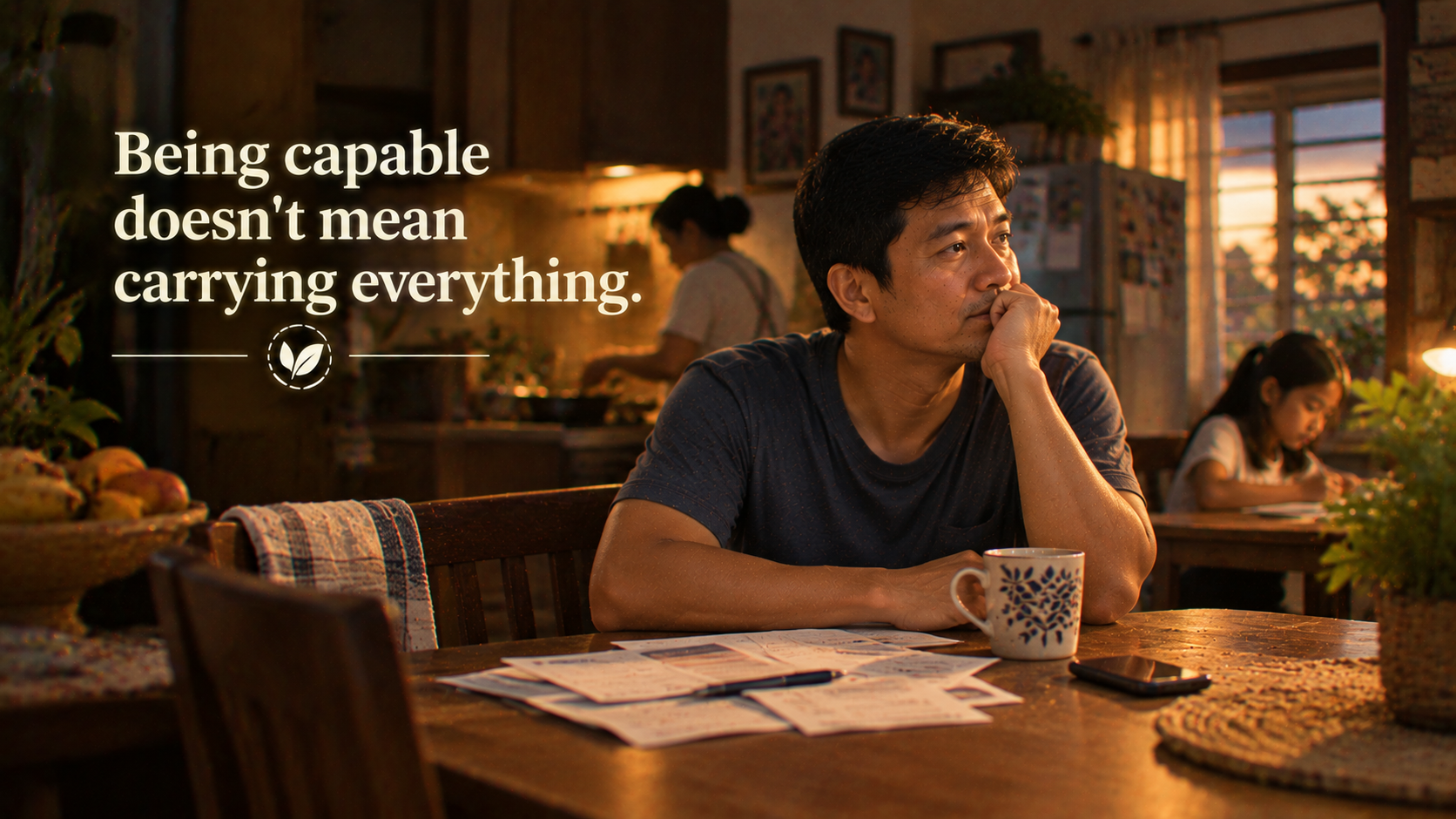
Something interesting happens when people stop confusing caring with carrying.
Compassion often becomes lighter.
Cleaner.
More peaceful.
Less resentful.
Less overwhelming.
You begin helping because you choose to—not because you feel trapped.
You become supportive without becoming consumed.
Present without becoming depleted.
A Different Definition of Love
Perhaps love is not measured by how much weight you absorb.
Perhaps it is measured by how consistently you can remain present.
And presence requires energy.
Attention.
Patience.
Capacity.
Things that become difficult to offer when exhaustion takes over.
A Quiet Reframe

Many caring people spend years believing their role is to hold everything together.
But perhaps your role was never to carry everyone’s burdens.
Perhaps your role is simply to walk beside people while they carry what belongs to them.
That may sound smaller.
But often, it is healthier for everyone involved.
Finally, Something Important
You are allowed to care deeply without becoming responsible for everything.
You are allowed to love people without solving every problem.
You are allowed to support others without sacrificing your own wellbeing.
These are not signs of indifference.
They are signs of maturity.
Closing Reflection

Because compassion was never meant to consume the person practicing it.
Its purpose was never self-destruction.
Its purpose was connection.
And perhaps one of the quietest forms of wisdom is learning how to remain kind without becoming overwhelmed.
To remain generous without becoming depleted.
To remain present without carrying the entire world on your shoulders.
Because the goal is not to prove how much weight you can endure.
The goal is to remain whole enough that your compassion can continue serving people for a very long time.
Not dramatically.
Not endlessly.
Just steadily.
And sometimes, steady compassion changes lives more than heroic exhaustion ever could.
One of the surprising discoveries of adulthood is that love becomes healthier when it is no longer driven by fear, guilt, or over-responsibility.
The more we grow, the more we learn that caring for others and caring for ourselves are not opposing choices.
They are part of the same stewardship.
And perhaps that is why sustainable compassion feels different.
It leaves room for other people to grow—
and leaves room for you to breathe too.
Catch Thanjo’s personal finance column every Tuesday at 7 p.m. on IKOT.PH and across Facebook, X (Twitter), and Instagram.
DISCLAIMER:
The views and opinions of our partners and contributors expressed in this article are exclusively their own and are made in their personal capacities. They do not reflect the views, policies, or official stance of IKOT.PH, its editors, officers, or affiliates. As such, nothing contained herein shall be construed as professional advice or as an official declaration, endorsement, or position of IKOT.PH.