
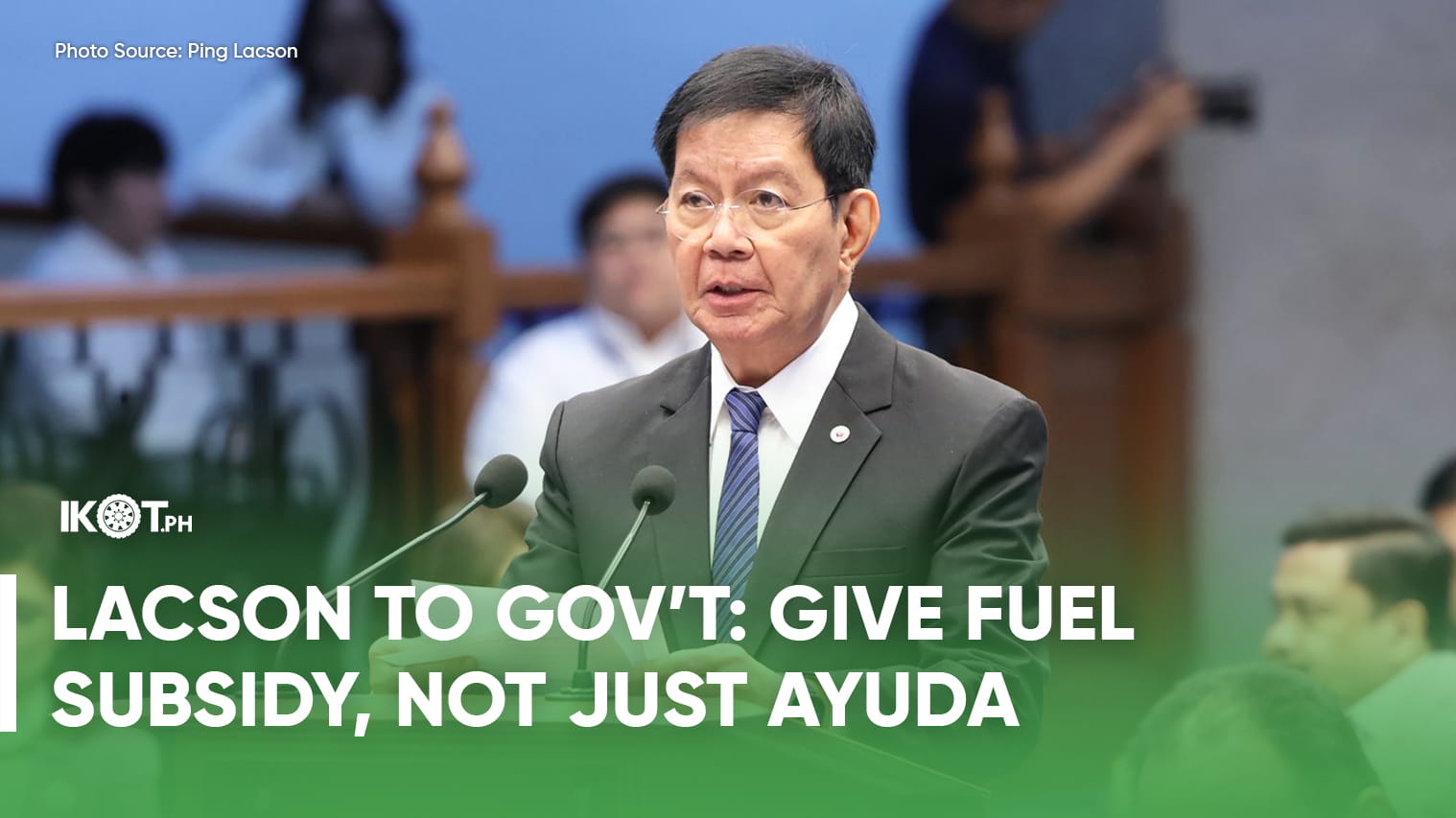
Senate President Pro Tempore Ping Lacson urged the government to go beyond traditional “ayuda” and explore more targeted measures to support Filipinos affected by the fuel crisis triggered by the conflict in the Middle East – including a possible fuel subsidy.
Lacson said the government may study approaches used by neighboring economies such as Taiwan, which implements subsidy mechanisms to help cushion fuel price spikes.
“Hindi ako nagmamarunong. Ang suggestion ko lang, pag-aralang mabuti kung anong mas nakakabuti sa sektor na talagang apektado,” the veteran legislator said in an interview on DZBB radio.
The seasoned lawmaker added that if the government can collect enough taxes to offset potential revenue losses from the suspension of the excise tax on fuel, equivalent amounts could be redirected for targeted subsidies.
Citing Department of Finance data, the senator said the projected revenue losses for 2027 from suspending excise taxes on fuel products may amount to P200.899 billion; and the losses from suspending the value-added taxes in 2027 may amount to an additional P119.326 billion – or a total of P320 billion if both excise taxes and VAT are suspended.
He likewise urged the government to consider assistance mechanisms even in scenarios where global oil prices do not trigger the suspension of fuel excise taxes.
“‘Di lang may kotse ang makikinabang.”
“Pag-aralan lang, isama sa consideration sa halip mag-suspend kasi ‘di naman ito maski pumalo ng $100 per barrel sa world price pwedeng ‘di ma-suspend pero ang revenue na di mawala, baka pwedeng pagaralan para ilagak kung saan ang direktamenteng apektado ng presyo ‘yan ang makikinabang. At ‘di lang may kotse ang makikinabang,” Lacson explained.
He also renewed his call for a shorter monitoring period as a basis to suspend excise taxes on fuel products, citing the “extraordinary situation” caused by the Middle East conflict that has driven oil prices sharply upward.
On the other hand, Lacson said the government must go beyond “ayuda” in dealing with the fuel crisis, especially if its implementation is weakened by politicking.
“Parang nahirati tayo sa ayuda. Kung ia-analyze natin context muna, ang nabigyan ng ayuda, hindi naman ito ang apektado ng gasolina. Ito ang matagal nang nakalista. Ang masama nito, implementation – minsan mga leaders ng local government officials ang nakatala nakalista kasi nanggagaling sa barangay ang listahan,” he said.
“Ang nabigyan ng ayuda, hindi naman ito ang apektado ng gasolina.”
“So totoo bang naibsan ang kahirapan sanhi ng pagtaas ng oil, presyo ng langis, ang ating kababayan na talagang apektado? Transport sector, ordinary commuters, tataas,” Lacson added. “Dapat i-review din ng ating pamahalaan kung ano talaga ang nararapat na tugon na direktamenteng makatulong sa directly affected sa taas ng presyo ng langis.”