
The suspension of excise tax on petroleum products is not sufficient to ease the burden of Filipinos because of the rising cost of basic commodities due to soaring fuel price increases.
Senator Erwin Tulfo, during the Senate Proactive Response and Oversight for Timely and Effective Crisis Strategy (PROTECT) ad hoc committee hearing, suggested that reduction of excise tax should be coupled with the removal of value-added tax on petroleum to ease the burden of high prices of commodities for the general public—and not only for the commuters and vehicle owners.
“May mga nagsasabi po, Mr. Chair, na ‘yung pag suspinde po sa excise tax na ipinasa po natin dito, isinumite na po sa Pangulo, will not be sufficient,” the legislator said during the hearing.
The lawmaker admitted that the 10 percent excise tax reduction on fuel products would be felt by the vehicle owners and the drivers but not the public in general, describing the reduction as good “for a press release”.
“‘Yung mga nag-commute po, hindi nila mararamdaman po ito.”
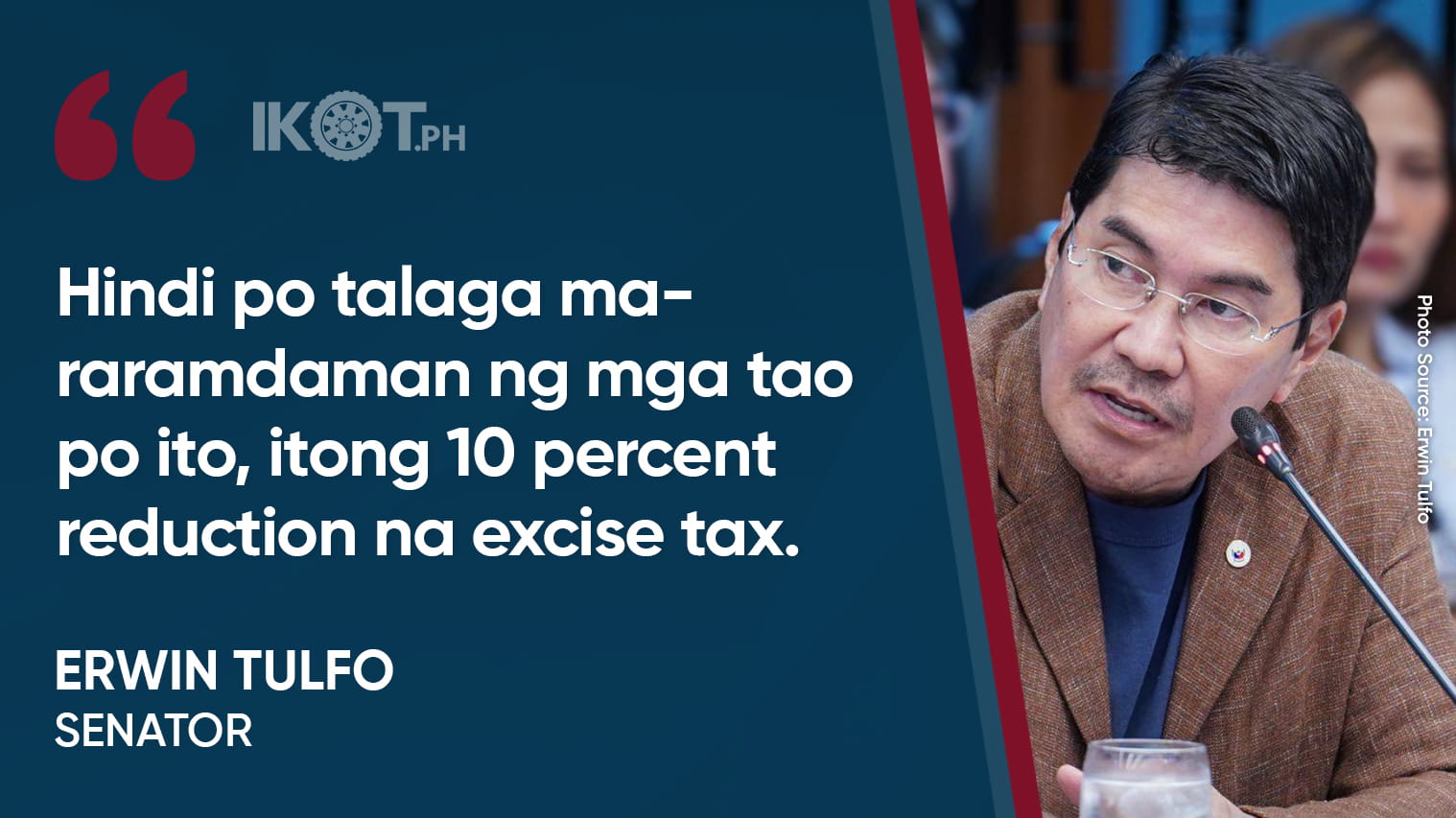
“Pero actually, hindi po talaga mararamdaman ng mga tao po ito, itong 10 percent reduction na excise tax,” the senator said, suggesting that VAT should also be removed for the public to benefit from such a temporary reduction or removal.
“Mararamdaman po ito kung ‘yung VAT din and aalisin din po natin. But if we remove excise tax sa mga gasolina, mararamdaman po ng konti ‘yun ng mga may sasakyan. But ‘yung mga nag-commute po, hindi nila mararamdaman po ito,” he said.
“Under Senate Bill No. 1935, the VAT on the sale of petroleum products would be automatically suspended once the average price of Dubai crude oil reaches $80 per barrel.”
Tulfo said his version of the law, Senate Bill No. 1935, the VAT on the sale of petroleum products would be automatically suspended once the average price of Dubai crude oil, based on the Mean of Platts Singapore (MOPS), reaches $80 per barrel.
The bill also proposes suspending the VAT on imported petroleum products once the same price threshold is reached.
In addition, the measure seeks to automatically stop the collection of excise taxes on petroleum products when global oil prices hit or exceed the $80-per-barrel level.
Department of Economy, Planning, and Development (DEPDev) Secretary Arsenio Balisacan, also during the hearing, said the agency is studying the implications of any of the proposals that would affect the overall fiscal economic system.
President Ferdinand Marcos on March 25, signed into law Republic Act No. 12316, giving him the emergency power to suspend or reduce only the excise tax rate on fuel.
The cut in excise tax on diesel and gasoline, however, would take 15 days after Marcos signed the measure for the law to take effect.