
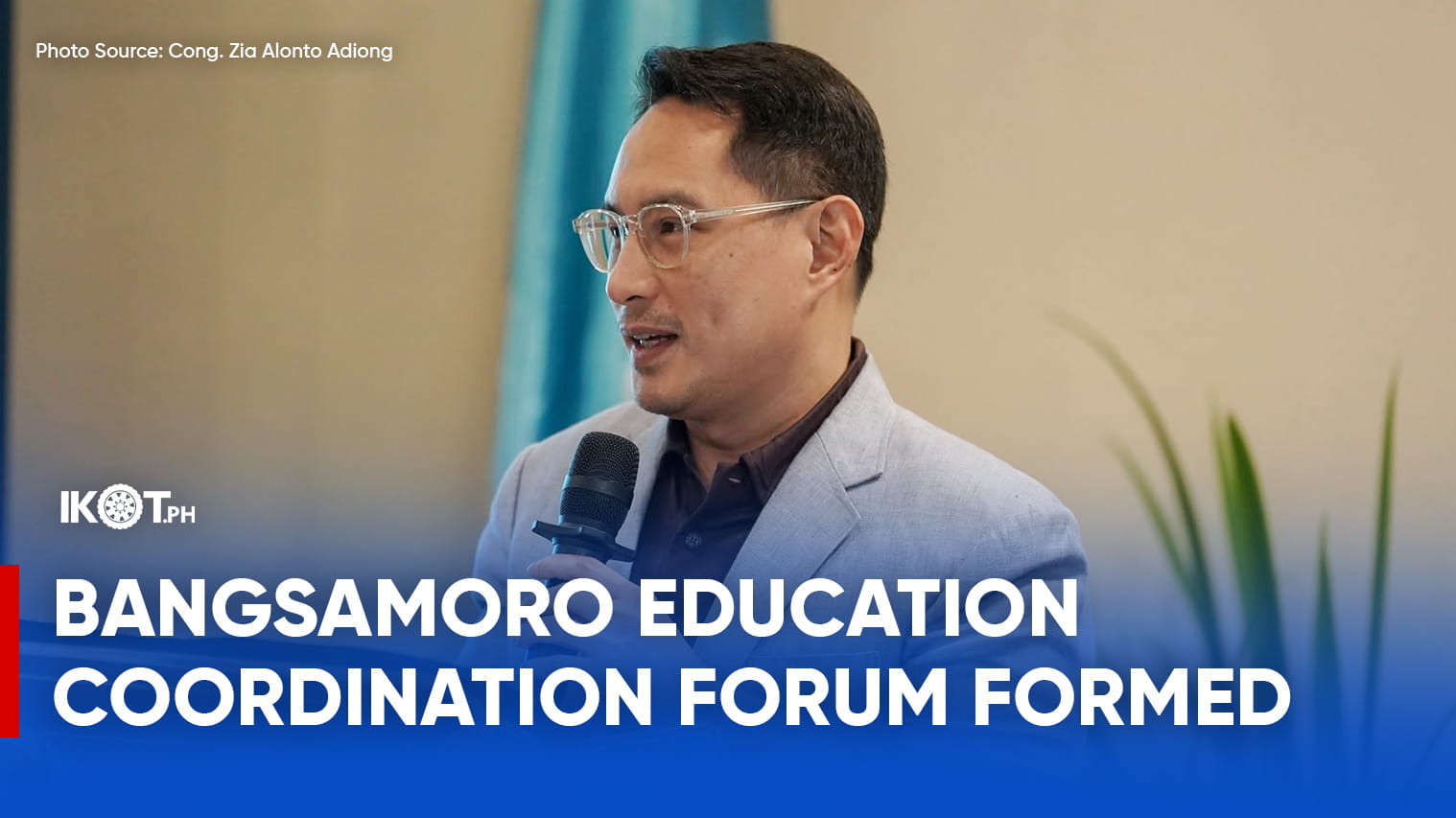
National and Bangsamoro education authorities signed a Memorandum of Agreement establishing the Bangsamoro Education Coordination Forum (BECF), following two years of sustained discussions convened and supported by EDCOM II.
The Forum brings together the Ministry of Basic, Higher, and Technical Education (MBHTE), the Department of Education (DepEd), the Commission on Higher Education (CHED), the Technical Education and Skills Development Authority (TESDA), and the Professional Regulation Commission (PRC) as a permanent platform for aligning priorities, strengthening coordination, and improving education outcomes across the Bangsamoro Autonomous Region in Muslim Mindanao (BARMM).
“We know that BARMM needs a lot of support and help. And hopefully po, the MOA for today will strengthen our partnership with BARMM at makita rin ho natin itong mga hinahanap nating reporma, hindi lang po sa ibang mga rehiyon kundi sa lahat ng rehiyon sa ating bansa,” EDCOM 2 Co-Chairperson Senator Bam Aquino said.
EDCOM 2 Co-Chairperson Representative Roman Romulo also expressed his support.
“The establishment of the Bangsamoro Education Coordination Forum is a significant step towards addressing long-standing coordination challenges in the delivery of education services in the BARMM,” Romulo said.
“For too long, questions relating to mandates, funding channels, eligibility and institutional responsibilities have sometimes stood in the way of learners accessing programs and opportunities that should be available to them. The Bangsamoro Education Coordination Forum will help address these doubts,” the veteran legislator added.
EDCOM 2’s nationwide assessment identified BARMM as a region where sustained, coordinated action could make an especially significant difference in children’s lives.
“BARMM has the country’s highest childhood stunting rate at 34.3%, alongside 16.9% anemia prevalence.”
The Commission’s Final Report found that BARMM has the country’s highest childhood stunting rate at 34.3%, alongside 16.9% anemia prevalence and moderate-to-severe household food insecurity affecting 48.2% of families.
These disadvantages begin early and compound as children progress through the education system. Nearly nine in ten Bangsamoro children aged three to four are not enrolled in preschool. Functional literacy across the region stands at 64.7% and falls to 32.7% in Tawi-Tawi. By Grade 4, learners are performing three to four years behind curriculum expectations in literacy and two to three years behind in mathematics.
“For too long, coordination between our agencies depended on goodwill. Today, we transform this mutual goodwill into a binding commitment. We are building a permanent platform where we share priorities, make collective decisions, share responsibility, and answer to each other and our people for their outcomes,” BARMM Interim Chief Minister and concurrent Minister of the Ministry of Basic, Higher and Technical Education (MBHTE) Abdulraof Macacua said.
Although the Bangsamoro Organic Law provides that the BARMM education system shall operate as a subsystem of the national education system, the absence of a formal institutional mechanism for coordination has long hindered joint planning, data sharing, and policy alignment. As a result, national education initiatives—including learning recovery programs, scholarships, and training opportunities—have often been delayed or have not reached Bangsamoro learners because of unresolved questions on funding channels, eligibility, and agency jurisdiction.
The establishment of the BECF also builds on the work of the Philippine Congress–Bangsamoro Parliament Forum (PCBPF), co-chaired by Senator Loren Legarda and Representative Zia Alonto Adiong, which has strengthened legislative and intergovernmental cooperation between the Philippine Congress and the Bangsamoro Parliament.
Legarda, Co-Chairperson of the Philippine Congress–Bangsamoro Parliament Forum, emphasized the importance of collective action.
“It sends a powerful message that no single institution can solve the challenges alone. And through genuine partnership among our national government, and the Bangsamoro government, our representatives, development partners, and local communities, we can finally begin to close these gaps and give every Bangsamoro learner the opportunities they deserve,” the veteran legislator stressed.
“This is the time that we can say, ‘pag sa edukasyon, pare-pareho at pantay-pantay tayong umangat’.”
“We really want BARMM to be a part of the progress and the reform that we want to initiate in our education system. This is an instrument for peace, dignity, and a lasting development in our area. Let this memorandum of agreement become more than a statement of intent. Let it serve as our commitment that no Bangsamoro child will be left behind because institutions failed to coordinate, because resources failed to arrive, or the government failed to act. This is the time that we can say, ‘pag sa edukasyon, pare-pareho at pantay-pantay tayong umangat’,” Adiong added.
To address these longstanding challenges, the newly established BECF will serve as a permanent coordination mechanism while fully respecting the distinct legal mandates and statutory powers of each participating institution. Through the Forum, member agencies will meet regularly to jointly identify education priorities, align policies and programs, and establish shared, measurable targets consistent with the National Education and Workforce Development Plan (2026–2035).
“Ito ang magiging behikulo para magkaroon ng mas malawak at mas malalim na pag-uusap para mabigyan natin ng solution ang mga problema ang hinaharap ng BARMM. Hindi po natin pababayaan ang BARMM dahil gusto namin makita na ang bawat bata sa BARMM ay mabigyan ng magandang edukasyon,” said Senate President Win Gatchalian who was present during the event.
The signing of the BECF Memorandum of Agreement marks a major step toward ensuring greater coherence and complementarity between Bangsamoro-led education initiatives and nationally funded education programs.
The Forum is expected to convene in August to identify priority reforms and agree on key education targets for 2027.