The national government plans to spend ₱17.8 billion next year to provide nutritious meals to undernourished children in public schools and day care centers, House Minority Leader and 4Ps party-list Representative Nonoy Libanan said, as the country marks the start of National Children’s Month.
Under the proposed 2027 National Expenditure Program (NEP), the sum of ₱11.4 billion has been earmarked for the School-Based Feeding Program (SBFP), while another ₱6.4 billion is allocated for the Supplementary Feeding Program (SFP), according to Libanan.
“As members of Congress, we have a duty to ensure that public funds are spent wisely and that people know where their money is going, especially when it comes to programs that directly affect social welfare,” the veteran legislator stressed.
The seasoned lawmaker said Congress has a responsibility not only to scrutinize government spending but also to inform citizens how public funds are being used, particularly for programs that directly benefit vulnerable sectors.
The Philippines observes National Children’s Month every November, highlighting the importance of protecting children’s rights and promoting their health, nutrition and overall well-being.
The United Nations Convention on the Rights of the Child, adopted on November 20, 1989, recognizes every child’s right to health, adequate nutrition, education and protection.
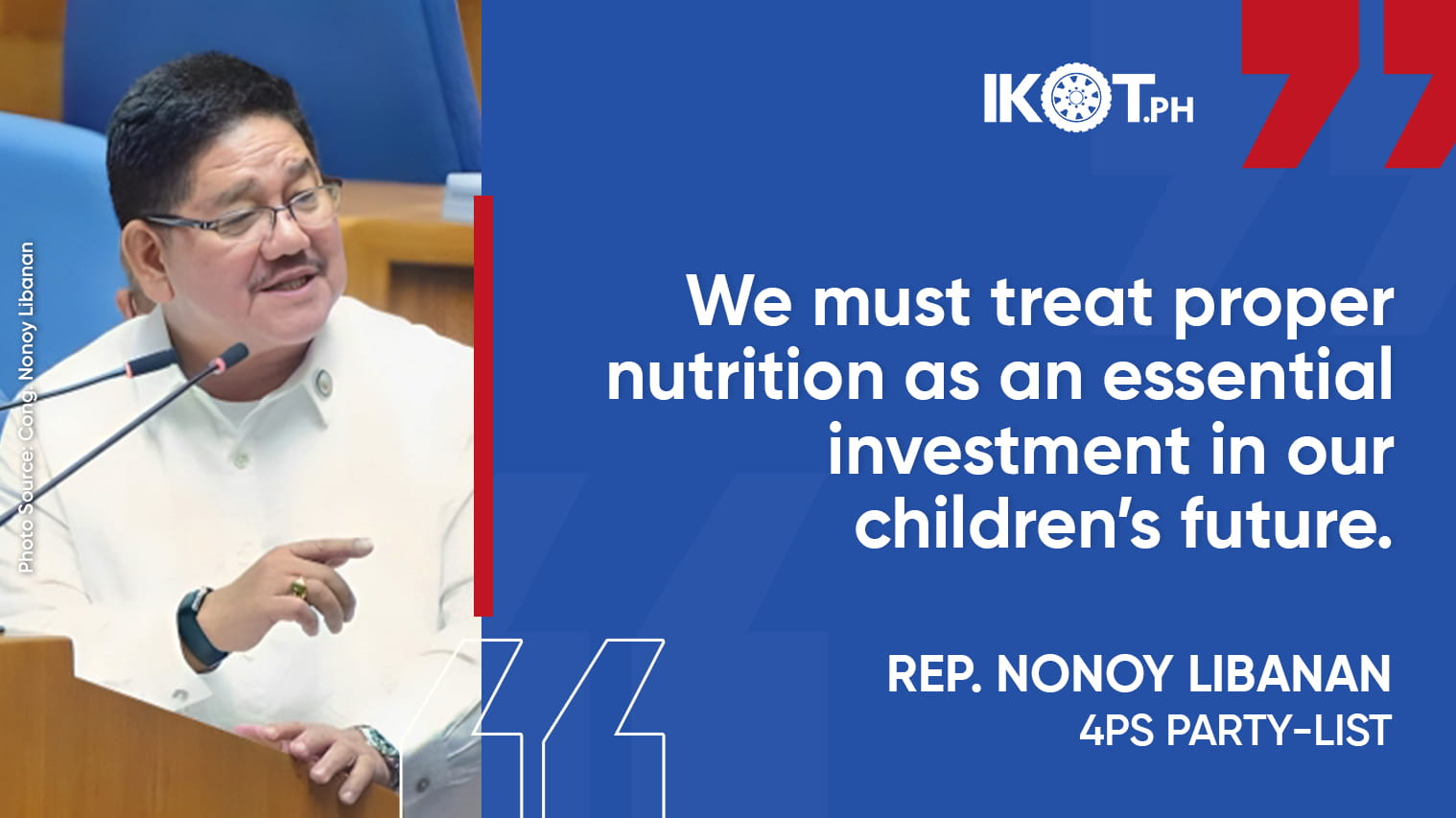
“We must treat proper nutrition as an essential investment in our children’s future. A child who goes to school hungry faces greater difficulty concentrating, participating in class and keeping up with lessons,” he said.
“By ensuring that nutritious food reaches children who need it most, these feeding programs can help remove hunger as a barrier to learning and give our young people a stronger foundation to grow and develop.”
“By ensuring that nutritious food reaches children who need it most, these feeding programs can help remove hunger as a barrier to learning and give our young people a stronger foundation to grow and develop,” Libanan added.
The need for sustained government intervention comes amid persistent reports of hunger among Filipino families.
“20.3 percent of families experienced involuntary hunger—being hungry and having nothing to eat—at least once in the second quarter of 2026.”
A Social Weather Stations survey found that 20.3 percent of families experienced involuntary hunger—being hungry and having nothing to eat—at least once in the second quarter of 2026.
A separate OCTA Research survey reported that self-rated hunger rose to 21 percent in July from 17 percent in March.
The SBFP provides nutritious meals to incoming kindergarten learners and pupils in Grades 1 to 6 identified as wasted, severely wasted, stunted or severely stunted.
It also covers learners at risk of dropping out as well as children from indigenous communities and indigent households.
Meanwhile, the SFP provides nutritious meals to preschool children enrolled in public child development centers, as well as children participating in supervised neighborhood play activities.